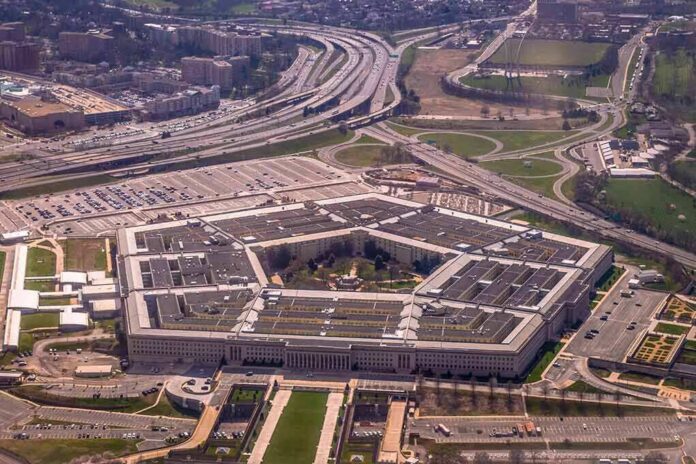
The Supreme Court’s refusal to hear this case was never really a ruling on guilt or innocence — it was a decision about who gets to decide, and the answer the justices left standing hands that power back to the Pentagon’s political leadership rather than to a negotiated bargain struck in a military courtroom.
Key Points
- The Supreme Court declined on October 19 to review a D.C. Circuit ruling that upheld then-Defense Secretary Lloyd Austin’s 2024 cancellation of plea agreements for Khalid Sheikh Mohammed and two co-defendants.
- The agreements, signed July 31, 2024, would have traded guilty pleas for life sentences; Austin rescinded them within 48 hours, reserving the authority to himself.
- The D.C. Circuit ruled 2-1 that Austin “indisputably” had legal authority to withdraw the deals, leaving the death penalty on the table.
- A military judge separately excluded Mohammed’s 2007 confessions as tainted by earlier CIA torture, complicating the prosecution’s evidentiary case.
- A military trial is now projected for June 2028 — nearly a quarter century after the September 11 attacks — with further delay widely expected.
What the Court Actually Did — and Didn’t Do
On October 19, the justices declined to hear the appeal through a one-line entry on the orders list — no opinion, no dissent, no reasoning offered. That silence matters. It means the Supreme Court never weighed in on whether the 2024 pretrial agreements were binding contracts the government broke; it simply let stand the D.C. Circuit’s answer to that question. For Mohammed, Walid bin Attash, and Mustafa al-Hawsawi, the practical effect is identical to a loss on the merits: the plea deals that would have guaranteed life sentences are dead, and prosecutors can again pursue the death penalty.
The underlying dispute traces to a single week in the summer of 2024. On July 31, the Pentagon’s convening authority overseeing the military commissions accepted agreements under which the three men would plead guilty to murdering 2,997 people in exchange for life imprisonment rather than execution. Two days later, Austin moved to undo it. His written order was blunt: he withdrew the convening authority’s delegated power to enter such agreements, reserved that authority to himself, and withdrew from “the three pre-trial agreements that you signed on July 31, 2024.” He justified the move by citing “the significance of the decision” — language that framed a capital sentencing question as one too consequential to leave with a subordinate official.
A Contested, Not Unanimous, Legal Question
The defense’s case was never frivolous. It rested on a genuine structural tension in how military commissions operate: can a defense secretary reach back into an agreement his own delegated officer has already accepted and unwind it unilaterally? The D.C. Circuit answered yes, but not without friction — the panel split 2-1, meaning one appellate judge saw the question differently. That dissent is the strongest evidence the defense’s position wasn’t a stretch; it was a live legal dispute within the judiciary itself, not merely a grievance from the accused. Still, a 2-1 panel majority is a majority, and the government’s framing prevailed: the ruling, in the court’s words, found Austin “indisputably had authority to cancel the agreements,” preserving for political appointees — not for the convening authority — the final call on whether these men face execution.
The government’s argument for Supreme Court inaction was straightforwardly institutional: letting the D.C. Circuit’s ruling stand, it argued, ensures that accountable political appointees, not career prosecutors or convening authorities, decide whether defendants accused of orchestrating the deadliest terrorist attack on American soil should face capital punishment. That is a coherent position, and it is the one that now governs the case.
Why the Prosecution’s Case Is Weaker Than the Charges Suggest
Winning the authority fight is not the same as winning the trial. The government’s evidentiary position has eroded steadily. A military judge ruled that Mohammed’s 2007 confessions at Guantánamo — statements prosecutors have called their most crucial evidence — cannot be used, because they were tainted by the earlier CIA interrogation program, which subjected Mohammed to 183 waterboarding sessions. That exclusion does not resolve the authority question the Supreme Court declined to touch, but it does mean the government now heads toward a capital trial with its central piece of evidence gone, a fact largely absent from coverage focused on the mastermind framing of the case.
A Quarter Century of Procedural Gridlock
This case cannot be understood apart from the broader failure of the Guantánamo military commissions as an institution. In more than two decades of operation, the commissions have produced only ten convictions, and eight of those came through plea agreements rather than contested trials — making negotiated pleas the system’s single most reliable path to any resolution at all. The commissions were struck down once already by the Supreme Court in 2006’s Hamdan v. Rumsfeld for violating the Uniform Code of Military Justice and the Geneva Conventions, prompting Congress to rebuild the framework through the Military Commissions Act. That rebuilt system has since been defined by exactly the pattern on display here: bureaucratic delay, disputed evidentiary standards rooted in torture, and contested lines of institutional authority between prosecutors, convening authorities, and the Pentagon’s civilian leadership. The 2024 plea deal was, by that measure, the closest thing to “the last, best chance for accountability” the system had produced — a negotiated resolution that sidestepped the torture-evidence morass entirely.
What Comes Next
A military trial is now projected for June 2028, though virtually every informed observer expects further slippage; the case has already run nearly twenty-five years past the attacks it concerns. The defendants retain other avenues — habeas petitions, renewed motions before the military judge, challenges to any future death sentence — but the Supreme Court has removed the one path that offered a defined, negotiated endpoint. What remains is a capital prosecution built on a weakened evidentiary foundation, moving through an institution that has rarely managed to convert its highest-profile cases into final judgments without years more delay.
Khalid Sheikh Mohammed faces death penalty trial after Supreme Court rejects effort to revive plea deal https://t.co/3CjfJdNRpe
🎤 @mackrosenberg reports
📸 Andrew Harnik/Getty Images, Derek Poteet via AP, AP Photo/Janet Hamlin pic.twitter.com/3ryNc2kZom
— 1010 WINS on 92.3 FM (@1010WINS) October 19, 2026
Sources:
nbcnews.com, upi.com, nytimes.com, detroitnews.com, courthousenews.com, usatoday.com, axios.com, yahoo.com, internazionale.it
© fixthisnation.com 2026. All rights reserved.