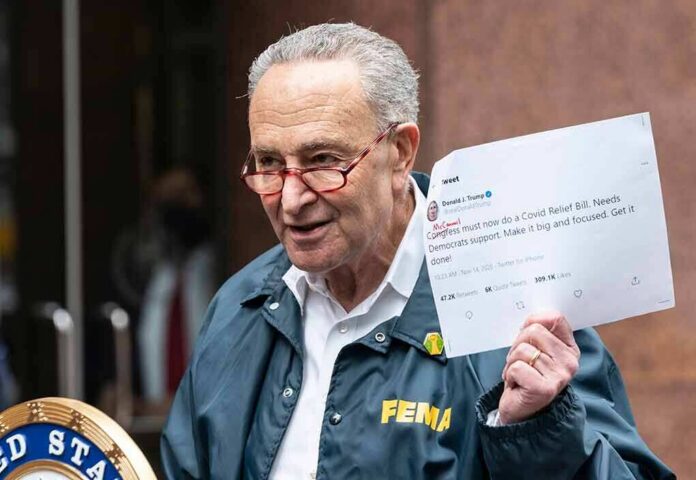
Leadership fights in the Senate are rare, but when they surface they clarify something essential about power on Capitol Hill: the majority leader’s job is not awarded for seniority or ideology; it is earned in a closed room by counting votes and convincing colleagues you can deliver. Senator Chris Van Hollen’s decision to formally challenge Senator Chuck Schumer for Democratic leader forces that question into the open.
At a Glance
- Van Hollen converted discontent into a formal bid to unseat Schumer, turning a critique of direction into a leadership race.
- He frames his run as channeling a voter mandate for change after Democrats’ strong midterm showing; Schumer counters that the win validates continuity.
- The caucus elects its leader by secret-ballot majority, making private commitments and coalition-building decisive.
- Van Hollen differentiates on U.S. policy toward Israel and Gaza; Schumer has public endorsements and claims he already has the votes.
How a Senate leadership challenge actually works
Inside the Senate, leadership is decided by the party conference, not by the public and not by seniority alone. After an election, the majority party holds closed-door leadership elections; a simple majority of the caucus selects the leader, and the ballots are secret. That structure rewards peer-to-peer persuasion, credibility with committee chairs, and a believable plan to pass bills and protect vulnerable members. It also means public headcounts can mislead; the real arithmetic happens on note cards behind closed doors, and reputations for keeping promises are currency. Contemporary reporting on this contest reflects that process: Democrats plan to hold their leadership vote in December, with the winner determined by a majority of the caucus present and voting.
Secret ballots have a disciplining effect. They allow senators to break publicly stated alignments if they doubt a leader’s ability to count votes, shield freshmen from retaliation, and concentrate attention on whether a challenger can demonstrate momentum without triggering a backlash. In practice, incumbency confers an edge—committee slot control, fundraising networks, and established floor teams—but it is not decisive if colleagues conclude the incumbent cannot deliver the next agenda.
What Van Hollen is arguing—and what makes it different
Van Hollen moved from “listening mode” to a filed challenge, presenting the party’s midterm gains as a mandate to change direction at the top. He has signaled a governing contrast most clearly in foreign policy—criticizing the administration’s approach to the Gaza war and supporting restrictions on certain weapons transfers to Israel. He also says he has secured more than ten pledges in the Senate, which, if true and expandable, could become a foundation for a coalition; because the votes are private, those commitments remain unverifiable in public reporting.
There is strategic logic to emphasizing a salience split. When an incumbent’s brand is tightly identified with a status quo on a divisive issue, a challenger who can aggregate skeptics across ideological lanes—progressives disenchanted with war policy and institutionalists impatient for clearer strategy—can translate a policy contrast into a leadership argument. The problem for any challenger is breadth: a position on Gaza does not, by itself, prove superior capacity to manage floor time, shepherd appropriations, or protect frontliners. Van Hollen will be pressed to show a first-100-days plan—committee priorities, filibuster tactics, reconciliation prospects, judicial and executive-confirmation strategy—if he wants undecideds to move.
Schumer’s counter-case: results, votes, and continuity
Schumer’s rebuttal is straightforward: winning expands, not weakens, a leader’s legitimacy. He has said plainly that he already has the votes to remain Democratic leader and intends to “lead our new Democratic majority and deliver for the American people”. Several Democrats have publicly committed to him—among them Sheldon Whitehouse, Kirsten Gillibrand, and Ruben Gallego—signaling that the incumbent’s network remains intact. Independent Senator Angus King added a memorable sports metaphor to the case for continuity: “Why would you fire the manager when you just won the World Series?”.
There is more here than rhetoric. Incumbent leaders build chits by recruiting candidates, raising money, and staging floor fights to define contrasts; colleagues who benefited from that infrastructure often return the favor at crunch time. Schumer’s allies underline those contributions and his mastery of Senate process. That procedural mastery matters—particularly with a narrow majority in a polarized chamber—because leaders must thread reconciliation rules, the Byrd Rule, and committee bottlenecks to turn slogans into statutes. For many members, confidence in that operational craft will outweigh dissatisfaction with a single policy stance.
What we can and cannot infer from the midterms
Both sides invoke the same election to justify opposite leadership conclusions: Van Hollen calls it a demand for change; Schumer calls it validation of the current course. The evidence supports the political fact of a strong Democratic outcome and the existence of a live leadership race. It does not, on its face, isolate voters’ intent toward Senate leadership. No exit poll or survey in the available reporting ties Senate results to preferences about Schumer personally; in other words, the “mandate” claim is an argument rather than a measured causal finding. That does not make the claim unserious—mandates are often constructed in the aftermath of victory—but it does counsel caution in treating the midterm map as a plebiscite on internal caucus roles.
Historically, successful leadership ousters in the Senate are unusual. Challenges are possible—party leaders are creations of their conferences—but most efforts to unseat an incumbent fail absent a broad, cross-factional consensus that the current leader cannot deliver the next phase of the agenda. The Senate’s own historical materials emphasize that, over time, the job migrated from seniority to demonstrated capacity to organize and lead the conference; the rare victories by challengers have hinged on peers concluding that personal regard for the incumbent could not overcome doubts about vote-counting effectiveness.
Where the real disagreement lies inside the caucus
Strip away the theatrics and three substantive questions divide Democrats. First, foreign policy and the Gaza war: should the Senate leader push for tighter conditions on U.S. military assistance to Israel, even at the cost of an intraparty split and friction with the White House? Van Hollen says yes; Schumer’s posture has been more supportive of the administration’s course, and several senators backing him appear comfortable with that alignment. Second, governing strategy in a tight majority: do members want a disruptor who is willing to force confrontations—through aggressive use of holds, conditional aid, or brinkmanship—or a steward who prioritizes predictable floor management, incremental wins, and member protection? Third, internal accountability: will the next leader codify an agenda with timelines and metrics that swing-state senators can take home, or preserve the current, leader-centered flexibility?
These are not abstract disagreements. Each touches the core competencies of a majority leader: allocating scarce floor time, sequencing votes to build leverage, structuring conference negotiations, and deciding when to risk failure to define a contrast. Members with tough races will privilege protection; members in safe seats may prioritize principles and speed. The winning case will be the one that convinces a majority that its approach best preserves the map while still delivering visible results.
🚨 VAN HOLLEN CHALLENGES SCHUMER FOR SENATE MAJORITY LEADER — MARYLAND DEMOCRAT JOINS PROGRESSIVE REVOLT
Maryland Sen. Chris Van Hollen officially announced Thursday that he is running for Senate Majority Leader, directly challenging longtime Democratic leader Chuck Schumer as… https://t.co/WqtyAy1ylK
— MDBayNews (@MDBayNews) November 13, 2026
What to watch next—and what actually decides this
Three indicators will tell you which way this breaks. First, on-the-record commitments: incumbents tend to hoard public endorsements; challengers need to show momentum. If Van Hollen can produce named supporters—and, better, a concrete early-term plan—that signals real traction beyond a single-issue critique. His claim of “more than ten” pledges is a start but, absent names, not a bankable whip count. Second, signals from institutionalists: committee chairs and dealmaking centrists often swing these races because they live with the leader’s floor strategy daily. If they drift, a cascade can follow. Third, the calendar: proximity to the December secret ballot compresses decision time and favors the status quo unless the challenger breaks through with a credible governing blueprint and a path to 50 percent plus one.
Bottom line
This is not a referendum on who gives the most compelling speech. It is a management choice by colleagues who will live with the consequences. Van Hollen has succeeded in transforming a diffuse appetite for change into a formal contest and has distinguished himself on a salient foreign-policy question. Schumer counters with results, endorsements, and a claim—backed by his track record—that he can marshal a larger majority to legislate. History suggests incumbents usually prevail, but the job is ultimately about trust: who can count the votes in December, and who can keep counting them when the floor lights are on in January.
Sources:
facebook.com, cbsnews.com, abcnews.com, nbcnewyork.com, ksbw.com, commondreams.org
© fixthisnation.com 2026. All rights reserved.