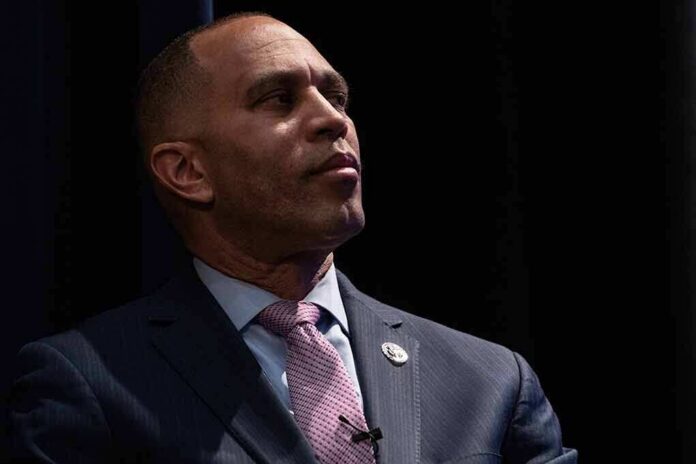
The clash between movement activists and party leadership is not a sideshow to American politics; it is one of its core mechanisms, shaping what gets on the agenda, how parties govern, and which priorities survive contact with power.
The Short Version
- A small group of protesters confronted House Democratic Leader Hakeem Jeffries at a Denver strategy conference, pressing for impeachment and ambitious progressive policies.
- Video shows a sharp exchange; Jeffries stayed composed and leaned into his authority, while attendees drowned out the disruption.
- Activists argue Democrats won power and owe delivery on Medicare for All and a Green New Deal; leadership counters with a focus on affordability, accountability, and passable legislation.
- Donor ties and incumbent-protection efforts arm critics with structural concerns, though no quid pro quo link to specific acts is established.
What happened in Denver, and why it matters beyond the room
At the Democrats’ “What’s Next” conference in Denver, protesters interrupted Hakeem Jeffries and accused him, in blunt terms, of betraying core priorities. C‑SPAN’s clip captures a protester calling Jeffries a liar and traitor; Jeffries, unflustered, replied, “I’m from Brooklyn, this is light work.” The exchange is memorable not because it was rare but because it was emblematic: activists demanding transformational policy and immediate accountability, leadership insisting on a governing program that can survive the constraints of Congress and the presidency. Coverage across outlets framed the moment as an interruption rather than a policy argument, a pattern that often reduces complex internal disputes to theater.
On substance, demonstrators pressed for Medicare for All and a Green New Deal and linked those demands to a broader claim: Democrats regained power and should use it to deliver, not triangulate. One named Sunrise Movement member argued young voters powered the party’s wins and expect commensurate policy in return. The room, however, was not with them; security escorted protesters out as attendees chanted Jeffries’s name, underscoring how party venues remain leadership space more than movement space.
Inside the representation gap: movements seek mandates, leaders count votes
Two logics collided. Movement politics treats electoral success as a mandate for specific policies; legislative leadership treats the same outcome as permission to negotiate within institutions. Jeffries has articulated a program organized around “affordability, accountability, and a return to American values,” naming housing, health care, energy, groceries, and caregiving as targets for early action. On accountability, he promises to “follow the facts, apply the law, be guided by the Constitution,” rather than pre-commit to a remedy or a target. That posture is not evasion; it is the procedural idiom of congressional leadership, designed to keep a large caucus aligned while reserving flexibility to pass bills that can become law.
That governing idiom also explains Jeffries’s frequent insistence that messaging votes are not the point. He has pushed for measures with plausible bicameral and cross-branch pathways—such as restoring ACA premium subsidies or reversing Medicaid cuts—arguing these could create pressure even a White House might struggle to resist. And on permitting reform, he has rejected rubber‑stamping a Senate product in favor of a more inclusive House process, a stance outside groups have explicitly welcomed. This is coalition maintenance, not movement maximalism.
The activist case: deliver the policies voters asked for
For activists, Denver was about priorities, not process. They want Medicare for All, a Green New Deal, and a willingness to pursue impeachment where they believe abuses warrant it. Their critique is not limited to policy outputs; it targets structure. OpenSecrets data document Jeffries’s successful fundraising and the sources that helped power it—AIPAC and other pro‑Israel groups bundling more than $1.2 million collectively, significant contributions from a marquee corporate law firm and from private‑equity employees. Those facts do not establish quid pro quo, and the research here does not tie any donation to a discrete legislative act; they do, however, give critics a concrete basis to argue that leadership incentives tilt toward donors and incumbents rather than insurgent priorities.
That perception is reinforced by Team Blue PAC, the leadership-aligned effort Jeffries co‑founded to defend Democratic incumbents from left‑wing primary challenges. For movement groups that see primaries as the only effective lever to shift the party’s policy mix, this looks like institutional self‑defense against ideological change. Again, proof of causation is not on the table here; the record shows alignment and intent, not a transactional exchange. But in politics, alignment and intent are often enough to define trust.
Impeachment, accountability, and the limits of claims
The Denver confrontation invoked impeachment alongside policy demands, but the record in this research package does not identify a specific resolution, vote, or directive that Jeffries blocked. Leadership’s line—accountability beginning “on day one,” guided by facts and law, with nothing ruled in or out—preserves both prosecutorial posture and legislative discretion. Given the constitutional character of impeachment as a political, not judicial, instrument, leaders will typically calibrate not just the evidence but also the coalition math, timing, and downstream governance costs. That is unsatisfying to activists who read the moral stakes as urgent and non‑negotiable; it is also how impeachment has functioned across eras.
What the evidence supports is a vivid expression of dissatisfaction, not a particular thwarted case. That distinction matters. The absence of a documented, named impeachment action foreclosed by leadership means the Denver footage is best understood as pressure on priorities—and as a warning about the costs of ignoring a mobilized constituent subset—rather than as proof of a specific dereliction.
Protesters demanding an end to President Donald Trump's war with Iran heckled Hakeem Jeffries, the incoming US House speaker, at a Democratic gathering in Denver on Friday.
Reuters reported that about 10 protesters interrupted Jeffries, also demanding government-funded…
— Iran International English (@IranIntl_En) November 13, 2026
Media framing and why the spectacle crowds out substance
Movements live or die on how their claims travel. Decades of research on protest coverage show a consistent “protest paradigm,” in which media emphasize conflict, disruption, or deviance over the underlying policy agenda—an editorial reflex that tends to legitimize status‑quo actors over challengers. When outlets reduce a complex accountability argument to a clip of an epithet and a leader’s riposte, the frame rewards composure and penalizes confrontation, irrespective of the merits of the policy case. That is what happened in Denver: the moment read as a test of Jeffries’s poise, not as a debate over health policy, climate investment, or constitutional remedies.
What to watch next: signals that matter more than the shouting
Four indicators will separate rhetoric from governing trajectory. First, the early legislative docket: whether the House moves bills that reduce costs in health, housing, energy, and caregiving while embedding durable reforms, as leadership vows. Second, the accountability portfolio: named investigations that follow evidence to legally and politically sustainable endpoints, rather than episodic hearings. Third, coalition‑shaping behavior: how Team Blue PAC and allied entities deploy resources in primaries, which is often a clearer signal of strategic intent than floor speeches. Fourth, agenda‑setting transparency: whether the caucus invites movement actors into drafting processes on climate and health policy instead of relegating them to outside pressure.
Sources:
youtube.com, nbcnews.com, foxnews.com, reuters.com, cnn.com, c-span.org, denvergazette.com, opensecrets.org
© fixthisnation.com 2026. All rights reserved.