In a city built edge to edge, the most perilous moment for an older building is often when the soil at its boundary moves; in Flatbush, a three-story structure gave way beside an active excavation, triggering a complex, multi-agency rescue that shows how fragile the margin can be between routine construction and catastrophe.
The Short Version
- FDNY launched a major technical rescue minutes after a partial collapse, with reports of people trapped.
- Firefighters and paramedics removed multiple victims from debris; at least one person died and more than ten were injured, several critically.
- The building fell toward an adjacent construction pit, turning the site into a dynamic, high-risk rescue environment.
- Multiple agencies — FDNY, NYPD, and city officials — managed search, medical transport, and scene safety while investigators began probing cause.
What happened: a rapid collapse beside an open excavation
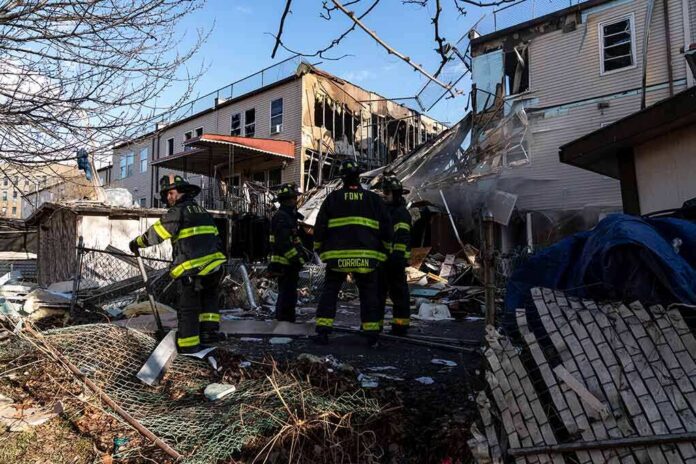
The incident began in the late afternoon when a three-story mixed-use building in Brooklyn partially collapsed into an adjoining construction pit. FDNY received reports of people trapped and initiated a technical rescue response — the service’s specialized playbook for structural failures — arriving to find exposed interiors and heavy debris fields at the edge of an open excavation. Within the early operational period, firefighters removed multiple victims from the rubble, and city officials confirmed one fatality and at least a dozen injuries, including several critical cases. The physical configuration — a sheared wall, leaning debris, and voids opening into a pit — shaped a rescue that was as much about preventing secondary collapse as it was about locating survivors.
Dispatch logs cited in contemporaneous coverage put the initial call around 4 p.m., with crews seen working in the pit and on upper floors to reach potential void spaces. Ladder companies accessed cut-off rooms while rescue technicians tunneled through piles to probe for survivable voids — the air pockets and protected spaces where trapped individuals can be found after a structural failure. Alongside FDNY’s operations, NYPD units managed perimeters and confirmed the first reported death at the scene.
Inside the rescue: tactics for a dangerous, dynamic scene
Structural-collapse rescue hinges on two imperatives: stabilize what can be stabilized, and search where physics says life might remain. With a building sloughed into an excavation, the priorities multiply. Crews must treat the excavation’s edge as a live hazard — unstable soil, undermined footings, and shifting loads — while also creating access paths to likely survivor locations. Video and eyewitness accounts showed firefighters deploying aerial ladders to reach upper exposures, conducting hand-searches and debris removal, and using drones to survey the pit and roofline — all standard in a “major technical rescue” posture when line-of-sight is limited and movement could trigger further failure.
Victim management unfolded in parallel. Paramedics and EMTs established treatment and transport lanes as firefighters delivered patients from the collapse zone. Early counts varied, as they often do during rolling rescues, and then resolved upward as additional patients were located and assessed. By nightfall, authorities reported at least one death and more than ten injuries, six of them critical, consistent with the scale of force required to shear a multi-story masonry structure into an open dig.
Why proximity to excavation raises risk — and how that frames the investigation
When an open excavation is cut beside an older structure, the load paths that keep that building standing change. Support-of-excavation systems — from soldier piles and lagging to secant piles or sheeted walls — and underpinning are designed to maintain those load paths while soil is removed. If sequencing, bracing, or underpinning breaks down, even temporarily, settlement can concentrate on a single wall or footing; distress accumulates until something gives. That mechanical reality is why excavation work in New York is permit-intensive and often requires neighbor notifications and monitoring. The city’s construction safety reporting has documented incidents where underpinning and support-of-excavation errors led to adjacent building damage or collapse, underscoring a recurring pattern of risk at these interfaces.
In Flatbush, reporting identified permitted excavation and support-of-excavation activity at the adjoining site and captured images consistent with a wall loss at the property line. The precise causal chain — which component failed, in what sequence, and why — is the domain of engineering investigation, not on-scene responders. That investigation typically combines permit drawings, field logs, monitoring data, and forensic analysis of the failed elements to determine whether the collapse flowed from design, construction means and methods, changed conditions, or a confluence of factors.
Operational timelines and evolving numbers: what to expect in a live rescue
Real rescues are messy by design; they privilege speed, redundancy, and safety over public-facing neatness. Early injury counts tend to be conservative snapshots; as triage expands and self-evacuated victims present at hospitals, numbers rise. The same is true for arrival times and unit rosters: dispatch timestamps capture notifications, while arrival intervals, sector assignments, and shoring decisions appear later in after-action documentation. In Flatbush, initial reports cited one death with three to ten injuries before settling at one death and at least a dozen injured, including several critical — the standard trajectory as patients are located and their conditions clarified.
Address descriptors also diverged in early coverage — 1321 versus 1323 Flatbush, with the construction site tied to Bedford Avenue — a common artifact when corner properties span multiple tax lots and storefront addresses. Those discrepancies are resolved in the public record through permits, certificates of occupancy, and department of buildings (DOB) job files; the underlying emergency operations do not depend on the naming convention so much as on the physical boundaries they describe.
A husband breaks down in tears of relief after his pregnant wife is pulled alive from the rubble of the Brooklyn building collapse. An incredible moment amid a terrifying ordeal. pic.twitter.com/F45ASrG2Co
— American Nightmare 🇺🇸 (@thewakeninq) November 12, 2026
What this means for cities: prevention upstream, performance downstream
The Flatbush collapse highlights a two-track responsibility that every dense city must manage. Upstream, prevention is regulatory and technical: competent geotechnical design, conservative sequencing, real-time monitoring, and enforcement that can stop work when adjacent stability is threatened. New York’s safety program has emphasized those controls, and recent reports point to reductions in overall incidents and injuries; yet the subset of failures tied to support-of-excavation and underpinning remains a priority because the consequence envelope — including adjacent-occupant harm — is large.
Downstream, performance is operational: when a failure occurs, the measure is speed, discipline, and survivability. By all reported accounts, FDNY and partner agencies mounted the correct rescue: fast arrival, major technical deployment, systematic searches, and multi-patient extraction under precarious conditions, with a fatality and numerous serious injuries that track with a perimeter-wall and floor system shedding into a pit. The investigation into causation will run on its own timetable; meanwhile, the rescue offers a case study in how modern urban fire-rescue systems integrate ladders, technical rescue, EMS, drones, and police support to stabilize chaos within the first operational period.
Sources:
youtube.com, enr.com, abc7ny.com, nytimes.com, nbcnewyork.com, abcnews.com, brooklyn.news12.com
© fixthisnation.com 2026. All rights reserved.