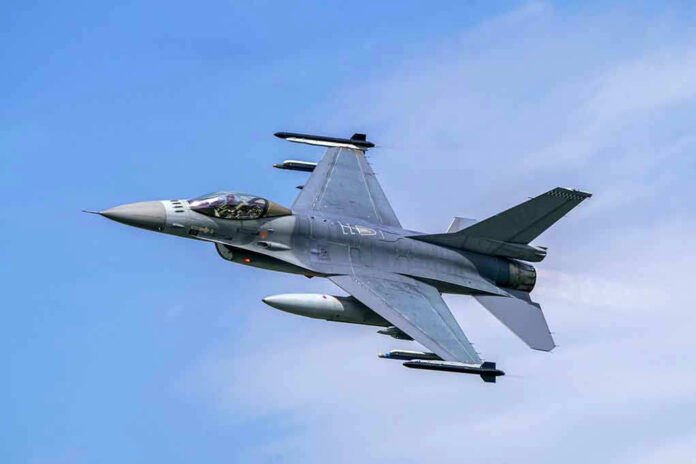
The sixth crash of a Navy F/A-18 Super Hornet in just ten months exposes a dangerous pattern of costly failures in the military’s aging fighter fleet, raising urgent questions about readiness and leadership as another $67 million taxpayer asset is lost.
Story Snapshot
- A U.S. Navy F/A-18E Super Hornet crashed off Virginia, marking the sixth F-18 loss in ten months
- The pilot survived after 90 minutes in rough seas, highlighting rescue risks and training demands
- Recurring mishaps expose maintenance, operational, and leadership challenges in the Navy’s fighter fleet
- Each crash drains taxpayer funds and threatens U.S. military readiness as investigations mount
Sixth Costly F-18 Mishap Raises Alarms Over Fleet Readiness
A U.S. Navy F/A-18E Super Hornet crashed into the Atlantic Ocean off Virginia during a routine training flight on August 20, 2025. The pilot, assigned to Strike Fighter Squadron 83 (VFA-83), ejected safely and endured nearly 90 minutes in the water before being rescued. This marks the sixth F-18 crash in ten months—an alarming rate that signals deeper problems within the Navy’s fighter fleet. The incident occurred near Naval Air Station Oceana, a major center for carrier aviation, at a time when the operational tempo and deployment demands remain high. Each lost jet represents a $67 million setback for U.S. taxpayers, with the fleet’s safety and reliability now under intense scrutiny.
This latest crash is part of a troubling series of F-18 mishaps. In the past year alone, three F/A-18s have been lost, including one that slid into the Red Sea after a failed carrier landing in May 2025 and another that rolled off USS Harry S. Truman in April. A December 2024 friendly fire incident over the Red Sea further underscores the risks. Over the last decade, Navy records show 82 Class B and 307 Class C mishaps involving F/A-18s. The crash off Virginia has already prompted a formal investigation, and Navy officials are reportedly considering a fleet-wide safety stand-down to review protocols, training, and maintenance practices.
Root Causes: Aging Aircraft and Operational Demands
The F/A-18 Super Hornet, introduced in the late 1990s, has long been the backbone of U.S. carrier aviation. However, the combination of aging airframes and relentless operational tempo is straining the fleet. Strike Fighter Squadron 83, the unit involved in the latest crash, recently returned from a nine-month deployment aboard the USS Dwight D. Eisenhower, logging more than 1,000 combat hours. These extended deployments in high-risk areas like the Red Sea not only stress equipment but also highlight the real-world risks faced by pilots and crew. Maintenance challenges have mounted, as older jets require more extensive upkeep to remain flightworthy, and accidents are increasingly blamed on both mechanical failures and human factors linked to training and fatigue.
Navy leadership faces immense pressure to balance mission readiness with safety and fiscal responsibility. Each mishap triggers not only immediate investigations but also congressional scrutiny over spending and risk management. As the fleet ages, the cost of sustaining these complex jets rises, while the threat to U.S. military readiness and deterrence grows ever more apparent. The repeated loss of expensive, irreplaceable assets raises questions about oversight and accountability—especially given the Navy’s prominent role in projecting American strength abroad. If these trends continue, calls for accelerated modernization and a renewed focus on pilot safety will only intensify.
Broader Implications for Defense Policy and Taxpayers
Beyond the direct operational consequences, the string of F/A-18 mishaps has broader implications for U.S. defense policy and taxpayer interests. Each incident not only puts highly trained pilots at risk but also undermines public confidence in military stewardship of resources. Defense contractors such as Boeing face increasing pressure to address support and reliability issues, while Pentagon leadership is challenged to justify continued investment in legacy platforms. Congressional oversight may escalate if investigations reveal systemic issues in training, maintenance, or procurement. The Navy’s response—whether through accelerated modernization, changes in protocol, or increased transparency—will be key to restoring trust and ensuring future readiness.
Navy pilot rescued after $67M fighter jet crashes during routine training exercise — the sixth pricey military plane lost this year https://t.co/Do82QXchzX pic.twitter.com/tEFWtYDmLa
— New York Post (@nypost) August 21, 2025
Expert analysis from aviation and defense specialists consistently highlights the dangers of deferred modernization and overextended assets. Safety researchers advocate for robust management systems and transparent reporting, while some defense policy experts suggest that repeated mishaps are a predictable consequence of pushing aging equipment beyond its intended lifespan. With each lost jet, not only is a valuable asset gone, but so too is a measure of America’s deterrent capability and the confidence of those who serve. As investigations proceed and Congress demands answers, the Navy must address both immediate risks and long-term strategy to safeguard U.S. interests and restore faith in its aviation forces.
Sources:
Navy pilot rescued from Virginia waters as F/A-18 fleet faces string of recent mishaps | Fox News
Navy pilot rescued after F/A-18 crash off Virginia | Stars and Stripes
Sixth US Navy F-18 fighter jet crashes off Virginia coast in 10 months | Tolqun News
Pilot Ejects From F/A-18E Off Virginia Coast | The Aviationist