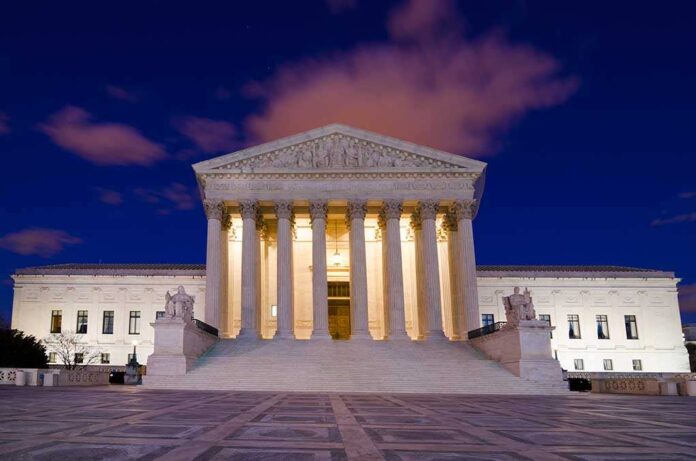
A Supreme Court ruling just forced President Trump to abandon his controversial deployment of National Guard troops in three major Democratic-controlled cities, marking a stunning defeat for executive power that could reshape federal-state relations for decades.
Story Highlights
- Trump withdraws National Guard from Los Angeles, Chicago, and Portland after Supreme Court limits presidential deployment authority
- California Governor Newsom claims legal victory, saying federal deployment was unconstitutional overreach
- Supreme Court ruled presidential power to deploy troops domestically limited to “exceptional circumstances”
- California’s deployment alone cost taxpayers nearly $120 million over seven months
- Trump warns of potential return “in a much different and stronger form” if crime rises
Constitutional Crisis Reaches Breaking Point
The withdrawal announcement came Wednesday after months of escalating legal warfare between Trump’s administration and Democratic governors. What started as immigration enforcement operations morphed into a fundamental constitutional showdown over presidential authority. The Supreme Court’s December ruling delivered a decisive blow to Trump’s claims of unlimited executive power over state National Guard forces.
The justices made clear that presidents cannot simply federalize state troops and deploy them indefinitely in domestic law enforcement roles. This precedent constrains not just Trump but future presidents from similar overreach. Justice Department lawyers had argued that once federalized, Guard troops could remain under presidential command without time limits and beyond judicial review—a breathtaking assertion of executive power that even conservative judges rejected.
Newsom Declares Victory in $120 Million Battle
California bore the heaviest financial burden of Trump’s military adventure, with Governor Newsom revealing taxpayers spent nearly $120 million over seven months. The deployment peaked at 2,000 troops in Los Angeles alone, ostensibly to protect federal buildings during immigration enforcement operations. Yet crime statistics tell a different story than Trump’s dramatic narrative about cities on the brink of collapse.
LAPD records show violent and property crime fell approximately 8% during the deployment period. This data undermines Trump’s claim that federal military intervention was essential to prevent urban catastrophe. Newsom celebrated the legal victory, stating his office “worked nights and weekends to defend the Constitution and bring about an end of the President’s unlawful overreach of executive power.”
Trump’s Strategic Retreat and Ominous Warning
Rather than acknowledge the legal defeat, Trump spun the withdrawal as mission accomplished. On Truth Social, he declared: “Portland, Los Angeles, and Chicago were GONE if it weren’t for the Federal Government stepping in. We will come back, perhaps in a much different and stronger form, when crime begins to soar again.” This threat suggests Trump views the current withdrawal as tactical rather than permanent.
Homeland Security Secretary Kristi Noem amplified this narrative, claiming Los Angeles would have “burned down” without federal intervention. Such hyperbolic rhetoric contradicts the actual crime data and reveals an administration struggling to justify constitutionally questionable deployments. The disconnect between official claims and measurable outcomes exposes the political rather than public safety motivations driving these decisions.
Broader Implications for American Federalism
This confrontation represents more than partisan political theater—it strikes at the heart of American federalism and the proper role of military forces in civilian governance. Multiple federal judges, including Trump appointees, expressed deep skepticism about claims that deployment decisions exist beyond judicial oversight. Congressional members from both parties raised concerns about civil liberties and the militarization of domestic law enforcement.
The precedent established here will constrain future presidents from similar federal overreach into state authority. Democratic governors successfully demonstrated that constitutional principles and legal persistence can check executive power, even when backed by federal military force. The 9th Circuit’s order returning Guard control to Governor Newsom represents a restoration of proper federal-state balance that the Founders intended.
Sources:
Trump administration retreats in Newsom lawsuit over National Guard deployment – Los Angeles Times
Trump abandons efforts to deploy National Guard to Chicago, Los Angeles, Portland – Irish Times