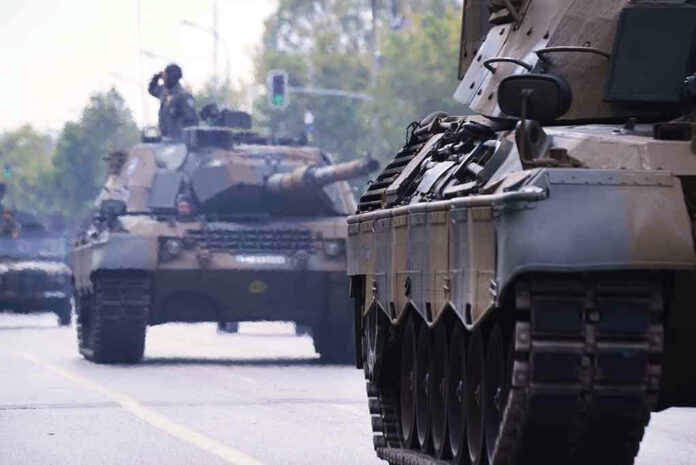
U.S. Army airlifts heavy Abrams tanks and Bradley vehicles to the Middle East in a rapid show of force, signaling President Trump’s unyielding commitment to American strength against foreign threats.
Story Highlights
- 3rd Squadron of the 278th Armored Cavalry Regiment deploys M1 Abrams tanks and M2A3 Bradleys via C-17 airlift to CENTCOM sites for urgent base defense.
- Unprecedented air transport cuts deployment time from weeks to days, countering drone swarms, shelling, and missile threats from Iran-backed groups.
- Move bolsters protection for 30,000 U.S. troops amid escalating tensions, rejecting weak retreats of the past Biden era.
- Combined arms integration provides firepower, infantry support, and TOW missiles, projecting an “iron fist” of deterrence.
Rapid Deployment Demonstrates Military Readiness
The U.S. Army’s 3rd Squadron, 278th Armored Cavalry Regiment, known as Task Force “Reaper” from the National Guard, loaded M1 Abrams main battle tanks and M2A3 Bradley infantry fighting vehicles onto C-17 Globemaster III aircraft. These heavy combat vehicles arrived at U.S. Central Command sites in the Middle East in recent days before January 20, 2026. This airlift operation replaced slower sea transport, enabling deployment in days rather than weeks. The effort addresses immediate threats to key facilities from regional instability.
Heavy Armor Shields Against Escalating Threats
Abrams tanks deliver superior firepower and protection, while Bradley vehicles support infantry with 25mm cannons and TOW anti-tank missiles. U.S. forces maintain around 30,000 troops at bases in Qatar, Jordan, Iraq, and Syria. This “shield wall” counters drone swarms, ballistic missiles, and shelling attacks on American positions. The deployment follows the Iraqi army’s takeover of Ain al-Asad airbase on January 17, 2026, ensuring no vulnerabilities emerge from partial withdrawals. CENTCOM oversees operations without disclosing exact locations, preserving strategic flexibility.
Strategic Deterrence Under President Trump
President Trump’s leadership restores swift power projection after years of hesitation under prior administrations. The Pentagon frames this as defensive measures to protect personnel and allies. Unnamed officials highlight shifts in threat perception, responding to attacks by Iran proxies. Recent additions like EAGLS counter-drone systems complement the heavy armor. This integration enables combined arms superiority in high-risk environments, deterring adversaries who test American resolve.
Ongoing air bridge operations confirm vehicle unloading with visual documentation. The U.S. Army states the equipment strengthens positions against base attacks. Potential considerations for the USS Abraham Lincoln carrier strike group underscore broader precautions amid Iran tensions, though unconfirmed. Troops gain enhanced safety, while allies benefit from sustained U.S. presence.
Long-Term Implications for Regional Stability
Short-term, the deployment bolsters defensive posture, deterring imminent threats. Long-term, it signals enduring American commitment, potentially stabilizing the balance against aggressors. Economic impacts include accelerated airlift logistics costs, but political reinforcement counters past over-withdrawals. Socially, it safeguards service members in volatile areas. Industry effects highlight demand for armor sustainment and airlift capabilities in modern warfare.
Sources:
U.S. Army bolsters Middle East presence with heavy armored vehicles
U.S. deploys EAGLS counter-drone system in Middle East
U.S. Army bolsters Middle East presence with heavy armored vehicles (AMP)
Abrams tanks Middle East deployment
U.S. Army deploys heavy combat vehicles to Middle East