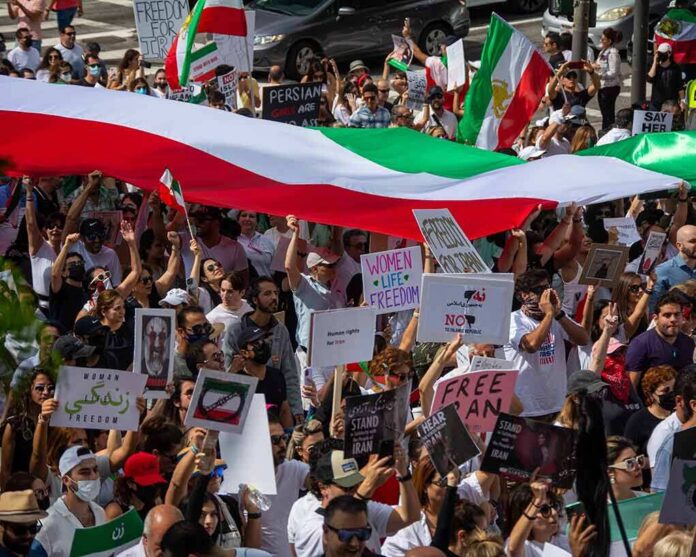
When Tehran and Sanaa fill with parallel, state-aligned crowds, it is not just spectacle; it is strategy—public theater designed to signal deterrence abroad, cohesion within ruling coalitions, and narrative control at home.
At a Glance
- Large pro-government demonstrations in Tehran and Houthi-held Sanaa showcased solidarity with Iran and its regional allies amid escalating conflict.
- Iran’s leadership and security organs visibly backed and helped stage the Tehran rally, casting turnout as proof of regime strength.
- Houthi-organized marches across Yemen’s capital and provinces framed steadfast alignment with Tehran as both deterrent and mobilization.
- Crowd size is an instrument of politics, not a referendum on legitimacy; mobilization capacity and logistics often drive the spectacle more than spontaneous consent.
What Happened: Twin Mobilizations, One Message
Tehran staged a large, centrally organized pro-government rally, described by wire coverage as drawing tens of thousands to hundreds of thousands into central squares in a show of power following periods of unrest and war-related tension. Footage and reporting placed senior officials and the Islamic Revolutionary Guard Corps (IRGC) apparatus in the event’s foreground, underscoring that this was not merely tolerated assembly but regime choreography designed to be seen at scale. In parallel, Houthi authorities in Yemen convened mass demonstrations across Sanaa and more than a dozen Houthi-controlled provinces, with participants declaring open solidarity with Iran and vowing resolve against regional adversaries; organizers cast the mobilization as a warning to Saudi Arabia and the United States.
These events were not isolated flashes. In both arenas, state-linked or movement-linked organizers repeatedly called their supporters into the streets, aligning messaging around loyalty to Iran’s “Axis of Resistance” and the righteousness of deterrence through unity. Photographs and dispatches show dense crowds, banners with the faces of Iranian leaders, and slogans binding local grievances to a transnational cause.
How the Machinery Works: Capacity, Choreography, and Symbols
Authoritarian and hybrid regimes treat crowd scenes as a strategic asset. The levers are familiar. First, organizational capacity: party, clerical, and paramilitary networks can issue synchronized calls, allocate transport, and marshal stewards to fill defined spaces at predictable times. Second, logistics and inducements: discounted or free transit, food, and lodging scale attendance and lower barriers to participation—especially for supporters mobilized from outside capital cores. Third, narrative framing: state broadcasters and aligned outlets present crowds as spontaneous proofs of legitimacy, while security services curate stagecraft—angles, overflights, and set-piece chants—to maximize the impression of unanimity.
In Iran, the IRGC and affiliated mobilization structures (e.g., Basij) are practiced at this work; their presence at pro-government events is both deterrent and enabling. In Houthi-held Yemen, the movement’s tight control over administrative and security space enables similar mass choreography, with rallies wrapped in language of resistance, martyrdom, and national dignity that binds local authority to Iran’s regional narrative. The common denominator is not spontaneity but reliable turnout under command.
Counting Crowds and Counting Power: Why Size Is Not a Referendum
How many people were actually there? That question matters less than many assume, and it is notoriously fraught. Even when credible outlets cite “tens of thousands” or “hundreds of thousands,” those are broad bands, not audited tabulations. Analysts who specialize in crowd estimation emphasize density-by-area methods—dividing a known footprint into zones and applying defensible density coefficients—to bound plausible ranges; over-claiming by state media is common and often identifiable through aerial imagery and physical constraints. In practice, state and movement officials highlight peak numbers, while independent observers caution against reading headcounts as plebiscites on legitimacy.
The appropriate inference is narrower and more useful. Large rallies demonstrate mobilization capacity and control over public space; they do not, on their own, validate mass consent. Reuters reporting, for example, has noted that even enormous turnouts around regime-aligned events are routinely aided by subsidies and logistical support, and that attendee motivations blend loyalty, obligation, and curiosity—signals of state reach rather than an unequivocal mandate.
Why Regimes Invest in Spectacle: Deterrence, Cohesion, and Narrative Control
Staged solidarity serves three audiences at once. Externally, images of vast crowds are meant to deter adversaries by implying societal resolve—that escalation will meet not just military resistance but a mobilized populace. Internally, they reassure cadres and fence-sitters that the center holds, dampening elite panic after shocks like assassinations, strikes, or waves of protest. Domestically, saturation coverage reframes the political baseline: loyalist assemblies become the imagined norm, while dissent is recast as fringe, foreign-backed, or criminal—narratives that ease subsequent repression or legal sanction.
For the Houthis, the calculus is similar but amplified by wartime conditions. Rallies that fuse Yemeni nationalism with Tehran-oriented “unity of the arenas” messaging reinforce the movement’s claim to speak for a besieged nation, even as they telegraph alignment with Iran’s regional strategy. The performative element—chants, portraits, martial vows—doubles as recruitment theatre and morale maintenance in a protracted conflict.
NEWS: Sanaa and Tehran see simultaneous large pro-Iran rallies fill the streets
— World in Motion (@WorldInMotionHQ) September 18, 2026
The Strategic Bottom Line
The parallel mobilizations in Tehran and Sanaa accomplished what their organizers intended. They filled the camera frame, demonstrated the state and movement’s capacity to command public space, and synchronized local politics to a regional message of resistance tied to Iran. Credible reporting records large turnouts across both capitals; the precise number is less instructive than the fact of coordinated, repeatable mass assembly under official direction. For analysts, the correct reading is disciplined: treat these scenes as indicators of organizational strength and information control—not as proxies for popular sovereignty. In environments where security services, party networks, and media ecosystems move in concert, headcounts measure power’s choreography more than the public will.
Sources:
zerohedge.com, reuters.com, eciks.org, en.mehrnews.com, lemonde.fr, english.ahram.org.eg, independent.co.uk, en.wikipedia.org, apnews.com, bastillepost.com
© fixthisnation.com 2026. All rights reserved.