When public mourning becomes a test of political character, minutes matter; an official leaving a 9/11 ceremony before the final name is read is interpreted less as scheduling than as signal, and that is why a brief exit to reach a television studio can ignite a conflict out of all proportion to the clock.
At a Glance
- The dispute centers on Governor Kathy Hochul departing the Ground Zero ceremony before the reading of names concluded, then appearing on CNN with Wolf Blitzer.
- Her office says she left on the same timetable as in prior years and framed the CNN segment as part of the day’s commemoration.
- Because 9/11 rituals are treated as civic liturgy, small deviations from the choreography carry heavy symbolic weight.
- This pattern is not unique to one official; anniversaries routinely become proxy battles over respect, politics, and media optics.
What actually happened and why the timing became the story
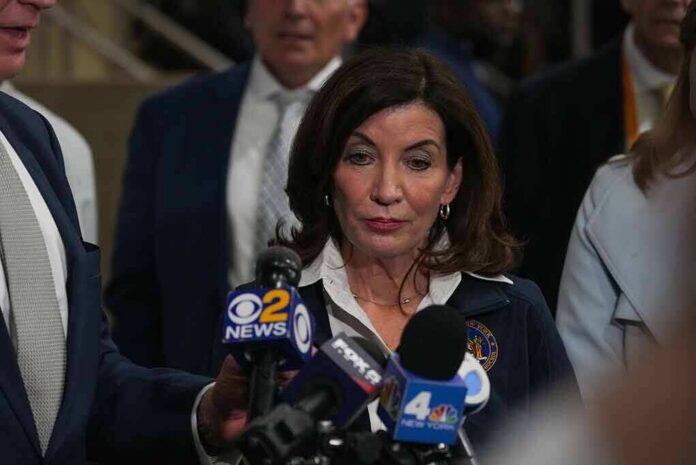
Contemporaneous reporting said Governor Hochul left the Ground Zero commemoration before the reading of victims’ names had concluded and then appeared on CNN; the juxtaposition of an unfinished roll call and a same-day cable hit furnished critics with a crisp narrative of disrespect. Her office answered with a procedural claim and a reframing: she departed at the customary time, in step with other dignitaries, and used the national platform to honor victims and discuss ongoing harms linked to the attacks. The governor’s press office, in fact, logged both events on its public schedule and later published the CNN transcript—an institutional breadcrumb trail consistent with a planned, same-day media appearance tied to the anniversary.
Two facts therefore anchor the episode. First, the reading of names was still underway when she left; major outlets have long documented that the recitation typically runs nearly four hours from the 8:46 a.m. bell, landing around early afternoon. Second, she did appear on CNN that day in an anniversary segment. The controversy lives in the seam between those facts: whether leaving during the ongoing ritual to do television is a breach of the day’s unwritten code, or a legitimate choice to extend commemoration to a national audience.
Why rituals like the Ground Zero ceremony function differently than ordinary events
The Ground Zero commemoration is designed as a civic liturgy rather than a political rally: no speeches by officeholders, a cadence of moments of silence, and the reading of every name. Officials are present as witnesses, not protagonists. In such a setting, choreography is meaning—where you stand, when you arrive, when you leave. Small deviations are legible to the public as values statements, which is why every anniversary spawns meta-arguments about attendance, comportment, and motive. Scholars and journalists have tracked how, over time, this ceremony’s nonpartisan aspiration has repeatedly collided with partisan atmospherics, especially in election cycles and milestone years.
That tension was visible again in the twenty-fifth anniversary coverage, which mixed solemnity with arguments over who should be there, who should speak elsewhere, and how leaders should acknowledge the wider arc of 9/11’s consequences—from foreign policy to toxic exposure—without instrumentalizing the day. The net effect is predictable: even routine scheduling decisions acquire a moral gloss in the public square, and the most combustible elements are brevity and optics.
The competing frames: disrespect versus responsible amplification
The critical frame is simple and potent: leaving before the final name is read privileges media over mourning. It uses a bright-line heuristic—be present until the end—as a proxy for respect. That argument gains force from the ceremony’s structure, where the reading is the act of remembrance and the presence of officials is explicitly subordinate to it; exiting mid-ritual can read as an elevation of self over the dead.
The counter-frame stresses continuity and purpose. If the governor’s departure matched prior-year practice, and if a national interview focuses on victims, families, and the still-emerging health toll, the choice can be cast as extending the memorial beyond the site to a broader public. The governor’s communications apparatus documented the commemoration and the interview and characterized the latter as remembrance-focused, including on toxic-exposure harms that continue to claim lives years after the attacks. The logic is that bearing witness at the pool and then speaking to the nation are complementary, not competitive, obligations.
Mechanics of the day: program cadence, media windows, and the meaning of minutes
The memorial program is not a single ceremony with a hard “end,” but a sequence—opening bell at 8:46 a.m., intervals of silence, interludes of names, culminating near early afternoon. Television bookers, especially on milestone dates, cluster their windows late morning to early afternoon to capture same-day reflections and to feed rolling coverage. Those constraints make a mid-ceremony exit the likeliest path to a live segment without pushing into taped evening packages. In practical terms, the decision vector is narrow: stay to the conclusion and miss the live national window, or leave during the recitation and catch a high-salience broadcast. Officials balance that calculus every year; the controversy is less about feasibility than about which norm—physical presence to the last name, or mass communication to a wider public—deserves primacy on the day.
This is also why “she left when she always leaves” is not automatically dispositive. A repeated practice, if misaligned with communal expectations, can become a repeated irritant. Conversely, if a departure pattern is widely shared among dignitaries and accepted by families, the same action reads as ordinary. The evidentiary record here shows each side furnishing its strongest fact—the overlap with the reading, and the asserted normalcy of the timing—and the audience adjudicating based on priors.
How we got here: the long politics of 9/11 memory
From the earliest anniversaries, 9/11 remembrance has been a contested space. Design choices at the Memorial, pandemic-era changes to programming, and competing observances have each generated accusations that one side is exploiting grief or muffling it. Analysts have noted that Ground Zero’s ceremonial neutrality, while real, sits inside a political culture that projects meaning onto every gesture; the closer the anniversary is to pivotal elections or round-number milestones, the harsher that projection becomes.
Two media dynamics amplify the pattern. First, cable news thrives on outrage discourse; producers select and frame conflict because it drives attention, particularly among those who disagree, a well-documented “confrontation effect” in political media engagement. Second, social platforms systematically inflate the perceived temperature of outrage, making modest breaches look like moral earthquakes and ensuring that a scheduling choice metastasizes into a referendum on character. Studies show users overperceive anger in political content, which nudges coverage and commentary toward the red zone.
Gov. Kathy Hochul leaves 9/11 Ground Zero ceremony early to appear on cable news show https://t.co/6Kwq65wWB2
New York Gov. Kathy Hochul dipped out of the reading of the names of 9/11 victims early at Ground Zero Friday morning so she could appear on CNN.
— 2026 Mets are trash 🗑️🗑️🗑️ (@NYMetsfan11279) September 12, 2026
What matters going forward: norms, transparency, and the hierarchy of duties
If leaders want to avoid this recurring cul-de-sac, two guardrails help. First, treat the reading of names as a boundary condition—if you attend, stay until it ends unless a true operational imperative intervenes. The power of the ritual is its endurance; leaving early will reliably be read as diminishing that power. Second, if a post-ceremony national message is necessary, pre-commit to a taped format or a post-conclusion live slot and publish that plan in advance. Transparency about the schedule reduces the interpretive vacuum in which symbolic fights thrive.
Sources:
twitchy.com, nypost.com, governor.ny.gov, cnn.com, thehill.com, transcripts.cnn.com
© fixthisnation.com 2026. All rights reserved.