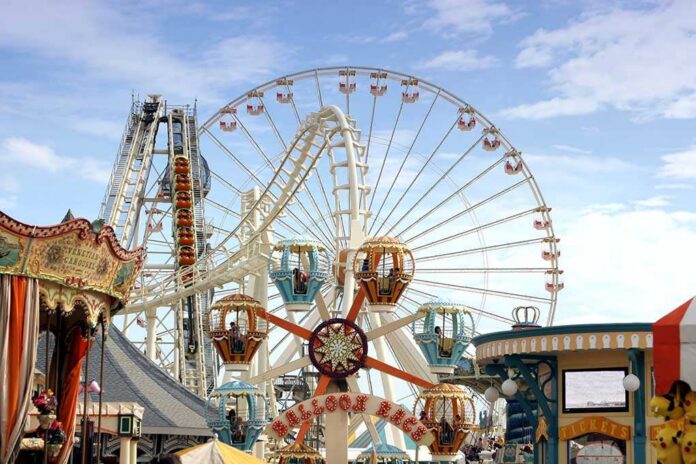
When a guest dies at a theme park, the first decisions that matter are not technical—they’re symbolic. Six Flags Over Georgia’s rapid move to strip the word “Dead” from a marquee Fright Fest show days after a fatal incident was a textbook example: acknowledge loss, remove gratuitous provocation, and signal respect while the facts are still being gathered.
At a Glance
- Six Flags Over Georgia publicly extended condolences after a guest died in an incident involving the Goliath roller coaster and said it was cooperating with authorities.
- The park renamed its Halloween show from “Dr. Fright’s Dead Man’s Party” to “Dr. Fright’s Party” ahead of reopening, citing respect for those affected.
- Six Flags temporarily closed nine comparable high-thrill coasters across multiple parks “out of an abundance of caution.”
- The renaming fits a broader pattern in which operators pair symbolic sensitivity with precautionary shutdowns while investigations proceed.
What Happened and How the Park Responded
On the afternoon of October 12, 2026, local authorities in Cobb County responded to a fatal incident at Six Flags Over Georgia involving the hypercoaster Goliath. One person died and several others were injured, according to contemporaneous local and national reporting based on official confirmations. The park issued a statement the same day expressing deep condolences to the guest’s family and noting immediate cooperation with investigators and first responders on site. As is standard in the early hours after a severe ride incident, the company avoided attributing cause while law enforcement and safety officials conducted initial interviews and scene management.
Within days, the company initiated two parallel tracks common to the industry’s crisis playbook. First, it undertook operational precautions: Six Flags temporarily closed nine high-thrill coasters of similar class across six parks, describing the step as an abundance-of-caution measure during the fact-finding window. The list included headliner rides such as Nitro, Orion, and Goliath at Magic Mountain, among others—closures reported and attributed to the company’s statements at the time. Second, it made a public-facing adjustment to seasonal entertainment. The Fright Fest stage show “Dr. Fright’s Dead Man’s Party” was retitled “Dr. Fright’s Party,” a change the park confirmed to USA TODAY was made out of respect for the incident and those affected, with the revised program scheduled for the October 16 reopening.
Why the Name Change Matters
To an outsider, swapping a single word on a Halloween show may look cosmetic; in practice, it is consequential because language frames experience. Parks invest heavily in seasonal theatrics built around horror tropes—zombies, crypts, jump scares—that are meant to be playful. After a real death on property, references to death shift from camp to callous. Removing “Dead Man’s” from a title is a low-cost, high-signal act: it honors the boundary between staged fright and real grief, it spares employees and guests from a jarring reminder, and it demonstrates situational awareness to a community processing a loss. That alignment between tone and circumstance is a core competence for any operator that runs large public spaces.
The timing also tracks with established industry behavior following serious incidents. Major parks often implement two categories of immediate actions: symbolic and procedural. Symbolic steps—public condolences, quieted marketing, modified show content—acknowledge human stakes without prejudging cause. Procedural steps—temporary ride closures, internal reviews, and cooperation with local authorities—buy time to establish the facts and, if necessary, implement targeted fixes before reopening. Six Flags’ dual-track response falls squarely within this pattern.
Mechanics of Precaution: Why Similar Rides Pause
When investigators do not yet know whether a failure mode is ride-specific, operational, or environmental, pausing analogous attractions is a rational containment strategy. Hypercoasters and other giga-scale steel coasters share envelope characteristics—speed, g-forces, restraint types, dispatch logic—that make them relevant comparators for early checks. A company can conduct accelerated inspections, validate restraint calibration, review maintenance logs, and confirm operator procedures against manufacturer specifications. This is not an admission of defect; it is a controlled risk posture that protects guests and reinforces public trust while technical teams work.
It also reflects the reality of oversight in the United States. Fixed-site amusement rides do not sit under a single federal regulator; state and local authorities lead, resulting in a patchwork of jurisdiction and documentation practices. In that environment, common corporate standards and voluntary pauses across properties function as a harmonizer—operators create their own baseline over and above minimum legal requirements while state partners complete their inquiries.
Language, Grief, and Operating a Public Stage
Halloween programming trades on theatrical mortality. That is sustainable because guests consent to the fiction: they buy a ticket to be startled, not to be mocked by circumstance. After a death, every on-property message is reread through a human lens. Entertainment titles, queue-line banter, and even merchandise that once felt cheeky can feel abrasive for employees handling questions and for guests who witnessed news coverage. The show rename from “Dead Man’s Party” to “Party” looks modest on paper; on a midway circulating thousands of people a night, it de-escalates emotional friction at countless touchpoints. As importantly, it spares front-line team members from avoidable conflict when they are already carrying the burden of a tragedy in their workplace.
Respectful framing is not reputation varnish; it is operational hygiene. In any large venue—theme park, stadium, or museum—leaders curate not only the physical environment but the emotional climate. The fastest way to signal that leadership is paying attention is to adjust what guests see and hear. Six Flags’ public language hewed to that standard, pairing condolences with a clear statement of cooperation and a quieting of death-related marketing while the park prepared to reopen.
Where the Facts End and the Process Continues
Public reporting established three uncontested points: a fatal incident occurred on October 12; Six Flags expressed condolences and cooperated with authorities; and the company both paused similar coasters and retitled a Fright Fest show prior to reopening. Specific technical causation—restraint performance, rider actions, or operator error—was not reported in these sources; that determination belongs to investigators and, if warranted, to courts. The company’s statements appropriately avoided speculating on that front while centering support for those affected and the privacy of the family.
For readers who follow ride safety at a systems level, the immediate question is not “why rename a show?” but “how does a mature operator move in the fog of early facts?” The answer is through layers: human-first communication; precautionary stoppages across analogous assets; structured inspections and documentation reviews; and reopening decisions calibrated to evidence and regulator guidance. In this case, each layer is visible in the public record—condolences and cooperation, temporary closures of peer attractions, and a respectful recalibration of seasonal entertainment.
Six Flags Over Georgia reopened today, four days after a man died falling from the Goliath coaster. The Goliath is still closed, and the park quietly renamed its Fright Fest show from Dr. Fright's Dead Man's Party to just Dr. Fright's Party. That rename says a lot without saying…
— The Daily Headlines (@DailyHeadHQ) October 17, 2026
The Broader Frame: Safety, Perception, and Continuity
Theme-park risk, properly understood, is managed rather than eliminated. Fixed-site ride injuries and fatalities are rare on a per-capita basis, yet the stakes are absolute for those directly affected. That asymmetry is why experienced operators tend to over-index on early, visible care and caution after a serious event—and why even modest changes to guest-facing language carry outsized importance. Six Flags’ decision to reopen with a retitled Halloween show was not mere optics; it was the public face of a governance model that, at its best, pairs empathy with engineering.
Sources:
nypost.com, wsbtv.com, cnn.com, usatoday.com, apnews.com, yahoo.com, nbclosangeles.com, people.com
© fixthisnation.com 2026. All rights reserved.