The United States’ absentee-voting framework is built around citizenship, not job titles—so when a U.S. citizen also happens to be a foreign head of state, the law still channels them through the same machinery as any other American abroad.
The Short Version
- Pope Leo XIV cast a mail-in ballot in Illinois as a U.S. citizen living abroad; the Holy See confirmed the act as routine civic participation.
- U.S. federal law provides an absentee pathway for citizens overseas, including those working for foreign governments, without carving out job-based exceptions.
- Reports tie the vote to a Will County registration and an absentee request submitted from abroad in early October.
- The legal architecture centers on citizenship and voting residence; symbolism and propriety are separate from eligibility.
What Happened: A Pope, A Ballot, And A Straightforward Legal Path
The Holy See stated plainly that Pope Leo XIV “has exercised his right to vote as a United States citizen,” adding that “he has submitted his mail-in ballot in Chicago.” The Vatican’s account does not describe a one-off flourish but a pattern—Leo has voted “whenever he was eligible to do so,” including while residing abroad before his papal election. Vatican News reproduced the statement and located this particular ballot in Illinois, via mail, consistent with the long-standing expatriate-voting process. Independent reporting traced the mechanics: a registration at a New Lenox address and an absentee ballot request lodged with the Will County clerk’s office on October 3, 2026.
That choreography—registration tied to a voting residence, request, issuance, and return—tracks the federal absentee architecture that governs Americans overseas. PBS summarized the controlling principle succinctly: U.S. citizens living abroad, even when employed by foreign governments, can vote by absentee ballot in federal elections; Leo’s dual U.S.–Peruvian citizenship and his role as head of the Holy See do not, by themselves, dislodge that right.
The Legal Architecture: Citizenship And Voting Residence, Not Occupation
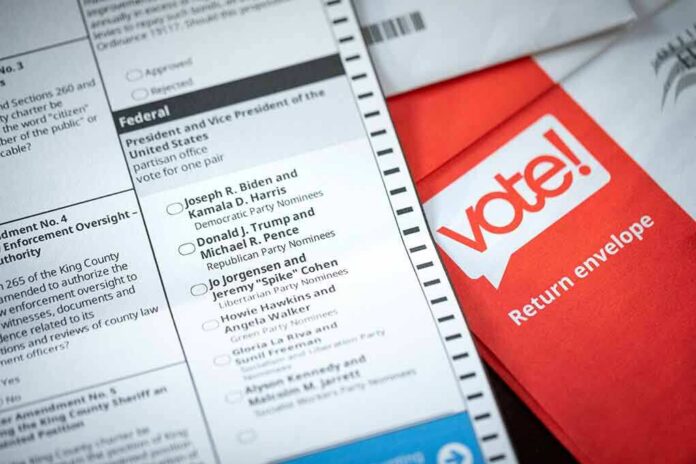
The Uniformed and Overseas Citizens Absentee Voting Act (UOCAVA) extends federal absentee voting to U.S. citizens living outside the country, alongside service members and eligible family members. In practice, the process is standardized: identify your voting residence (the address that anchors your ballot style), register and request via the Federal Post Card Application (FPCA) or state form, meet deadlines, mark and return the ballot. Nowhere in this workflow do officials assess your line of work as a gating criterion; the lodestar is citizenship tethered to a valid voting residence.
Federal guidance and State Department materials push the same signal: most U.S. citizens abroad who are 18 or older can vote absentee in federal races, and the FPCA is the doorway to do it. Election offices use the residence to determine ballot content and to validate the request and return, not to police extraneous professional roles—whether you’re a university rector, a shipping executive, or, in this unusual case, the sovereign of a microstate.
Mechanism And Precedent: How An American Abroad Votes From Rome
Mechanically, absentee voting from abroad is prosaic. The voter pins their ballot to a U.S. voting residence—often their last domicile before moving overseas—submits the FPCA or state-specific application, receives the ballot electronically or by mail (depending on state rules), and returns it under prescribed methods and deadlines. The Federal Voting Assistance Program’s guidance, updated each cycle, walks voters through the details and reinforces that the FPCA functions as both registration and a request for absentee ballots for a defined period, typically covering all federal contests in a calendar year.
The law’s design is status-neutral by intent. Congress built UOCAVA to stop absentee eligibility from turning on career particulars and to prevent local idiosyncrasies from trapping otherwise eligible citizens in paperwork limbo. PBS’s reporting distilled the upshot relevant here: Americans abroad, including those working for foreign governments, vote via absentee ballots under federal law—an umbrella wide enough to cover the edge case of a U.S.-born pontiff.
Symbolism Versus Eligibility: Two Different Conversations
The novelty of a pope participating in a U.S. election naturally draws attention to optics—church-state symbolism, Vatican neutrality, and whether a spiritual leader should wade into secular democratic rituals. Those are debates about propriety and perception. Eligibility sits on separate rails. The Holy See presented Leo’s ballot as private civic participation by a citizen, reinforcing that he has long voted when eligible; the news accounts, for their part, anchored the Illinois mechanics in ordinary county procedures.
The Associated Press placed the episode in historical perspective—first known instance of a pontiff voting in a U.S. general election—and recapped Leo’s dual nationality. It also noted that the State Department may actively review the citizenship status of Americans who serve as foreign heads of state, heads of government, or foreign ministers. That review function addresses nationality and diplomatic recognition questions; it is distinct from the election-office task of processing an absentee ballot for a qualified U.S. voter registered at a state residence.
Where The Law Is Silent—and Why That Silence Matters Less Than It Seems
There is no bespoke clause in UOCAVA or Illinois election law that singles out “foreign heads of state” for different treatment at the ballot box; the framework relies on citizenship, age, residence, and timely compliance. That silence is not a loophole—it is design. When Congress wanted to cordon off roles from political activity, it did so elsewhere (think Hatch Act–style restrictions for U.S. federal employees). For private citizens who happen to hold foreign office, the voting statutes stay focused on the narrow question American election administrators are competent to answer: is this person a U.S. voter linked to our rolls who satisfied our rules?
This is why the Leo case reads, administratively, as ordinary. Reports identified a Will County registration and an absentee request; the Vatican affirmed a mail-in return routed through Illinois. The fact pattern inserts an unusual biography into a standard process, but it does not change the process itself.
That fact is that the @FBI should be examining this move because Illinois election officials certainly won’t.
Robert Prevost is not eligible to vote in the United States.
Why? Because a pope ordinarily holds office for life. Leo XIV is not a missionary temporarily assigned to… https://t.co/ydhYnQhyJv
— Mia Sardinella (@MiaSardinella) November 1, 2026
Why It Matters: Guardrails, Precedent, And The Scope Of Citizenship
The episode clarifies something larger than a single ballot: the American electoral system treats citizenship as the controlling credential for participation, even when the citizen’s public life takes them far from home and into roles Americans do not typically imagine for a neighbor on the voter rolls. That choice is not accidental. It reflects a long-standing commitment to enfranchising citizens whose work, service, or vocation pulls them abroad—an architecture that presumes private political agency survives public position unless a specific law says otherwise. In Leo XIV’s case, no such contrary law appears in the absentee-voting framework; the ordinary pathway sufficed.
Sources:
zerohedge.com, sun-sentinel.com, pbs.org, vaticannews.va, people.com, phuulishfellow.wordpress.com, todayville.com, apnews.com, bbc.com, firstpost.com, dw.com, cnn.com, aol.co.uk
© fixthisnation.com 2026. All rights reserved.