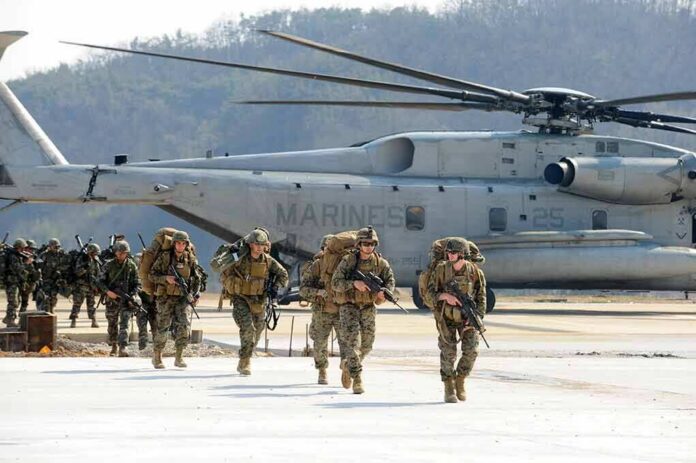
When federal agents break with routine to confirm an active case, it signals institutional stakes: NCIS and the Marine Corps have publicly acknowledged an investigation involving one of the Corps’ most celebrated Iraq War veterans, and they have anchored it to a specific job, school, and window of time rather than a rumor in search of facts.
At a Glance
- NCIS confirms an active investigation involving retired Sergeant Major Bradley Kasal; the Marine Corps identifies his civilian JROTC employment as the locus of the allegations.
- The Basic Academy of International Studies in Henderson, Nevada, is the school named; the district says Kasal resigned in August 2025.
- Former cadets describe boundary-crossing conduct; authorities have not announced a specific charge or statute.
- The case sits within a wider, documented JROTC oversight problem that has drawn GAO scrutiny and congressional pressure.
What is established: an active NCIS probe tied to a defined setting
NCIS confirmed that its Camp Pendleton field office is conducting an active investigation involving retired Marine Sergeant Major Bradley Kasal, a Navy Cross recipient whose combat valor in Fallujah made him one of the Corps’ most recognizable figures. The Marine Corps, speaking to the same outlet, specified that the matter concerns allegations arising during Kasal’s service as a civilian Junior ROTC instructor at the Basic Academy of International Studies, a Clark County School District public high school in Henderson, Nevada. The district stated that Kasal resigned in August 2025. These details—agency confirmation, institutional setting, and timeframe—fix the inquiry to a concrete context rather than a free-floating allegation.
Published reporting further describes the investigative focus: former cadets recounted rides home, Starbucks meetings, time spent off-campus outside school events, and occasions when Kasal was allegedly alone with a cadet. Such accounts map to standard boundary concerns in youth-serving programs; they also explain why a felony-level investigative agency with jurisdiction over Marine-connected matters would take statements and canvass a defined witness pool of students, parents, and staff.
What remains undisclosed: the suspected offense and procedural posture
Neither NCIS nor the Marine Corps has identified a suspected statute or a charging theory. “Felony-level” describes NCIS’s remit, not an indictment. There is no public charging document, warrant, or affidavit in the record, and authorities have not stated when the case opened, whether prosecutors have received a referral, or whether a grand jury is engaged. That is typical of active federal investigations; it does not diminish the significance of the confirmation but does limit what can be inferred about criminal exposure or timing. A single caveat belongs here: an investigation is not a finding of guilt.
Also absent is a substantive response from Kasal or counsel in the materials cited, which compresses the public narrative into institutional confirmations and former cadet accounts. For readers parsing signal from noise, the prudent line is straightforward: treat the existence and scope of the investigation as established; treat specific criminal conclusions as premature until prosecutors speak through filings or declination letters.
How JROTC oversight works—and where it has failed
JROTC programs are unusual hybrids: Department of Defense–certified instructors, often retired military, teach leadership and citizenship courses inside public high schools. That structure disperses accountability across school districts, service branches, and, at times, local law enforcement. When allegations surface, parallel processes activate—school Title IX procedures, service-branch certification reviews, and, when warranted, criminal investigations led by military investigative services or civilian police. The Government Accountability Office has found gaps in how the services track, compare, and respond to instructor misconduct, and has issued recommendations to standardize training, documentation, and interagency agreements to close those seams.
The base rates help contextualize attention to any single case. Across recent multi-year spans, official counts and congressional inquiries have tallied dozens to more than a hundred allegations of sexual misconduct involving JROTC instructors, with watchdogs pressing DOD and the services to tighten prevention and response protocols. While methodologies differ, the through-line is consistent: data collection is fragmented, oversight uneven, and remediation incomplete—conditions that invite underreporting and inconsistent sanctions.
Marine Corps legend Bradley Kasal — the Navy Cross hero of the Fallujah "Hell House" photo — is under NCIS investigation over his years as a Nevada high school JROTC instructor. No charges filed; allegations undisclosed. Full record: https://t.co/jBg725hPDH
— CancelPeople.com (@cancelpeoplenow) November 20, 2026
Why NCIS would confirm—and what that does and does not mean
NCIS does not routinely confirm active inquiries. When it does, public-interest considerations usually predominate: a defined school community, a youth-serving setting, and an identifiable investigative population that may include additional witnesses. Confirmation telegraphs that investigators are operating openly enough to encourage reporting, without previewing evidence or telegraphing charges. It also reduces the risk of speculation attaching to the wrong school or the wrong time period by anchoring facts to a named institution and role.
That confirmation, however, is not a proxy for strength of evidence. Its value to the public is directional—investigators are engaged; the locus is JROTC at a specific school; relevant witnesses know who they are. Its limits are equally clear—no adjudication is implied, and the statutory lens is undisclosed.
Reading boundary claims in youth-serving environments
Experienced safeguarding professionals distinguish criminal conduct from precursor or boundary-violating behaviors—patterns of special favors, off-hours contact, gifts, or private meetings that erode professional distance. In many substantiated cases across youth-serving organizations, those boundary violations precede or accompany offenses; in many others, they reflect poor judgment that still contravenes policy and warrants administrative action even absent a criminal charge. JROTC oversight bodies and GAO reviewers have emphasized codifying boundaries, standardizing Title IX training for instructors, and clarifying when and how concerns escalate from school discipline to law enforcement.
Against that backdrop, the behaviors former cadets described—rides, off-campus meetups, one-on-one time—are precisely the types of facts investigators test against policies, corroborating records, and statutory elements. Whether those facts support a charge depends on details the public record does not yet contain: age differentials, intent, communications, physical contact, and the totality of circumstances.
What to watch: process milestones that actually matter
Three inflection points will convert today’s confirmed investigation into tomorrow’s clear outcome. First, a prosecutorial referral and disposition—acceptance and charging, or a declination—will frame the legal bottom line. Second, administrative actions—service certification changes, district employment findings—will show how policymakers apply boundary standards independent of criminal thresholds. Third, the Department of Defense’s implementation of GAO recommendations—especially standardized data, training, and interagency agreements—will determine whether cases like this are rarer, clearer, and faster to resolve in the future.
Sources:
cbsnews.com, latimes.com, warren.senate.gov, congress.gov
© fixthisnation.com 2026. All rights reserved.