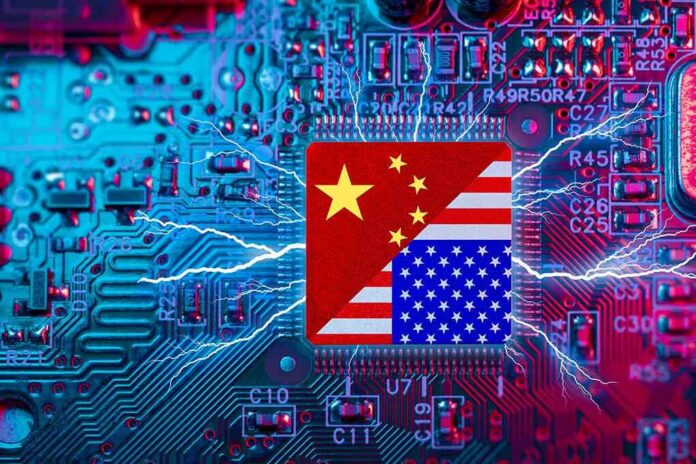
When a founder-CEO at the center of the AI hardware boom agrees to brief Congress behind closed doors, the stakes extend far beyond one executive’s conduct; they cut to whether the United States can harden its semiconductor supply chain and corporate controls against state-backed acquisition—direct or indirect—of strategic technology.
At a Glance
- House committee chairs requested a classified briefing from Jensen Huang on interactions with Megaspeed’s Alice Huang and Nvidia’s safeguards; Huang agreed to appear.
- The inquiry targets concrete national-security questions: access to confidential data, influence over management and policy, and potential chip diversion to China.
- Congressional concern rests on prior evidence that Nvidia products and support reached ecosystems later linked to the PLA, intensifying scrutiny of export-control enforcement.
- Nvidia and its board say they see no indication company or national-security secrets were compromised and that interactions resembled ordinary customer engagement; an independent review is underway.
What Congress is actually probing, and why it matters
Three Republican House committee chairs—Foreign Affairs, the Select Committee on the CCP, and Intelligence—formally requested a closed-door briefing with Jensen Huang to examine two intersecting risks: personal-access risk tied to his interactions with Megaspeed executive Alice Huang, and systems risk tied to Nvidia’s controls over sensitive information and export-restricted products. Their letter did not merely lament “China ties”; it specified testable propositions: whether Alice Huang obtained Nvidia confidential information, whether she influenced internal decisions or U.S. semiconductor policy via Huang, and whether restricted GPUs were diverted to China or Chinese military-linked users. Framed this way, the episode is a stress test of corporate counterintelligence hygiene in a strategically central firm.
The institutional basis is clear. Congress has treated advanced GPUs as dual-use assets central to national power, scrutinizing licensing and end-use controls. In 2025, Chair John Moolenaar pressed the Commerce Department on prospective H20 licensing after earlier China-focused bans, citing risks to America’s AI lead. In early 2026, the Select Committee publicized documents indicating Nvidia technical support for an AI model used in PLA systems and that Nvidia products used by DeepSeek were later procured by the PLA—findings leveraged to argue for rigorous enforcement around H200-class exports and end-user safeguards. That history explains why committees are not satisfied with general assurances; they want documentary answers on access, influence, and diversion pathways.
What is known, what is alleged, and what remains unproven
The committees characterize Alice Huang as a “publicly reported PRC intelligence asset,” a description that sharpened the political optics but, as yet, lacks a declassified assessment, charging document, or named official substantiation in the public record. That gap circumscribes the public case. The core investigative questions—did she obtain confidential information, shape Nvidia management or U.S. policy, or facilitate diversion—are precisely the points still under inquiry; the record offered no logs, emails, or forensic indicators confirming access or influence, nor shipment-level evidence that ties any diversion to Huang personally or to a breakdown in Nvidia’s controls. The gravity of the questions justifies the hearing; it does not, on its own, answer them.
Nvidia’s position is direct: meetings with customer executives—including Megaspeed—fall squarely within a CEO’s remit; the company says Megaspeed received ordinary business information, not sensitive trade secrets or anything germane to national security, and that the board sees no evidence company or state secrets were compromised. The board initiated an independent review and pledges to examine all available information; Huang has publicly committed to cooperate fully. These are corporate assertions, not adjudicated findings—but they shape the counter-narrative to expansive espionage claims and set a baseline against which Congress will test particulars.
Mechanics of risk: how sensitive compute leaks without a single “smoking gun”
Two distinct mechanisms animate congressional anxiety. The first is insider and proximity risk: senior-executive interactions, even when routine, can expose architectural roadmaps, software enablement details, support pathways, or pricing signals that help foreign actors triangulate capabilities. The second is post-sale leakage: even when export rules are followed at the point of sale, complex broker networks, cloud access, and third-country intermediaries can route compute to restricted users. The Select Committee’s DeepSeek/PLA discussion is illustrative: it suggests that U.S.-origin GPUs and associated know-how can surface in military ecosystems via downstream procurement, even if the original vendor observed its formal controls. That dynamic refocuses the question from “did Nvidia intend diversion?” to “are the end-user warrants, distributor controls, telemetry, and serial-number tracking regimes resilient enough to detect and disrupt it?”
Congress has been signaling for two years that the answer may be “not yet.” Letters from the China committee highlight concerns about loosening guardrails on export-compliant SKUs and urge Commerce to resist pressures that could create gray-market slack. The underlying policy theory is straightforward: in AI, usable compute is the coin of the realm; marginal increases in access compound into capability. Enforcement, therefore, has to reach beyond initial licensing to persistent verification—auditable end-user certificates, reseller transparency, shipping telemetry, and consequences for willful blindness.
The locus of genuine disagreement
The dispute is not over whether GPUs are strategic; both parties in Washington accept that premise. The fault line is evidentiary and institutional. Lawmakers point to prior committee documents tying Nvidia products and support to ecosystems linked to the PLA and demand a tighter compliance perimeter—hence their insistence on sworn testimony, access logs, security-audit records, distributor chains, and licensing files. Nvidia replies that there is no indication of compromise or improper disclosure, that executive-customer engagement was ordinary course, and that past smuggling allegations tied to Megaspeed were already investigated and debunked—positions the board says it is testing through an independent process. Because some probative material—intelligence sourcing, cyber forensics, and licensing rationales—will remain classified or commercially confidential, much of the public argument will hinge on what limited, citable artifacts emerge from the committees’ review.
It is also true that the most incendiary claim—Alice Huang as an intelligence asset—has not been corroborated in public by a declassified assessment or charge. Singaporean authorities have said she was not investigated for espionage, and Chinese officials dismissed the allegations as groundless; those statements do not settle the matter, but they underscore how far the public is from dispositive documentation and why closed-door testimony is the chosen venue for next steps. In short: the national-security questions are specific and serious; the proof, either way, sits largely behind classified or confidential walls.
The spy novel is the sideshow. I read four years of Nvidia's SEC filings and wrote it all down: the numbers, the footnotes, the law, the CFO, the auditor, the SEC, DOJ and PCAOB. The fullest account I know of the question nobody is asking. https://t.co/ysxBFvXjqu
— John Reed Stark (@JohnReedStark) November 15, 2026
What effective oversight would actually look like
Substance, not spectacle, will decide whether this inquiry strengthens U.S. technology security. On access risk, investigators can test verifiable claims: visitor and device logs, email metadata, NDAs, segmentation policies around sensitive design repositories, and insider-risk monitoring controls. On diversion, serial-number tracking across distributors, end-user certificates, customs data, and Commerce licensing files can be cross-referenced to Chinese procurement records and any PLA-linked entities identified by the intelligence community. If prior DeepSeek-related materials exist as described by the Select Committee, releasing non-sensitive portions would help the public distinguish systemic leakage from sensationalism.
For policymakers, the lesson likely transcends one executive. In a world where compute rents can be purchased abroad and brokered across borders, compliance programs must operate like continuous control systems: telemetry-rich, distributor-disciplined, with rapid revocation mechanisms and a bias toward verification over trust. Congress can aid that shift by clarifying liability for willful blindness in reseller networks, funding export-enforcement analytics that stitch shipping and corporate registry data, and aligning incentives so that firms central to national competitiveness invest proportionally in end-use assurance, not just perimeter licensing.
Bottom line
Huang’s agreement to brief Congress is not the resolution; it is the opening of the only forum that can adjudicate classified signals, commercial confidentiality, and the integrity of a strategically essential firm’s controls at the same time. The case will turn on documents and logs, not headlines. If the committees surface evidence of access or diversion failures, expect a push toward tighter end-use verification and distributor accountability across the AI hardware stack. If they do not, the episode should still catalyze a sturdier compliance architecture commensurate with the role GPUs now play in national power—because the systemic risks the inquiry spotlights will persist, with or without a scandal bearing one executive’s name.
Sources:
cbsnews.com, chinaselectcommittee.house.gov, foreignaffairs.house.gov, cnbc.com
© fixthisnation.com 2026. All rights reserved.