When a city opens its meetings with prayer, the constitutional question that actually matters is not which faith takes the microphone but whether the government runs the practice with viewpoint-neutral rules — and whether the room allows the invited speaker to be heard.
The Short Version
- Bartow, Florida placed an imam on its official meeting agenda to deliver the opening invocation; the invitation came through the city, not as a surprise appearance.
- The city’s stated rationale: the invocation slot is open to all faiths and consistent with constitutional tradition when administered neutrally.
- The imam’s prayer emphasized civic virtues — dignity, fairness, compassion — and was ultimately completed after officials restored order amid disruptions.
- The real legal hinge is the selection process and decorum enforcement, not whether a particular prayer is Christian or Muslim; Supreme Court precedent tolerates sectarian legislative prayer so long as access and conduct remain evenhanded.
What happened in Bartow, and why it matters
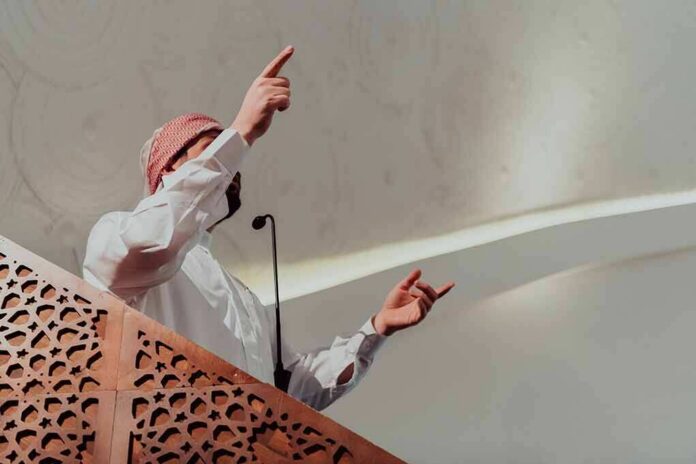
Bartow’s City Commission placed Imam Sajid R. Bhuiya of Masjid Al Nur on the November 16 agenda to deliver the invocation. As the meeting opened, some attendees attempted to drown out the prayer with recitations of the Lord’s Prayer and chants; the commission paused proceedings, called for order, and the imam finished the invocation. These are the hard facts that matter for analysis: the city extended an official invitation, the speaker’s remarks were civic in tone, a disruption occurred, and officials used their control of the meeting to complete the scheduled agenda item.
According to the imam, the city attorney framed Bartow’s practice clearly: historically Christian in flavor but open to all faiths as a matter of both policy and constitutional consistency. That position tracks the governing federal jurisprudence on “legislative prayer,” which treats such invocations as permissible when administered in a nondiscriminatory way and not exploited to proselytize, denigrate, or coerce participation.
How legislative prayer is evaluated under the Constitution
Since Marsh v. Chambers (1983) and Town of Greece v. Galloway (2014), the Supreme Court has recognized a limited tradition-based carve-out for opening invocations before legislative bodies — including local boards — with two guardrails: governmental neutrality in access and the absence of proselytizing, disparagement, or coercion. Town of Greece held that prayers need not be “nonsectarian”; a city may host explicitly religious prayers, provided its selection process does not systematically exclude other faiths and the setting does not pressure attendees to conform.
Applied to Bartow’s facts, the key questions are institutional rather than theological. Did the city invite speakers across faiths using a neutral method, such as outreach to local congregations without ideological screens? Did it enforce decorum to allow the invited speaker to be heard, irrespective of viewpoint? The available reporting supports an official invitation, an all-faiths rationale, and an eventual restoration of order so the invocation could proceed — all factors that align with Town of Greece’s tolerance of diverse clergy-led openings when run evenhandedly.
Content and conduct: what the prayer said, what the room did
The imam’s remarks were not a litmus test of orthodoxy but an appeal to civic virtues: treating one another with dignity, guiding officials toward fairness, justice, compassion, honesty, and understanding. In other words, the prayer’s content read like the genre the Court envisioned — an invocation to solemnize deliberation, not a sermon aimed at conversion or a condemnation of other faiths.
By contrast, the disruption — chanting over the speaker and reciting a competing prayer during the agenda’s invocation slot — posed a decorum problem, not a constitutional trump card. A city commission controls its meeting to accomplish official business; once a guest is recognized for the invocation, the government’s duty is to apply its rules consistently so the speaker can complete the task. Bartow paused and restored order, and the invocation concluded. That is how a content-neutral decorum rule should operate, regardless of who holds the microphone.
Competing claims and the limits of “counter-speech” during a meeting
Some attendees and advocacy groups defended their response as the right to challenge teachings they see as inconsistent with human dignity, religious liberty, or American principles. Citizens absolutely have that right — at the proper time in a meeting designed for public comment, and in forums designated for debate. They do not, however, acquire a right to seize the invocation itself or to prevent a duly invited speaker from being heard. Courts distinguish between a city’s controlled agenda time — government speech or a limited forum — and the public’s allotted comment period. Counter-speech belongs in the latter, not as a disruption of the former.
There is also a strategic misread here. If the goal is to preserve opening prayers rooted in a community’s Christian heritage, the surest way to end the practice is to transform it into a spectacle that invites litigation or political backlash. Secular organizations responded to Bartow’s incident by urging the city to abolish invocations altogether — a predictable move whenever decorum collapses or access looks exclusionary.
In Bartow, Florida, a Muslim invocation speaker at a city council meeting was *repeatedly* interrupted by Christian zealots who screamed out the Lord's Prayer.
One deranged activist later told the council, "These people do not belong here." pic.twitter.com/JySWZWCW4c
— Hemant Mehta (@hemantmehta) November 19, 2026
Where the real vulnerabilities lie for cities
The record we have is largely journalistic: it cites an agenda listing, the imam’s account of the city attorney’s rationale, and video excerpts. The decisive institutional evidence — a written invocation policy, selection logs across months or years, and adopted decorum rules — remains offstage. That is where cities get in trouble: if an invitation pipeline drifts into favoritism, if staff quietly screen out minority faiths, or if decorum is enforced asymmetrically depending on the speaker. Town of Greece tolerates sectarian prayer; it does not tolerate a sham open-door policy or a meeting that doubles as catechism for one creed.
Prudent practice is straightforward. Publish a neutral selection procedure, rotate invitations across a wide directory of local faith and ethical communities (including nonreligious invocations), avoid content review, and apply decorum rules without regard to a speaker’s theology. If a community would rather not referee religion at all, the cleanest alternative is to replace prayer with a moment of silence or to omit invocations entirely — a policy choice some advocates now press in Bartow’s wake.
What Bartow tells us about pluralism that works
The Bartow meeting distilled a perennial truth: pluralism is not the absence of conviction but the presence of restraint. A Christian prayer one month and a Muslim prayer the next does not erase anyone’s faith; it signals that the government is not in the business of ranking them. The imam’s remarks — dignity, fairness, compassion — were squarely within the invocation tradition the Court has permitted. The commission’s job was to let him finish. It did. That is the constitutional center of gravity, and it is where communities keep their footing when tempers rise.
Sources:
pembrokepinesflnews.com, hoodline.com, tampabay28.com, yahoo.com, x.com, wfla.com, thecitrustea.com, wtsp.com, theblaze.com, justice.gov, almonline.org
© fixthisnation.com 2026. All rights reserved.