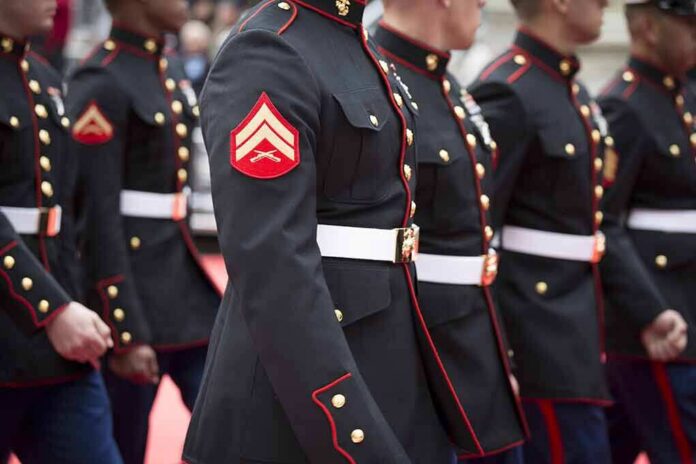
A half-million-dollar gift announced for “The President’s Own” was not just a flourish at a South Lawn helipad; it was a high-profile instance of private citizens — one of them the sitting president — pledging personal funds to recognize active-duty military musicians, with the stated intent that the money be distributed to individual band members.
At a Glance
- President Trump and UFC chief executive Dana White publicly announced a combined personal donation of $500,000 to members of the U.S. Marine Band.
- The White House initially framed the gift as $100,000 each, then the amount was raised to $500,000 during the event.
- Officials stated no taxpayer funds were involved and characterized the contribution as purely personal.
- The stated purpose was per-member recognition of the band’s work, spotlighting recent high-visibility performances.
What Happened: A Personal Gift Announced, Then Increased
On November 20, 2026, at a White House helipad reception, President Trump and UFC chief executive Dana White announced a personal gift to the United States Marine Band, widely known as “The President’s Own.” The figure, initially described by the White House and reported by national media as $200,000 total — $100,000 from each donor — was increased on the spot to $500,000, with Trump marking up a ceremonial check to reflect the higher amount. A White House official told Military Times the contribution came entirely from the donors’ personal funds and did not involve taxpayer dollars. Broadcast and on-scene coverage reflected the final $500,000 figure and the donors’ framing of the gift as personal.
The stated purpose was direct recognition of individual Marine Band musicians. Reporting described an intent to divide the funds among the band’s members, a framing that dovetailed with remarks lauding the band’s work at recent high-profile events and its historic role in national ceremonies dating back to 1798. While outlets varied on the number of musicians referenced in remarks that day, the public commitment was unambiguous: a half-million dollars pledged personally by Trump and White for the people who make up “The President’s Own”.
Why It Resonated: Recognition for “The President’s Own”
The U.S. Marine Band occupies a singular place in American civic life. Established in 1798 and famously championed by Thomas Jefferson, the ensemble has performed for presidents, visiting heads of state, and pivotal national moments for more than two centuries. In recent seasons it has also stepped into popular culture’s center ring — literally — through collaborations tied to major public events. Coverage surrounding the helipad reception highlighted the band’s precision and versatility, including ambitious, tightly staged performances with rigorous preparation cycles that mirror the operational discipline of the military itself. For audiences who only encounter the band at inaugurals, state arrivals, and national rituals, this was a reminder that “The President’s Own” is both a ceremonial guard of honor and a top-tier professional ensemble.
The donors’ public framing of the gift as a per-member acknowledgment underscored that point. It aimed to translate applause into a tangible bonus — not to buy equipment or fund a program, but to reach individual service musicians as a personal reward for excellence. That is unusual in the federal context and, for many observers, part of why the moment landed with such visibility.
The Mechanics Matter: Gifts, Awards, and DoD Rules
Whenever private money is directed at federal personnel, ethical and legal categories control what is possible. DoD policy begins from a simple premise: an “outside source” gift to a government employee is generally prohibited unless it fits an exception. The gift definition is broad — essentially anything of monetary value — and exceptions include bona fide awards recognizing meritorious public service, provided the donor does not have interests that may be substantially affected by the recipient’s agency responsibilities. These rules exist to protect both the public and service members: recognition should be earned and untainted by the appearance of pay-to-play, and acceptance must follow a channel that preserves integrity and public trust.
Several pathways can lawfully accommodate recognition of service members, including acceptance under ethics regulations for bona fide awards or through authorized gift-acceptance authorities that route funds via appropriate accounts or nonprofit intermediaries. The Army’s published guidance — representative across the Department of Defense — explains the general prohibition, the exceptions, and the principle that ethics officials must ensure any acceptance aligns with regulation before funds reach individuals. In short, the celebratory moment is only step one; completion requires a compliant mechanism that matches the gift’s intent.
Counts and Calculus: Headcount, Per-Person Amounts, and Public Messaging
Media accounts differed on the band’s headcount cited in remarks that day, with figures around 135 and approximately 170 appearing in coverage — a difference that, when attached to a fixed-dollar pledge, naturally shifts the implied per-person share. One outlet’s rough calculation using a 135-member figure lands well north of $3,000 per musician; another description framed it closer to four figures. Those mismatches reflect the reality of live remarks and quick math, not a dispute over the pledged total itself, which multiple outlets documented at $500,000 and attributed to the donors’ personal funds.
Why the variance? Ensembles scale for different missions, and “The President’s Own” encompasses musicians, support, and specialty units whose participation fluctuates by program. When a pledge is pegged to “the band,” a precise roster at the time of distribution — not an event-day estimate — is the operative denominator. That’s routine in grantmaking and awards administration; the number that matters is the one certified when funds are disbursed.
How We Got Here: A Public Ceremony, A Familiar Pattern
This episode fits a recurrent pattern in military recognition: a prominent donor makes a public pledge to uniformed personnel, the moment is captured in a spectacle-forward setting, and attention then shifts to the administrative work of routing funds within ethical constraints. The Department of Defense’s ethics materials and service-level advisories consistently spell out the same architecture — start with the presumption against outside gifts, then document the exception that applies, and ensure the acceptance and any distribution follow an approved channel. When the donor is also a public official or a high-profile business leader, the optics intensify, but the underlying rules do not change.
That framework is why the gift’s onstage details mattered: the donors called it a personal contribution, multiple outlets reinforced that framing, and a White House official explicitly said taxpayer money was not involved. Within the ethics architecture, those elements point squarely toward the bona fide award exception and comparable acceptance mechanisms that DoD uses to keep recognition cleanly separated from official decision-making and appropriated funds.
Im in tears. President Trump said himself and Dana White are PERSONALLY giving $500,000 to Marine Corps band members
"We decided to increase it, right Dana. So we were going to give $200,000. Now making it $500,000”
This is HUGE ❤️pic.twitter.com/L3171ncS9T
— John J Kennedy Jr (@JohnFKennehjod) November 20, 2026
What It Means Going Forward
As a headline, “$500,000 for ‘The President’s Own’” captured a striking act of recognition at the highest level of public life. As a practice, it also underscored the durable guardrails that govern private generosity toward federal employees. For military musicians — elite performers who carry the weight of American ceremony — the moment put a spotlight on work that is often heard but less often singled out with personal awards. For institutions, it reiterated that celebratory pledges and lawful payments are two halves of the same story, joined by a process that exists to honor service while protecting the public trust.
Sources:
militarytimes.com, businessnews975fm.iheart.com, newsday.com, nbcnews.com, kfoxtv.com, thehill.com, dodsoco.ogc.osd.mil, reuters.com
© fixthisnation.com 2026. All rights reserved.