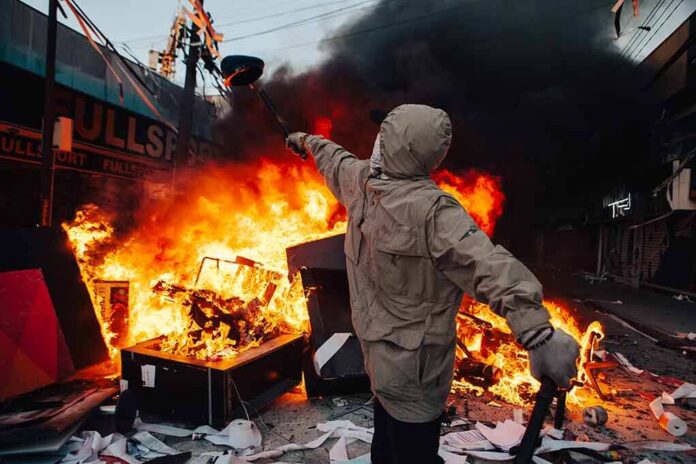
Mass protest and marginal violence are not contradictions in France; they are the twin dynamics through which nationwide discontent routinely expresses itself and is then contested in public memory.
At a Glance
- Hundreds of thousands marched nationwide, with official and union counts aligning on a large, geographically broad mobilization.
- The core grievances were concrete—education quality, cost of living, and public-service strain—rather than pure street disorder.
- Serious violence occurred at the fringes: looting, arson, and attacks on public buildings and police, prompting large arrest totals.
- Authorities escalated security and messaging, while student and union leaders condemned destruction and argued policing was excessive.
France’s dual reality: mass participation and fringe chaos
Two facts can be true at once: France saw very large, coordinated demonstrations, and it also endured outbreaks of damaging violence at the margins. Interior Ministry estimates placed nationwide turnout around 550,000 on one weekday of action, with the CGT union pegging it closer to 800,000; Paris alone approached or surpassed six figures by official count. These figures matter because they push the events beyond sporadic disorder into something structurally political—organized routes, banners, and cross-city mobilization—fueled by concerns over education, living costs, and public services.
That backbone of civic protest coexisted with episodes that looked like urban unrest: masked groups breaking away to loot or set fires, attacks on police and municipal buildings, and highly visible damage in major cities. In one subsequent weekend, authorities still counted roughly 410,000 demonstrators and described rallies as largely peaceful, yet reported more than 1,300 arrests—a contrast that captures the core ambiguity the public then argues over.
What the movement is about: grievances with institutions, not just the street
This wave began with students. Accounts trace early actions to high-schoolers protesting decrepit facilities, teacher shortages, and an admissions system seen as structurally unfair to disadvantaged students. As it scaled, the coalition widened to labor and cost-of-living protesters who linked school conditions to a broader picture of public underinvestment and squeezed households. The mix is politically legible: education quality sits at the heart of social mobility expectations, while inflationary pressures and service bottlenecks erode daily life. In short, the marches had an agenda; they were not simply a canvas for confrontation.
Leaders said so explicitly. Alice de Brito, a vice president of the student union UNEF, condemned looting and property destruction and cast her organizations as pacifist, while criticizing policing as unusually harsh—an important signal that, at least in declared aims, student organizers tried to draw a line between their marches and opportunistic violence.
The fringe violence: acute, photogenic, and decisive for narrative
Still, the violence was real and sometimes severe. Reporting cataloged looted shops, torched buildings, damaged ATMs, and attacks on emergency services; Lyon’s tourism office was set ablaze. Such incidents invite executive condemnation and harden the security response; President Emmanuel Macron vowed prosecution for those who vandalized and looted municipal institutions—a predictable and, given the record of damage, defensible posture.
This violence-narrative dynamic is not new in France. The country’s protest tradition has long paired large, substantive mobilizations with clashes at the edges, after which competing actors try to define the whole by its margins. Scholars have traced how images of flames, shattered glass, and armor-clad police disproportionately shape public interpretation, even when most participants march peacefully; the “protest paradigm” in media coverage reinforces that tilt, privileging conflict visuals and authority frames over movement substance.
Numbers, methods, and why headcounts do not settle the argument
Crowd-size disputes are ritualized in France, and the gap between Interior Ministry and union counts is structural rather than incidental. Both are estimates, not censuses; both carry sampling and route-coverage assumptions; and both become political instruments of legitimacy. The point, analytically, is less who nailed the precise number and more that both sides measure in the hundreds of thousands across many cities, which anchors the movement’s representativeness. A Paris turnout of roughly 110,000 in one tally sits coherently inside a national day between 550,000 and 800,000.
Arrest and injury figures are trickier. They move quickly, vary by cutoff, and blend dissimilar events. Across the period, totals reported ranged from a few hundred to well over a thousand arrests on particular days; police-injury counts likewise climbed into the hundreds. Without a shared methodological baseline that separates march-route detentions from off-route rioting, precision about the ratio of peaceful to violent participants remains difficult—a reality that bad-faith actors can exploit.
Tensions erupted in Paris today as thousands of protesters took to the streets for another massive demonstration against rising living costs, expensive fuel, inflation, and growing concerns over France’s public services and education system.
The demonstrations, involving… pic.twitter.com/VtrqQlVfrK
— Mighty News (@Mighty__News) October 31, 2026
Policing, escalation, and proportionality
France’s security apparatus responded at scale—tens of thousands of officers deployed, rerouted marches, and restrictions on sensitive squares and commercial hubs—reflecting lessons from prior cycles in which authorities were outmaneuvered late in the day. From a crowd-management standpoint, such posture can tamp down opportunistic vandalism; from a civil-liberties standpoint, it can look like preemptive containment that raises tensions before speeches even begin. This is the needle French policing struggles to thread.
On the ground, allegations of excessive force were specific and numerous—use of tear gas, stun grenades, and so-called LBD projectiles, with watchdog probes reportedly opened into serious injuries. But the available material stops short of adjudicated findings. What remains solid is the simultaneity: documented destruction by some protesters and documented allegations of disproportionate tactics by police. Both can be—and often are—true in the same city, even on the same block.
How to read the episode in France’s longer tradition
France’s repertoire of contention, from 1968 to the gilets jaunes and beyond, reliably fuses mass, issue-focused mobilization with fringe violence that colonizes attention. The civic risk is that the edge defines the whole—to the movement’s detriment and to the state’s benefit in justifying stronger controls. The civic opportunity is the opposite: organizers who keep their routes disciplined, isolate vandals, and sustain issue clarity can outlast a single news cycle and force institutional bargaining on education and cost-of-living reforms. The scale reached here suggests the grievances are not ephemeral; they are structural and therefore persistent.
The most honest synthesis is straightforward. These were very large demonstrations anchored in concrete socioeconomic and public-service complaints; they were also marred by destructive violence at the fringes that triggered a muscular security response and a political fight over definitions. Treating either fact as dispositive misreads how French protest actually works—and how change, when it comes, emerges from the messy coexistence of both.
Sources:
facebook.com, novaramedia.com, cbc.ca, irishnews.com, ynetnews.com
© fixthisnation.com 2026. All rights reserved.