A rapper’s cameo on a presidential rally stage tells you less about that rapper than it does about a particular political strategy: the deliberate pairing of mass-culture celebrity with mass-rally politics to manufacture attention a conventional stump speech cannot generate on its own.
Key Points
- Nicki Minaj traveled aboard Air Force One with President Trump to Port Huron, Michigan, on October 25, 2026, and appeared onstage at his rally for Senate candidate Mike Rogers.
- White House Communications Director Steven Cheung posted video from the flight, joking that Minaj might be the “new White House Press Secretary.”
- Onstage, Trump called Minaj “the queen of rap” and said she has “been with me from day one”; Minaj told the crowd, “I am so honored to be working with this president.”
- The rally centered on Michigan’s contested Senate race, with Trump also promoting candidate John James and attacking Democratic nominee Abdul El-Sayed.
- Decades of political-science research on celebrity endorsements shows wildly inconsistent effects — from the well-documented Oprah Winfrey “bump” for Barack Obama to multiple studies finding no measurable shift in votes at all.
What Happened in Port Huron
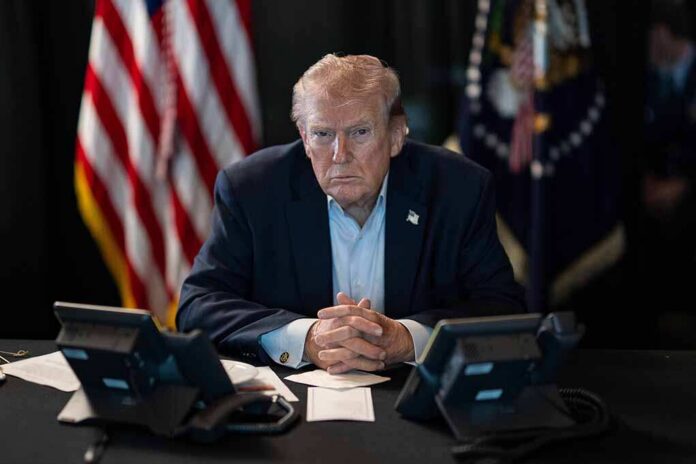
On October 25, 2026, President Trump flew to Port Huron, Michigan, to rally support for Mike Rogers, the Republican Senate candidate, at an event held at McMorran Place with a scheduled start time of roughly 3:00 p.m. Nicki Minaj traveled with him aboard Air Force One, a detail first surfaced by the Washington Examiner and confirmed in a video Steven Cheung posted from the flight, captioned as a tongue-in-cheek suggestion that Minaj might become the administration’s next press secretary. Minaj herself amplified the coverage on her own X account before later posting a photograph taken aboard the aircraft.
She did not merely attend. Trump brought her onstage, introducing her as “the queen of rap” and telling the crowd she had “been with me from day one” — a nod to her public support for him dating back to earlier campaign cycles. Minaj addressed the crowd directly, saying, “I am so honored to be working with this president,” and urged attendees to back both Rogers and John James in Michigan’s down-ballot races, framing the election as “a major turning point.” She closed with an explicit pledge of future loyalty: “If you run again I will support you again.” Local and national broadcasters, including Fox News and Forbes Breaking News, captured the exchange live, placing the moment squarely within the broader rally rather than as a separate or informal sideline event.
Why Trump Reaches for Celebrity at the Podium
This was not improvisation. Pairing a sitting president with a chart-topping musical artist at a midterm rally is a calculated bid for a kind of media oxygen that policy speeches rarely generate — cable hits, entertainment-press pickup, and social clips that travel well beyond the political audience the campaign could reach on its own. Port Huron is a mid-sized industrial city; a routine Senate-race rally there competes for coverage against dozens of other midterm events happening the same week. Minaj’s presence changed that calculus instantly, pulling outlets from the Daily Mail to AllHipHop into coverage that would otherwise have stayed confined to state political desks.
The tactic has precedent within Trump’s own political career and across the broader history of American campaigning, where entertainers, athletes, and cultural figures have long been recruited to lend a campaign cultural relevance it cannot manufacture through ordinary messaging. What distinguished this instance was the staging: not a pre-recorded endorsement video or a social-media post, but physical co-presence — the shared flight, the joint appearance, the unscripted exchange onstage, including an off-color aside from Trump about Minaj’s appearance that drew cheers from the crowd and additional media attention of its own. The spectacle, in other words, was the point as much as the endorsement itself.
What the Research Says About Whether It Actually Moves Votes
Here the evidence turns genuinely mixed, and intellectual honesty requires saying so plainly. A widely cited study of Oprah Winfrey’s 2008 endorsement of Barack Obama, measured through proxies like regional magazine subscriptions and book-sales patterns, estimated the endorsement generated roughly one million additional votes along with increased campaign contributions and higher overall turnout. That finding anchors the popular belief that a beloved celebrity can swing a close race. But it is closer to the exception than the rule. A separate body of experimental research — including a widely reported North Carolina State University study — found that celebrity endorsements generally fail to improve how voters evaluate candidates, and in some cases can actively hurt a campaign if the celebrity is polarizing. A meta-analysis of experimental studies on celebrity endorsement effects more broadly found a near-zero overall effect on audience response to the endorsed subject.
The honest synthesis is this: celebrity endorsements reliably generate attention, media coverage, and event attendance — all three were plainly on display in Port Huron — but they do not reliably convert into votes or durable shifts in candidate favorability. The Minaj appearance guaranteed Trump’s Michigan rally outsized coverage relative to a comparable event without her; whether it moves persuadable voters toward Rogers or James in a tight Senate contest is a separate question the research suggests campaigns should not take for granted.
Nicki Minaj on the way to joins Trump onstage at Michigan rally pic.twitter.com/NCmh3CYnRx
— 🏳️🌈titi🖤 (@TTelf16) October 26, 2026
The Lasting Lesson for Campaign Strategy
What this episode illustrates, beyond its own news cycle, is a durable truth about modern campaigning: attention and persuasion are not the same currency, and campaigns increasingly optimize for the former because it is easier to manufacture and easier to measure in real time — views, shares, trending topics — than the latter. Minaj’s flight, her onstage remarks, and the viral exchange with Trump delivered attention in abundance. Whether that attention translates into ballots cast for Mike Rogers in a competitive Michigan Senate race is the kind of question that only the returns themselves, not the rally footage, can ultimately answer.
Sources:
youtube.com, thegatewaypundit.com, ground.news, mlive.com, washingtonexaminer.com, dailymail.com, allhiphop.com, news.ncsu.edu, cambridge.org
© fixthisnation.com 2026. All rights reserved.