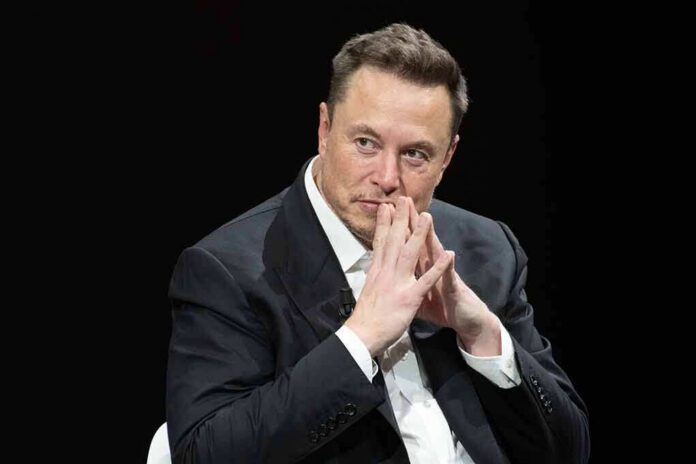
Every election cycle now produces its own version of the same argument: was that crowd real, or was it rented? The gathering outside Elon Musk’s West Lake Hills compound on November 7, 2026, is a textbook case, and the honest answer is more interesting than either side’s talking points — the event was simultaneously a genuine expression of voter sentiment and a professionally organized political production, because in modern advocacy those two things are no longer opposites.
Key Points
- Roughly 60 people arrived on two chartered party buses outside Musk’s Austin-area home for a post-election celebration featuring music, speeches, and a Cybertruck-shaped piñata, with no reported violence or arrests.
- The event was organized by three established advocacy groups — VOCAL-TX, the Center for Popular Democracy, and People’s Action — not by an unaffiliated group of neighbors.
- Those three organizations reported combined 2024 revenue of $56.1 million, a figure critics cite as evidence of professional staging, though no record ties that money directly to this specific event.
- The protest’s message centered on Musk’s spending in the Texas Senate race, where Democratic candidate James Talarico publicly accused him of “trying to buy this Senate seat.”
- The deeper, unresolved question isn’t whether the party happened — it did — but how to classify political events that are both organizationally engineered and voluntarily attended.
What Actually Happened Outside the Compound
The facts of the day are not in serious dispute. Dozens of people — reporting settles around 60 — rode two blue Fly-Rides party buses from downtown Austin out to West Lake Hills, where they held what organizers called the “People Over Billionaires Election After Party.” CBS Austin described speeches and dancing that gave way, eventually, to a piñata shaped like a Tesla Cybertruck. No outlet in the available record reports arrests, injuries, or property damage. Local organizer JJ Ramirez framed the purpose plainly: a message that billionaires who’d relocated to Austin “can’t buy our elections.” Whatever one makes of the politics, the on-the-ground conduct was closer to a tailgate than a confrontation.
What elevates this from a one-day local story to something worth examining structurally is who built the tailgate. VOCAL-TX did not materialize that Saturday; it operated as a bus captain system, with coordinator Eli Cortez, 28, helping marshal attendees onto the chartered vehicles. That level of logistics — chartered transportation, named coordinators, a branded event title — is not what spontaneous assembly typically looks like. It is what an organization with staff and a calendar looks like.
The Money Behind the Message
The three organizing groups — VOCAL-TX, the Center for Popular Democracy, and People’s Action — reported combined 2024 revenue of $56.1 million, according to their most recent tax filings. That number has done a lot of work in conservative-leaning coverage of the event, functioning as shorthand for “this wasn’t grassroots.” It’s a legitimate data point, but it proves less than it’s often asked to prove. Aggregate annual revenue for three national nonprofits tells you about institutional capacity; it does not, by itself, tell you who paid for two buses, a sound system, and a piñata on a single Saturday in Austin. No invoice, donor disclosure, or event-specific budget has surfaced publicly connecting that $56.1 million to this particular afternoon. The gap matters: it’s the difference between showing an organization *could* fund something and showing it *did*.
That gap cuts both ways, though. The absence of a documented expenditure trail doesn’t vindicate a purely grassroots reading either — it simply means the honest answer, for now, is unresolved. What’s verifiable is organizational sponsorship; what’s unverified is the dollar-for-dollar financing of this specific gathering.
Why Musk’s Home Was the Target
The protest’s substantive claim — that Musk was attempting to buy political outcomes in Texas — has a specific referent. Democratic Senate candidate James Talarico publicly accused Musk of “trying to buy this Senate seat in Texas,” pointing to spending reported in the hundreds of millions of dollars across the race. That allegation sits inside a much larger pattern: national election spending topped roughly $12 billion in the most recent cycle by OpenSecrets’ tracking, with nearly $3.9 billion coming from outside groups unaffiliated with individual campaigns. Dark-money spending specifically — funds moving through nonprofits that don’t disclose donors — hit a record $1.9 billion in the 2024 federal cycle, per Brennan Center research. Whichever side of this protest one sympathizes with, the broader backdrop is real and well documented: both billionaire-funded political spending and professionally organized advocacy infrastructure have become permanent features of American elections, not aberrations.
Two party buses, anti-Musk posters and Cybertruck piñatas show up outside Elon Musk's Texas home. Now, the money behind the protest is drawing attention.
Fox News Digital reports that three progressive organizations involved in Saturday's demonstration reported a combined $56.1… pic.twitter.com/EL0yVtzawV
— Fox News (@FoxNews) November 9, 2026
Grassroots or Astroturf — The Real Dispute
Here is where the two sides actually diverge, and it isn’t over what happened but over what to call it. Critics labeled the event evidence of professional staging; organizers and sympathetic attendees called it a genuine expression of voter frustration. Both can be true at once. Academic research on political mobilization draws a narrower, more useful distinction: astroturfing specifically describes sponsors concealing their involvement to simulate spontaneous grassroots support — not the mere fact that an advocacy organization provided buses and a microphone. By that standard, this event doesn’t clear the bar for deceptive astroturfing, since the organizers were named, quoted, and never hid their role. But it also doesn’t clear the bar for “spontaneous grassroots” in the colloquial sense critics use to dismiss it — because it plainly wasn’t spontaneous.
The more accurate frame is a hybrid one that political scientists increasingly rely on: professionally scaffolded participation, where an organization supplies the infrastructure — transportation, permits, production — while individual attendees bring authentic, voluntarily held political conviction. That’s a different animal from both a purely organic crowd and a hired one, and treating it as either extreme flattens a phenomenon that’s become the default mode of American protest organizing on both the left and right.
What Would Settle the Question
A handful of records would resolve most of the remaining ambiguity: event-specific invoices or reimbursement logs from the three organizing groups, a police incident log from West Lake Hills confirming the peaceful character of the gathering, and participant-level interviews establishing how many attendees were unaffiliated residents versus organizational staff or members. None of that has surfaced publicly yet. Until it does, the fair reading is this: the protest was real, peaceful, organizationally sponsored, and tied to a genuine and ongoing argument about billionaire influence in Texas politics — and the loudest claims on either side, that it was either pure grassroots or pure manufactured theater, outrun what the record actually supports.
Sources:
the-express.com, cbsaustin.com, zerohedge.com, quorumreport.com, statesman.com, journals.sagepub.com
© fixthisnation.com 2026. All rights reserved.