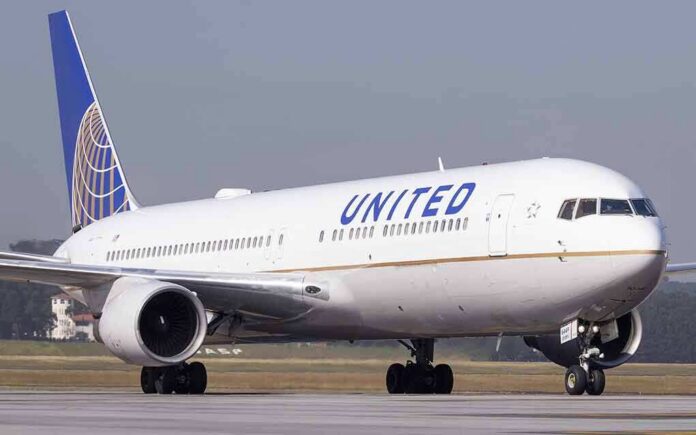
In commercial aviation, words alone can trigger the highest level of emergency response—and that is by design. When a passenger on United Flight 2174 claimed to have a bomb and reportedly moved toward the cockpit, the crew treated it as an unlawful-interference event, transmitted the hijack code, and brought the aircraft to a safe landing where deputies arrested the suspect. That sequence—credible threat, decisive cockpit action, orderly resolution—is how the system is supposed to work.
At a Glance
- United Flight 2174 landed safely in New Orleans after a passenger claimed to have a bomb; deputies arrested the suspect without incident.
- Pilots transmitted transponder code 7500, signaling unlawful interference/hijack conditions to controllers and nearby aircraft.
- No injuries were reported; passengers deplaned and law enforcement met the aircraft upon arrival.
- Authorities booked the passenger on charges tied to conveying false information and terrorizing, reflecting standard statutes for false bomb threats.
What Happened Onboard Flight 2174
United Flight 2174, operating Newark to New Orleans, alerted air traffic control to an unlawful-interference emergency when a 34-year-old passenger claimed to have a bomb and, according to multiple accounts, advanced toward the cockpit area. The cockpit crew set their transponder to 7500—the standardized hijack signal—while cabin crew managed the situation and kept the individual away from the flight deck. The aircraft continued to a safe landing at Louis Armstrong New Orleans International Airport, where passengers were deplaned and deputies arrested the suspect at the gate area without incident. Local officials later identified the booked charges as communicating false information of planned arson and terrorizing—statutes commonly used in aviation bomb-hoax cases.
Reports citing reviewed air traffic communications describe the suspect being held at the rear of the cabin until landing, consistent with crew playbooks for disruptive or threatening passengers. United confirmed the aircraft carried 46 passengers and six crew and that law enforcement met the flight after arrival. No injuries were reported, and there was no operational damage to the aircraft.
How the Hijack Code Works—and Why Crews Use It
Transponder 7500 is not a rhetorical flourish; it is a crisp operational declaration that the flight crew perceives unlawful interference—most commonly an attempted hijacking or cockpit breach. When that code appears on a controller’s scope, it automatically escalates the response: controllers prioritize the flight, security and law enforcement are cued, and the airline’s operations center synchronizes with authorities. Press reporting correctly captured that Flight 2174 “squawked 7500” following the passenger’s bomb claim and cockpit approach, a textbook trigger for this alert.
Squawking 7500 does not purport to adjudicate truth. It transmits a condition that warrants immediate security response. In practical terms, that means the cockpit focuses on aviate–navigate–communicate while the cabin crew contains the individual and manages passengers, preserving the flight’s integrity until wheels-down. That’s what happened here, and the absence of injuries attests to disciplined crew coordination and adherence to training.
Cabin Procedures Under Threat: Contain, Communicate, Coordinate
Cabin crews are trained to treat any claimed device as potentially real while minimizing escalation. The first moves are containment—physically separating the passenger from sensitive areas—followed by rapid communication with the cockpit and coordination with able-bodied passengers only if necessary and safe. Accounts from this flight align with those practices: the individual was reportedly moved or held at the back of the aircraft and monitored until police boarding after landing. This approach buys time, protects the flight deck, and keeps the plane stable for a safe arrival.
Airlines also drill for language barriers and agitation; crews prioritize clear, simple commands and de-escalation techniques, especially when details are ambiguous. The core objective is unchanged: deny access to the cockpit, stabilize the cabin, and land without delay.
Why Most Bomb Claims Prove False—But Must Be Treated as Real
Bomb-threat base rates cut a paradoxical path in aviation risk management. On one hand, the overwhelming majority of such threats prove unfounded; on the other, even a small false-negative risk is unacceptable once aloft. That is why regulators and carriers insist on maximum caution: the response is keyed to the claim’s potential, not its eventual falsity. Recent reporting has underscored the prevalence of hoaxes—Reuters, for example, described the “vast majority” of bomb threats as false alarms while emphasizing they must be handled as real until investigated. The pattern holds internationally; the BBC cataloged a concentrated spate of hoax threats that nonetheless triggered emergency actions across multiple airlines because procedures leave no room for guesswork in flight.
From a passenger’s perspective, this can seem like an overreaction; operationally, it’s the minimum safe response. The discipline is necessary because aviation cannot wait for ground truth while airborne.
The Legal Architecture: What “False Threat” Charges Actually Mean
Federal and state laws distinguish between protected speech and criminally actionable threats in transportation contexts. In the aviation setting, statutes typically target willful or knowing conveyance of false information about explosives or threats to an aircraft. Federal frameworks, including 18 U.S.C. § 35(b) and related aviation provisions, map civil penalties to lower-culpability conduct and felony exposure to willful, malicious, or knowing falsehoods; appellate decisions have parsed those lines explicitly. Courts have repeatedly upheld convictions where defendants conveyed false bomb threats connected to flights—whether to disrupt operations, force diversions, or induce emergency landings—recognizing the safety and economic harms even absent a device.
States layer parallel statutes—such as “terrorizing” or false public-alarm offenses—allowing local prosecutors to charge conduct that triggers significant emergency response. That appears to be the posture here, with deputies booking the suspect on charges for communicating false information of planned arson and terrorizing after the safe landing. One procedural caveat applies in any case: an arrest is an allegation, not a conviction; facts are ultimately resolved in court.
Why the System Worked Here—and What Matters Next
Measure the outcome against the objectives of aviation security: protect the cockpit, keep the aircraft controllable, land safely, and transition to law enforcement without injury. Flight 2174 met each test. The crew identified an unlawful-interference scenario, sent the appropriate hijack code, contained the threat in the cabin, and completed a safe landing where deputies assumed control and arrested the passenger. Passengers disembarked without harm; no device injured anyone. That resolution is not lucky—it is the product of standardized training, codified procedures, and cockpit–cabin discipline under stress.
The aftermath will follow a familiar track. Investigators and prosecutors will align statutory elements with the facts: what the passenger said, whether he knew the claim to be false, how the crew perceived and relayed the threat, and the operational consequences. Case law provides a clear scaffold for charging decisions and, if necessary, trial—while the industry absorbs yet another confirmation that rapid, conservative responses to bomb claims remain essential to safety.
#BREAKING: There's been another United Airlines flight scare involving New Jersey's Newark Liberty Airport. A 34-year-old passenger on United Flight 2174 stormed the cockpit Monday night as the plane was flying to New Orleans. The man allegedly claimed to have a bomb on board.… pic.twitter.com/Y1ZKl9OfZ8
— Salem News Channel (@WatchSalemNews) November 10, 2026
Bottom Line for Travelers
When a flight declares an unlawful-interference emergency, the cabin may feel tense and opaque, but the choreography behind the scenes is deliberate. The cockpit locks down, the cabin team contains the risk, and the system clears a path to the ground. On Flight 2174, that choreography held—and everyone walked off the airplane. That is what matters most.
Sources:
nypost.com, wlox.com, timesnownews.com, dailynewsrecap.com, spanish.news-pravda.com, courtlistener.com, law.justia.com, bbc.com, ca1.uscourts.gov
© fixthisnation.com 2026. All rights reserved.