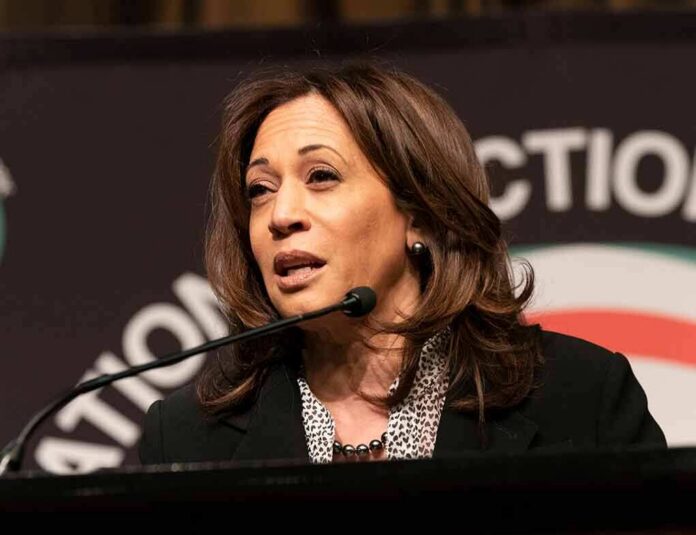
The headline that traveled — that Kamala Harris mangled a motivational quote and drew “crickets” in Mississippi — obscures the substantive reality: a routine, high-energy campaign stop in Columbus that fit the final-stretch cadence of a statewide Senate race.
The Short Version
- Harris appeared in Columbus, Mississippi, on October 22, 2026, to rally support for Democratic Senate candidate Scott Colom.
- The event, moved to Columbus High School after an initial venue declined, was publicly promoted and covered by local and national outlets.
- Claims about a botched quote and a silent crowd are not established in contemporaneous reporting; the attested facts are the stop, the venue, and the campaign purpose.
- The episode illustrates how brief clips or framing can eclipse the larger campaign context during peak season.
What actually happened in Columbus
On October 22, 2026, Kamala Harris traveled to Mississippi for campaign events that included a rally with Democratic Senate nominee Scott Colom in Columbus. Local and national coverage described the stop as part of her late-tour push to bolster Democrats in competitive or symbolically significant contests. The rally — organized to energize turnout and frame closing arguments for Colom’s challenge to incumbent Republican Senator Cindy Hyde-Smith — took place at Columbus High School after a venue change earlier that week. The underlying logistics and purpose of the event are firmly documented, as is Harris’s presence on the program.
Organizers pitched the gathering as a community rally designed to build momentum, a standard offering in the late weeks before Election Day. Colom’s team publicly promoted the event in advance, inviting supporters and press; Harris’s itinerary included additional Mississippi stops the same day, consistent with a broader midterm barnstorming pattern reported by national outlets. These are the concrete elements that define the occasion: time, place, and political aim — all reliably established by independent reporting and public notices.
The venue shift — why it happened and why it mattered
The rally’s location changed after Mississippi University for Women declined to host, citing logistical considerations; the campaign subsequently moved the event to Columbus High School. Venue shifts in the final stretch of a campaign are not unusual, and they often reflect the tug-of-war between security, crowd size, and institutional constraints. They also affect coverage: a school gym’s acoustics, camera sightlines, and press risers differ markedly from a university hall, which in turn can shape how a speech looks and sounds on video. The move did not alter the program’s basic character — a high-energy, public-facing mobilization stop for a statewide race — but it did create the sort of environment where snippets travel faster than context.
Local outlets and statewide talk formats noted and adjusted to the change, continuing to frame the event as an anchor appearance for Colom’s closing message. The persistent through-line in that coverage was the campaign function itself, not any single line from the stump. In other words, the logistics were a variable; the objective — to rally voters for Colom — was the constant.
How this became a clip-ready controversy
Short, emotionally charged portrayals of campaign moments can dominate attention during peak season, sometimes outrunning the fuller record. Media researchers have described this as a “cheap fake” or context-collapse dynamic: the footage is genuine but excerpted, repackaged, or captioned to steer the viewer to a particular interpretation divorced from the surrounding minutes of audio, the room’s energy, or the larger argument of the speech. In Mississippi, the attested facts are that Harris was there, the campaign rallied, and the venue changed; what spread online was a tighter, more dismissive framing that did not rest on corroborated transcripts or regularly cited local reporting.
That distinction matters because campaign events are designed for cumulative effect — the rhythm of applause lines spaced through a talk, the candidate handoffs, the local endorsements — rather than a single viral sentence. When the public record firmly establishes the stop, the speakers, and the purpose, but not the precise contested wording or documented crowd response, the story that stands up is the one about the rally itself, not the meme version of it.
Mississippi’s 2026 Senate race and why a Harris visit is consequential
Mississippi is rarely the first place national Democrats send a top surrogate; when they do, it signals an investment in organization, message testing, or long-game coalition building. Colom’s campaign pitched the rally as a momentum-builder, which makes strategic sense: a high-profile guest concentrates media, draws volunteers, and offers the local candidate a platform to contrast with the incumbent. National coverage placed Harris’s stop within a multi-state push, the kind of itinerary that can help down-ballot campaigns bank attention they could not purchase on their own.
Republicans, for their part, moved to protect the seat, underscoring that both parties read the calendar the same way in late October. In that phase, the fundamentals of a campaign — persuasion where possible, turnout always — are what a rally is built to serve. Harris’s role in Columbus, then, was less about novelty and more about mechanics: lend national heft to a statewide message, recruit energy, and turn a page of local news into a week of mobilization.
🇺🇸 Kamala Harris is back on the campaign trail, rallying in Mississippi and keeping her 2028 presidential ambitions alive. Despite Trump’s massive 22-point win in the state, her presence signals a strategic push to reclaim ground. Could this mark a pivotal moment for the Democ……
— Headlines (@lordnewss) October 23, 2026
Why the narrative and the record diverge
Once a snappy frame takes hold — a botched quote, an awkward pause — it competes with the slower work of local reporting that focuses on who showed up, where, and why. The Mississippi episode demonstrates that divergence. The evidentiary backbone is sturdy on timing, venue, and purpose; it is thin on the purportedly embarrassing line and the room’s reaction. Responsible synthesis, therefore, centers what is documented: Harris joined Colom in Columbus as part of a coordinated late-campaign push, after a venue change, to mobilize voters in a high-stakes Senate race.
Sources:
drooid.social, wtva.com, x.com, supertalk.fm, magnoliatribune.com, apnews.com
© fixthisnation.com 2026. All rights reserved.