A federal grand jury’s refusal to indict is not an acquittal and it is not a vindication — it is simply the government’s inability to clear the lowest evidentiary bar in American criminal law, and that distinction is the whole story of what happened to Cassidy Hutchinson.
Key Points
- A Washington, D.C. grand jury declined to indict former White House aide Cassidy Hutchinson on charges that she lied to Congress about President Trump’s conduct on January 6, 2021, according to AP and other outlets citing people familiar with the matter.
- The disputed testimony concerned a secondhand account of an alleged altercation inside the presidential SUV — an episode Hutchinson explicitly said she did not witness firsthand.
- The Secret Service driver later disputed the steering-wheel detail but corroborated other elements, including that Trump was angry and tried to reach the Capitol.
- The Justice Department’s Civil Rights Division, not the U.S. Attorney’s Office for D.C., ran the investigation — an unusual assignment that has drawn its own scrutiny.
- Federal perjury and false-statement law require proof of materiality and willful intent, not merely a conflict between two witnesses’ accounts.
What the Grand Jury Was Asked to Do
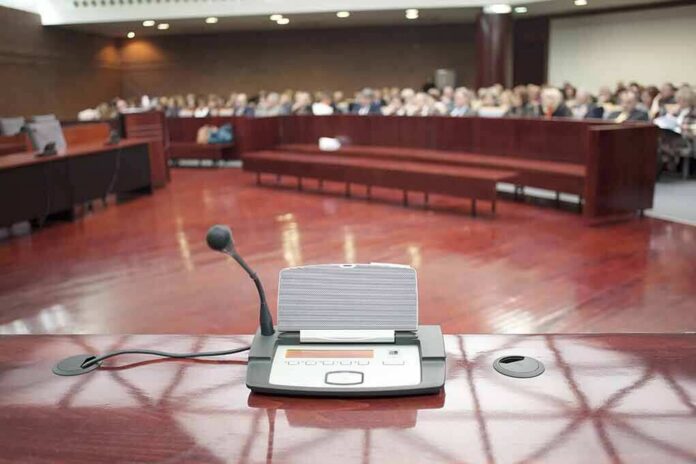
Prosecutors brought a proposed indictment against Hutchinson to a federal grand jury in Washington, and that grand jury said no. AP, citing two people familiar with the matter who were not authorized to speak publicly, reported the outcome on October 27; NBC News had separately reported that the grand jury heard evidence against her in early October. ABC News framed the sought charges plainly: lying to Congress in connection with her 2022 testimony before the House Select Committee investigating January 6. A grand jury’s job is not to weigh guilt beyond a reasonable doubt — it is to decide whether probable cause exists even to proceed to trial, hearing only the prosecution’s version of events. That a panel presented with one-sided evidence still returned what lawyers call a “no true bill” is a meaningful signal about the thinness of the case, even though grand jury secrecy means the public cannot see exactly what was presented.
The Testimony at the Center of the Dispute
Hutchinson’s most explosive public testimony, delivered in a nationally televised June 2022 hearing, described an alleged confrontation in which President Trump reached for the steering wheel of his SUV and lunged toward the front seat after being told he could not be driven to the Capitol on January 6. Crucially, Hutchinson testified — and multiple outlets have since reported — that she did not witness this herself; she relayed what White House deputy chief of staff Tony Ornato had told her, with Secret Service agent Robert Engel allegedly present for the actual incident. That chain of attribution matters enormously to any false-statement case, because accurately reporting what someone else told you is not the same legal act as fabricating an eyewitness account.
A Contradiction, Not a Clean Refutation
The Secret Service driver of the presidential vehicle later told the House Select Committee, in testimony reported by the committee’s Republican critics and recounted in subsequent reporting, that Trump “never grabbed the steering wheel” and that the driver did not see him “lunge to try to get into the front seat at all”. That is a real and specific contradiction on the most dramatic detail of Hutchinson’s account. But the same driver corroborated other elements of what she described — that Trump was “animated and irritated” after being refused a trip to the Capitol, and that he pushed to go there anyway. Engel, for his part, reportedly did not recall Trump gesturing toward him, which is different from affirmatively denying that an angry exchange occurred. A mixed record of partial corroboration and partial denial is a much weaker foundation for a perjury case than a flat, documented contradiction would be.
Why the Legal Bar Is Higher Than It Looks
Federal perjury and false-statement statutes do not criminalize being wrong, misremembering, or relaying bad information in good faith. Congressional Research Service guidance on these statutes is explicit that a conviction requires proof the false statement was material — capable of influencing the proceeding — and made willfully, meaning the speaker knew it was false when she said it, not merely that it later proved inaccurate. A secondhand account that turns out to be incomplete or imprecise does not satisfy that standard unless prosecutors can show Hutchinson knew, at the time she testified, that what Ornato told her was untrue. Nothing in the public reporting indicates prosecutors possessed that kind of direct evidence of her state of mind — no admission, no contemporaneous correction, no documented warning she ignored.
An Unusual Prosecutorial Path
The investigation was reportedly directed to the Justice Department’s Civil Rights Division rather than the U.S. Attorney’s Office for the District of Columbia, the office that ordinarily handles cases of this kind. That division’s conventional mandate covers matters like police misconduct and voting rights enforcement, and its leadership under Harmeet Dhillon has limited background in prosecuting false-statement cases of this nature, according to commentary accompanying the reporting. Whatever the internal rationale, the routing invites a fair question about institutional fit — a question entirely separate from whether Hutchinson told the truth, but one that shapes how the episode will be read by anyone assessing the Justice Department’s judgment.
The Pattern This Case Fits
Hutchinson’s case did not happen in isolation. It arrived alongside other high-profile instances in which federal grand juries declined to return indictments sought by the current Justice Department against figures perceived as adversaries of President Trump, a pattern that multiple outlets — AP, The New York Times, CNN, and NBC among them — have tied to a broader post-2024 effort scrutinizing figures connected to the January 6 investigation. That context does not determine whether any individual case had merit. But when several grand juries, hearing only the government’s evidence, decline to indict in politically charged cases, it becomes harder to treat any single refusal as an outlier rather than part of a recognizable trend.
What Remains Unresolved
A no true bill closes the criminal door, at least for now, but it does not settle the underlying factual dispute about what happened inside that SUV on January 6, 2021. The committee itself, in its final report, acknowledged it could not fully corroborate Hutchinson’s secondhand account while still documenting that Trump was angry and pushing to reach the Capitol. Full transparency would require the proposed indictment itself, the complete Secret Service interview record, and testimony from Ornato under oath — none of which is currently public. Until then, the honest assessment is narrower than either side’s preferred narrative: prosecutors could not prove Hutchinson lied, and the grand jury’s rejection, while not proof of her truthfulness, stands as the most concrete institutional judgment rendered on the case so far.
Sources:
nypost.com, apnews.com, kmbc.com, cnbc.com, pbs.org, abc13.com, nbcconnecticut.com, abc7.com
© fixthisnation.com 2026. All rights reserved.