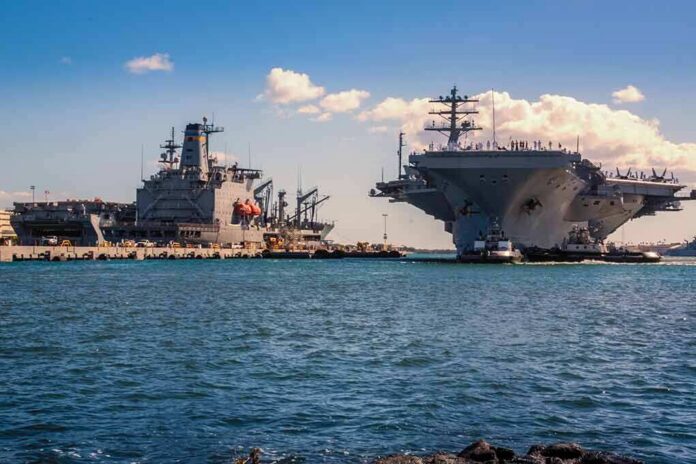
Defensive air and maritime power in the Strait of Hormuz is ultimately about keeping commerce moving; the United States’ limited strikes near Qeshm Island fit that logic precisely, targeting capabilities tied to threats against ships transiting the world’s most consequential energy chokepoint.
The Short Version
- U.S. officials say American forces conducted limited defensive strikes near the Strait of Hormuz, focusing on Qeshm Island.
- Iranian state-linked outlets reported explosions on or near Qeshm, corroborating that events occurred on the ground.
- Officials framed the operation as aimed at deterring or disrupting threats to commercial shipping and U.S. aircraft.
- Qeshm hosts IRGC-linked military infrastructure integral to anti-ship and coastal defense networks in the Strait.
What Happened: A targeted, defensive operation in the Strait
Multiple U.S. officials told major outlets that the United States executed limited defensive strikes against Iranian targets near the Strait of Hormuz, with Qeshm Island identified as a focal point. Reporting converges on the core facts and timing: the strikes occurred on or about November 2, 2026, and were described by senior officials as defensive—intended to blunt or deter Iranian actions that threaten shipping and U.S. assets in the Strait. One strand of sourcing ties the decision set directly to Iranian fire directed at an American aircraft, while another emphasizes the aim of preventing attacks on commercial vessels. Taken together, the accounts describe a contained action with a clear protective purpose rather than a broad offensive campaign.
Crucially, independent Iranian state-linked media acknowledged that explosions occurred on or near Qeshm Island, lending geographic and temporal corroboration even if attribution and battle damage assessments remain the province of U.S. officials and classified reporting. IRNA and state television referenced multiple blasts, which aligns with the U.S. narrative that kinetic activity occurred in precisely the place officials say it did.
Why Qeshm: The Strait’s geography and Iran’s coastal defense network
The Strait of Hormuz is a narrow maritime funnel where coastal geography grants outsized leverage to land-based missile, drone, and naval assets. Qeshm—lying along Iran’s side of the Strait—has long mattered because it can host the sensors, shooters, and small craft that animate Iran’s anti-access playbook: coastal radars to track ships, anti-ship cruise and ballistic missiles to hold them at risk, fast-attack craft to swarm tankers, and mines to shape sea lanes. Open-source reporting has repeatedly described Qeshm’s military role, including underground or hardened sites, IRGC naval facilities, and capabilities consistent with anti-ship missions; those elements render it a logical target set for a strike designed to protect maritime traffic without widening the scope of conflict.
That geography is inseparable from the operational concept. In any fight around Hormuz, coastal defenses and maritime interdiction tools are the first rung of escalation. Degrading the enabling nodes—sensors, missile launchers, boat pens, or command-and-control—has immediate defensive value. It decreases the probability that a single incoming weapon or swarm will achieve surprise, and it complicates Iran’s ability to mass effects at a time and place of its choosing. That is the textbook definition of a limited defensive strike.
How Washington framed the operation—and the single caveat that matters
U.S. officials described the action as defensive in two linked senses: responsive to hostile fire against a U.S. aircraft and prophylactic against pending or ongoing attacks on commercial ships. The first claim points to an immediate trigger; the second speaks to the enduring mission of keeping the Strait safe for navigation. Both are consistent with the United States’ stated regional objectives since the onset of the current cycle of confrontation. While Central Command did not issue a contemporaneous public strike release and the record relies on attributed and background official statements, the essential contours—time, place, and intent—are reinforced by separate reporting and by Iranian media acknowledging explosions on Qeshm.
That blend of responsiveness and deterrence tracks with established practice. The United States has repeatedly paired limited, precise use of force with an explicit intent to lower risk to global shipping rather than to signal a march toward broader war. The messaging here—defensive, limited, aimed at protecting vessels and U.S. forces—follows that script.
Mechanism: How a “limited, defensive” strike works in practice
A limited defensive strike around Hormuz typically integrates ISR (intelligence, surveillance, reconnaissance), electronic warfare, and time-sensitive targeting to neutralize weapon systems and nodes credible analysts associate with imminent or ongoing threats. Think coastal radar suppression to blind targeting networks, destruction of anti-ship missile launchers or storage to sap immediate firing capacity, and precision hits on command-and-control to compress the adversary’s decision loops. In parallel, maritime patrol aircraft and surface combatants posture to interdict small boats, while mine countermeasure assets stand ready to reopen traffic if mines are laid. Although public accounts in this case do not spell out each target, the described focus—Qeshm and associated IRGC military assets—maps onto this well-understood defensive sequence.
The aim is narrow but consequential: reduce the probability of a successful strike against a tanker or a U.S. patrol aircraft tomorrow morning, not to rewrite the strategic map. By staying inside that lane—focusing on enabling nodes and near-term capacities—Washington preserves escalation control while signaling capability and resolve.
The pattern: Hormuz incidents and rapid, bounded escalation
Episodes like Qeshm do not occur in isolation; they slot into a durable regional pattern. In the 1980s “Tanker War,” limited attacks on shipping evolved into a sustained contest of protection and reprisal, culminating in Operation Earnest Will and Operation Praying Mantis after a U.S. warship struck an Iranian mine. The through-line is constant: commercial vulnerability creates strategic leverage, and narrow waterways magnify the effect of modest arsenals. Contemporary assessments from the U.S. government and independent analysts have similarly cataloged how Iranian threats to shipping—and U.S. and allied countermeasures—shape flows through the Strait, with direct consequences for energy markets and global trade.
This history informs current practice. When officials choose limited, defensive strikes, they are operating from a playbook designed to interrupt escalation ladders early, before mines close lanes or a single missile strike kills mariners and spikes freight rates worldwide. It is not a panacea; it is a risk-management tool with a strong pedigree in this waterway.
U.S. Strikes Iran's Qeshm Island After Surface to Air Missiles Fired at American Assets: Qeshm Island explosions: the U.S. struck Iranian targets on November 2 over surface to air missile fire… silentdossier.com/articles/qeshm-island-explosions-us-strike-iran-strait-of-hormuz pic.twitter.com/qavlnr927f
— Silent Dossier (@Silent_Dossier) November 3, 2026
Implications: Shipping risk, diplomacy, and escalation control
Protecting the Strait of Hormuz is not an abstract exercise in maritime law; it is a hard-edged calculus about the safety of crews and the stability of energy markets. The International Maritime Organization and market analysts have repeatedly detailed how even brief disruptions in Hormuz ripple across fuel prices, insurance, and supply chains, with humanitarian knock-on effects for import-dependent states. Against that backdrop, the rationale for neutralizing anti-ship capabilities on Qeshm is straightforward: reduce the immediate threat to tankers and naval patrols, thereby stabilizing a corridor that underwrites global commerce.
Diplomacy and deterrence are not mutually exclusive here; they are interdependent. Coercive restraint—precise, bounded strikes that remove near-term attack options while avoiding broad civilian harm—can create negotiating space by lowering the adversary’s confidence in escalation payoffs. That is especially true in Hormuz, where a handful of missiles or mines can produce outsized strategic effect. The Qeshm strikes, as described by U.S. officials and corroborated by reports of on-island explosions, fit that strategic logic: limited action to keep ships moving and to preserve the conditions under which diplomacy can matter.
Sources:
cbsnews.com, wsj.com, cbs8.com, usnews.com, cnbc.com, france24.com, news.sbs.co.kr
© fixthisnation.com 2026. All rights reserved.