Caravans are less a test of how fast a crowd can walk than a test of how governments coordinate, message, and enforce long before anyone reaches a port of entry; by the time a caravan nears the United States, the decisive moves have usually been made hundreds of miles south.
The Short Version
- Public posture from Washington is unambiguous: migrants arriving as a caravan will be turned around or arrested, prosecuted, and deported, with no releases at the border under current policy.
- U.S. officials say they are coordinating with Mexico to disrupt caravans pre‑arrival; Mexican dispersal, transport offers, and status-regularization programs often fragment these groups.
- Many caravan participants shift goals en route, accepting Mexican documents and work rather than pushing on to the U.S. border.
- Historically, the “border spectacle” shapes outcomes as much as law: publicity spurs rapid policy signaling and upstream enforcement that determine what, if anything, reaches the line.
What a caravan is likely to encounter long before the U.S. boundary
When senior officials go on national television to declare that a caravan “will be immediately turned around, or arrested and prosecuted and deported,” they are not just previewing a line-of-scrimmage confrontation; they are activating a chain of upstream interventions that usually unfold far from the Rio Grande. In practice, Mexican authorities respond to U.S. pressure and their own domestic imperatives with a mix of tactics: bus transfers to state capitals, offers of temporary documents that regularize status locally, and piecemeal dispersal that dissolves the mass into smaller, administratively manageable flows. Credible reporting from Mexico’s El Universal describes Fe y Esperanza participants accepting transport from the National Migration Institute in exchange for documents—precisely the kind of upstream settlement that reduces the number who ever attempt a U.S. crossing.
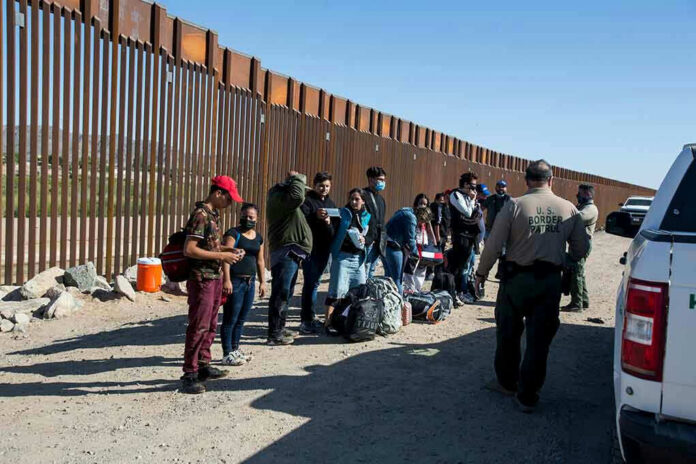
That pre-border choreography is by design. DHS officials say they track caravans in southern Mexico and coordinate with their counterparts to discourage northbound progression, while publicly warning that entry to the United States will be refused and that any illegal crossing will trigger enforcement without release. Whether a specific caravan ever tests those promises at a U.S. port is almost secondary; the message is aimed at would‑be travelers and at partner governments with the capacity to change the journey’s trajectory.
At the line: what “no releases” and removal really mean operationally
“Zero releases” from the border, as articulated by the administration’s border lead, signals an intent to hold or swiftly remove those apprehended rather than issuing notices to appear and releasing them into the interior while their claims proceed. That posture implies maximized use of expedited removal (a fast-track administrative process for those without lawful entry and without credible fear) and criminal prosecution for repeat crossers or aggravated violations. It also gestures at a backstop: removal to third countries when home states delay accepting returns—an option raised publicly but without the underlying list of receiving countries, bilateral instruments, or eligibility rules that would make the mechanism legible to outside observers.
Enforcement rhetoric aside, the fulcrum remains capacity and law. Holding people in custody requires bed space; prosecution requires docket time; removal requires travel documents and a willing receiving government. The policy statement tells us intent. It does not, by itself, evidence throughput against a particular caravan—no arrest logs, deportation manifests, or court dockets have been cited for this group. That distinction matters for analysts; it does not blunt what an arriving caravan is likely to see: closed entry without parole, rapid screening, and transport into detention or return if claims do not clear legal thresholds.
Why many caravans thin out: incentives, paperwork, and fatigue
Caravans are mixed‑motive, mixed‑eligibility populations: families and single adults, some with viable protection claims, others primarily seeking work. Along the route, incentives change. Humanitarian groups provide aid; Mexican authorities offer documentation that unlocks legal work or safer transit inside Mexico; exhaustion and injury mount. Reporting from the Fe y Esperanza march captures that pivot: the majority, according to local coverage, expressed a preference to remain in Mexico to work if they could regularize status, and they accepted government transport to pursue that option. That is not a moral aboutface; it is the predictable effect of a state offering a nearer, lawful alternative to a longer, riskier gamble with a visibly closed U.S. border.
This pattern is consistent with the scholarship: since the 2018 media‑magnified caravan, caravans have functioned as social movements and as catalysts for containment policies across the region. Public attention accelerates policy signaling and intergovernmental action; those actions, in turn, reduce the number who make it to—and through—the final checkpoint.
The spectacle dynamic: why statements matter even when untested
Analysts sometimes discount televised warnings as “mere messaging.” In caravan dynamics, messaging is a tool that shifts behavior upstream. Research tracking dozens of caravans found that political signaling and media coverage often yield hurried policy changes—some effective, some not—but they reliably alter the journey’s terms well before a specific group reaches the border. The point is not that press clips are policy; it is that they trigger policy by shaping the choices of counterpart governments and migrants. When the U.S. declares there will be no releases, and when Mexico offers documents to stay and work, the rational response for many travelers is to accept regularization in Mexico rather than confront an enforcement wall with no safety valve.
This feedback loop creates the “border spectacle” critics decry and practitioners use: images of a marching mass prompt hardened rhetoric; hardened rhetoric prompts upstream policing and administrative dispersion; the dispersion dissolves the image before it can test the rhetoric at the line. The caravan still matters—to the people in it most of all—but the decisive encounters are administrative and upstream, not cinematic and at the fence.
Where the real disputes lie: law, capacity, and proof
Three unresolved questions shadow any confident promise of turnback, arrest, prosecution, and deportation. First, legal authorities: third‑country transfers require durable agreements and due‑process pathways; without public documentation, the scope of that tool remains opaque outside government. Second, capacity: “no releases” presumes sufficient detention space and removal logistics; those are finite and contested in budget and court. Third, verification: public statements about enforcement outcomes against a specific caravan carry weight when paired with operational records—encounter data, detention rosters, removal tallies. Those records are not in the public domain for this group, which means the only thing we can state confidently today is the policy posture and the upstream responses it has elicited, not the eventual U.S. case dispositions for any given marcher.
None of that negates what a caravan is likely to see. It clarifies the difference between what is visible and what is verifiable: visible is a strong U.S. deterrent message, Mexican administrative dispersion, and migrant recalculation; verifiable—on a lag—is whether and how many who persist to the U.S. line are detained, prosecuted, or removed.
Bottom line for a caravan deciding whether to push north
Expect hard signals and soft landings—but not at the same border. The hard signal is at the U.S. line: no releases, expedited processing, and removal for those without successful protection claims, with officials publicly vowing to turn caravans back and to use detention and deportation if they arrive. The soft landing is often in Mexico: transport offers, temporary documents, and access to local labor markets that allow many to stop short of a futile confrontation and stabilize legally where they are.
Sources:
bigleaguepolitics.substack.com, rvmnews.com, ifapray.org, eluniversal.com.mx, laopinion.com, wsws.org, newsweek.com, mcnair.ucdavis.edu
© fixthisnation.com 2026. All rights reserved.