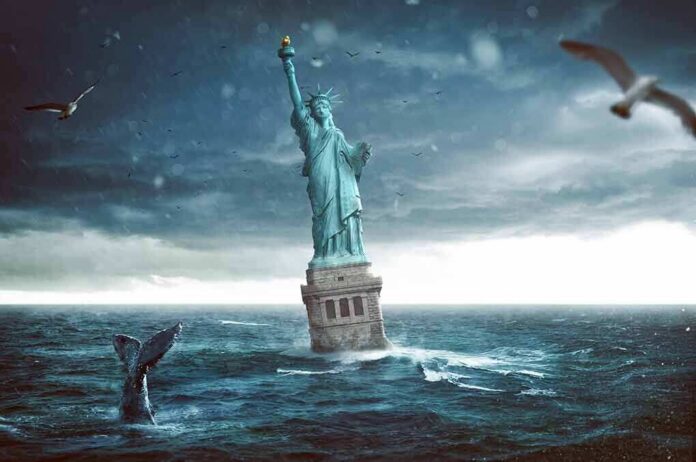
The Cumbre Vieja “megatsunami” story endures because it is built on a physically sound mechanism but an extreme assumption: a single, enormous slab of La Palma’s west flank sliding rapidly into the Atlantic. The hazard is real in principle; the question that decides East Coast risk is how much mass can fail, and how fast.
The Short Version
- A 2001 peer‑reviewed model showed that a very large, fast landslide at La Palma could launch basin‑spanning waves; the physics is not in dispute.
- What is disputed is the failure style and scale: incremental, piecemeal collapses produce far smaller far‑field waves than a single coherent block.
- USGS and later simulations argue the U.S. East Coast would likely see on the order of 1–2 meters in a worst credible La Palma collapse, hazardous but not “cataclysmic.”
- Near‑field risk in the Canaries is serious and fast; far‑field transatlantic catastrophe requires an extreme, contested scenario.
The mechanism is simple—and the devil is in the slide
Tsunamis from landslides are impulse problems: rapidly displace a large volume of water, and you inject energy into long gravity waves that can traverse an ocean. The 2001 Ward–Day study framed the debate with explicit numbers: a hypothetical west‑flank failure of 150–500 cubic kilometers, moving at about 100 meters per second, produced modeled transatlantic waves reaching the Americas in the 3–8 meter and 10–25 meter ranges, respectively. The paper established that a sufficiently large, rapid slide could, in theory, deliver multi‑meter waves to distant coasts—well beyond a media claim; it is a published calculation with stated inputs and a propagation model. What the paper did not and could not do was assign a probability to that specific failure geometry or speed.
That gap—clear physics, unclear likelihood—created room for outsized narratives. Later popular accounts attached headline‑friendly numbers (such as “65 feet in nine hours”) to the same general mechanism without equal transparency about the underlying parameters. Those numbers are sensitive to the slide’s volume, coherence, and velocity, and to how the model treats wave generation and transoceanic decay. The ocean does not reward imprecision here; double the slide speed or volume and you do not simply double the impact—you can change the regime the model is in.
What later research changed: failure style and far‑field scaling
Where the scientific reassessment has been most consequential is not in denying landslide tsunamis, but in revising what failure La Palma can plausibly deliver. Seafloor mapping around the Canary Islands shows landslide deposits that look composite and segmented—evidence consistent with multi‑stage or piecemeal collapses rather than a single, monolithic block departing at once. That matters because fragmented failures bleed energy into multiple, smaller impulses; the resulting waves interfere, disperse, and decay more quickly at basin scale. On that basis, a USGS summary pointed to newer simulations that place maximum U.S. East Coast wave heights on the order of 1–2 meters even under a worst‑case La Palma collapse—hazardous for ports and low‑lying areas, but a different category than a wall of water.
Independent reviews and modeling groups have echoed the same directional conclusion: when you constrain the slide to volumes and kinematics consistent with present‑day geology, the far‑field signal drops sharply from early extreme scenarios. Some researchers have gone further, arguing that a truly trans‑oceanic “mega‑tsunami” from Cumbre Vieja is not supported by the best available evidence, and that communications that conflate a speculative worst case with an imminent forecast have amplified anxiety well beyond the risk. The substance of that critique is not semantic; it is about geomechanics meeting wave physics.
Where the disagreement actually lies
The live scientific debate is narrow and technical: Could Cumbre Vieja’s west flank fail as a large, coherent mass at high velocity under realistic triggering—magma intrusion, pore‑pressure changes, or seismic shaking—or is the structure too segmented and the potential detachment too weakly connected for that to happen as a single event? The 2001 paper demonstrated that if you grant the coherent, fast slide, transatlantic wave heights become materially concerning. Subsequent field evidence and simulations have tended to erode that premise for today’s volcano, favoring multi‑phase or smaller‑volume failures and correspondingly modest far‑field waves. In short, the physics channel is open; the geologic faucet is likely narrower than the original setting.
One can acknowledge this without downplaying coastal exposure. A meter‑scale tsunami superimposed on high tide, in a harbor or on a shallow shelf with local amplification, can inundate infrastructure, damage port equipment, and threaten life. The United States has experienced lethal Atlantic tsunamis from submarine landslides in the historical record, and the vulnerability of built shorelines is not a function of headline height alone. But category matters for planning: one to two meters demands a robust warning, rapid evacuation of specific zones, and resilience of utilities; twenty meters demands wholesale rethinking of coastal risk. The balance of evidence supports the former for La Palma, not the latter.
Implications for preparedness: near field, far field, and monitoring
The Canary Islands themselves face the sharpest end of the hazard. Landslide‑generated waves are most destructive close to the source, where periods are short, runup is large, and arrival is measured in minutes. Civil defense in the archipelago sensibly prioritizes slope stability, evacuation routes, and real‑time monitoring—seismicity, ground deformation from GNSS and InSAR, gas emissions, and thermal signals—to catch accelerations that might herald a sector failure. The 2021 eruption, despite intense activity, did not precipitate a catastrophic flank collapse, underscoring that eruption alone is not a sufficient condition. That history argues for vigilance, not fatalism.
For the U.S. East Coast, the signal advantage is time. Even in aggressive scenarios, transatlantic travel times are on the order of several to nine hours. The Deep‑ocean Assessment and Reporting of Tsunamis (DART) buoys and coastal tide gauges would detect an outbound wave train; numerical forecast systems can then refine heights and arrival windows. Emergency managers should treat a La Palma sector‑collapse watch as a serious but not apocalyptic alert: move people off beaches and out of low‑lying harbor districts, clear bridges and tunnels that funnel water, secure port operations, and stage for rapid damage assessment. That posture matches the best current synthesis of the hazard.
How to read the next alarming headline
Three questions cut through noise. First: what slide volume and speed does the scenario assume, and are they justified by current structure and monitoring? Second: does the model treat the failure as a single coherent block or as staged, fragmented collapses? Third: is the cited wave height an offshore amplitude, a near‑shore runup, or an inundation depth—and on which coast and shelf geometry? A claim that squarely answers those questions, and ties them to a named, peer‑reviewed model, carries more weight than one that does not. The 2001 paper remains valuable as a bounding analysis; two decades of geologic mapping and modeling since then make the bound tighter and the far‑field hazard smaller.
The Cumbre Vieja tsunami hazard refers to the risk that a volcanic eruption on the island of La Palma, Canary Islands, Spain, could cause a large landslide triggering a megatsunami in the Atlantic Ocean. Volcanic islands and volcanoes on land frequently undergo large…
— Yours Truly (@JohnBernasconi1) November 2, 2026
Bottom line
You do not need to deny the physics to reject the apocalypse. A catastrophic, fast, coherent flank collapse at Cumbre Vieja could send large waves across the Atlantic; the seminal model showed that clearly. The preponderance of subsequent evidence indicates that such a failure mode is unlikely for the present volcano, that collapses tend to be piecemeal, and that the far‑field signal reaching the U.S. would most plausibly be in the meter‑class: serious, manageable with warning, and a poor canvas for “cataclysmic” headlines. That is not minimizing risk; it is aligning it with what the Earth, to date, has actually built.
Sources:
nypost.com, moodys.com, dailymail.com, earthref.org, en.wikipedia.org, www1.udel.edu
© fixthisnation.com 2026. All rights reserved.