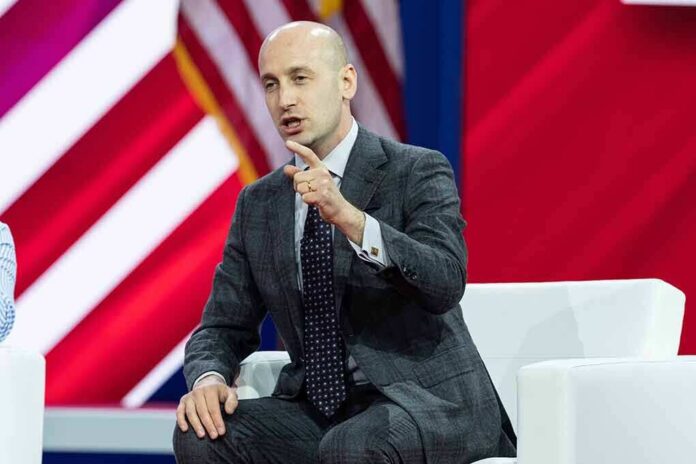
When presidents swap chiefs of staff, they don’t just change a scheduler; they reset the nerve center that translates presidential will into government action. President Trump’s decision to replace Susie Wiles with Stephen Miller formalized that kind of reset — consolidating power around a longstanding confidant known less for neutral process management and more for ideological through-lines and presidential loyalty.
The Short Version
- President Trump appointed Stephen Miller as the 33rd White House chief of staff, succeeding Susie Wiles.
- The White House and multiple national outlets reported the move and its effective date in lockstep.
- The shift followed bruising Republican midterm losses, inviting interpretations of a political recalibration.
- Miller’s elevation signals a tighter alignment between the West Wing’s gatekeeping function and Trump’s core policy instincts, especially on immigration and enforcement.
What happened and how we know
The White House announced Stephen Miller as the 33rd chief of staff, naming him the successor to Susie Wiles and emphasizing his years as a senior adviser embedded in President Trump’s inner circle. The release framed Miller as a “driving force” behind administration priorities and put a date certain on the transition. National outlets reported the same contours within hours: Wiles out, Miller in, effective Monday, with Miller moving up from deputy chief of staff — a title those reports attributed directly to the president’s statement and West Wing messaging. Miller, for his part, publicly accepted the appointment and thanked Wiles, which created a complete circle of institutional announcement, external corroboration, and appointee confirmation.
One cautionary note belongs here and no further: the contemporaneous record documents the announcement and planned effective date; it does not include a personnel instrument or staff directory snapshot confirming the moment Miller physically assumed duties. That absence doesn’t change the central fact — the president named him chief of staff and set the start date — but it explains why some subsequent coverage focused on the announcement rather than the first day’s mechanics.
What a chief of staff actually does
The chief of staff is the president’s integrator. In practical terms, the role controls information inflow to the Oval Office, sets the cadence of decision-making, adjudicates staff disputes, brokers interagency priorities, and enforces the president’s choices across the executive branch. It is not a Senate-confirmed position; the authority flows from proximity to the president and from the discipline the chief of staff can impose on process. Styles vary. Some chiefs are classic “process czars” who emphasize orderly memos, option sets, and strict meeting hygiene. Others function as political enforcers or ideological stewards, using the position to harden administrative policy through every lever — personnel, guidance, and the daily agenda.
That distinction matters here. Wiles had been described as a stabilizer who brought tighter operations and longer tenure relative to Trump’s first-term churn. Miller’s portfolio, by contrast, has been policy-forward and message-disciplined, with signature emphasis on immigration and enforcement. Elevating someone with that profile signals less a return to anonymous staff traffic control and more a presidency that wants its chief of staff to be an amplifier of presidential priorities and a closer, not simply a referee.
How we got here: the timing and its politics
Presidents frequently reorganize after electoral shocks. Trump’s first term set a baseline of rapid turnover; he cycled through four chiefs of staff — Reince Priebus, John Kelly, Mick Mulvaney (acting), and Mark Meadows — each reflecting a different theory of control. Wiles, often described as Trump’s longest-serving chief of staff, anchored a longer stretch of operational steadiness. The 2026 midterms ended that quiet. Within days of Republicans losing control of both chambers, the president announced Miller’s promotion and Wiles’s shift to political operations, a sequencing that aligns with the familiar post-defeat pattern: tighten the circle, sharpen the agenda, reassert presidential preferences.
Interpretations bifurcate from the same facts. One view treats the move as routine presidential staffing — the prerogative to select a chief of staff whose temperament matches the moment. Another sees a political response to electoral losses: after a drubbing, the president turned to a confidant steeped in his core issues. The record cleanly supports the timing and the selection; it does not — and need not — adjudicate motive. What it does suggest is intention: choose a chief whose policy instincts and loyalty are already proven in the crucible of proximity.
Stephen Miller’s operating system
Miller’s resume inside Trump-world is less a list of job titles than a consistent function: translating the president’s priorities into enforceable policy and hard-edged messaging. During prior service he helped architect the administration’s immigration posture — from asylum tightening to enforcement optics — and became a public-facing explainer of the White House’s theory of deterrence. The White House announcement leaned into that track record, pointing to his role across crime, border, and fraud initiatives as rationale for the elevation.
As chief of staff, that background implies a few operational shifts. Expect crisper vertical integration between communications and policy staff; fewer mixed signals between the podium and the policy memo; and stronger alignment between political imperatives and the daily schedule. Chiefs of staff set incentives — what earns face time, what gets buried, what returns to agencies with red ink. An ideologically aligned chief can compress decision cycles and reduce friction for preferred initiatives, while potentially narrowing the aperture for dissenting views. That tradeoff is neither inherently good nor bad; it depends on the clarity of presidential aims and the quality of the internal challenge culture the chief is willing to tolerate.
What changes for the West Wing
Every chief of staff reshapes three things: the gate, the calendar, and the rules of engagement. The gate is access — who briefs, how often, and on what terms. Under Miller, expect more direct routing for homeland, immigration, and law-enforcement portfolios, and a higher bar for cross-cutting proposals that dilute message or pace. The calendar is tempo — which meetings define the week. Look for more policy rollouts married to comms plans, fewer meandering debates without a decision memo attached. The rules of engagement are culture — leak tolerance, staff accountability, and the feedback loop with agencies. Miller’s longstanding reputation for message discipline suggests stricter comms hygiene and tighter interagency follow-through on presidential directives.
A second-order effect will be on personnel. Chiefs of staff rarely change policy alone; they change people who make policy. That can mean recalibrating deputy roles, refreshing directorates that have drifted, and empowering policy councils whose work aligns with the chief’s strengths. If the president’s priority stack foregrounds border, crime, and fraud initiatives, those lanes will likely see increased resourcing and seat time.
White House Chief of Staff Stephen Miller pledges his “absolute loyalty” and “total devotion” to President Trump during remarks at Mar-a-Lago.
“I swear to you, and I pledge to you, Mr. President, my absolute loyalty, my unwavering commitment, and my total devotion to your…
— AF Post (@AFpost) November 7, 2026
What to watch next
Three indicators will show whether this transition is cosmetic or consequential. First, process discipline: are decisions clearer, faster, and better executed across agencies than under Wiles’s steadier tenure? Second, agenda coherence: do the White House’s communications, legal posture, and regulatory moves converge around a concentrated set of priorities, particularly on immigration and enforcement? Third, political integration: does the promised shift of Wiles to the political operation translate into a more unified feedback loop between campaign imperatives and governing choices, or does it create a bifurcated structure where politics and policy compete for presidential bandwidth?
Sources:
redstate.com, whitehouse.gov, npr.org, nbcwashington.com, nytimes.com, abc7.com, cleveland.com, en.yna.co.kr
© fixthisnation.com 2026. All rights reserved.