In general aviation, survival after engine failure hinges less on avoiding impact altogether than on managing energy and control to turn an inevitable off-field touchdown into a survivable, contained event; a North Carolina couple and their two dogs did exactly that when their single-engine Piper lost power at night, executed a treetop, nose-high arrival, and all walked away.
The Short Version
- A husband, wife, and two dogs exited a downed Piper PA-32 with minor injuries after a nighttime loss of engine power.
- The pilot reported the engine stopped producing power around 6,000 feet and coordinated with air traffic control while troubleshooting.
- FAA officials confirmed mechanical trouble before the aircraft struck trees, which dissipated impact energy and left the fuselage above ground.
- A final pull-up maneuver presented the aircraft’s belly to the trees, aiding survivability; a formal cause of the power loss remains under investigation.
What happened: a forced landing, controlled to be survivable
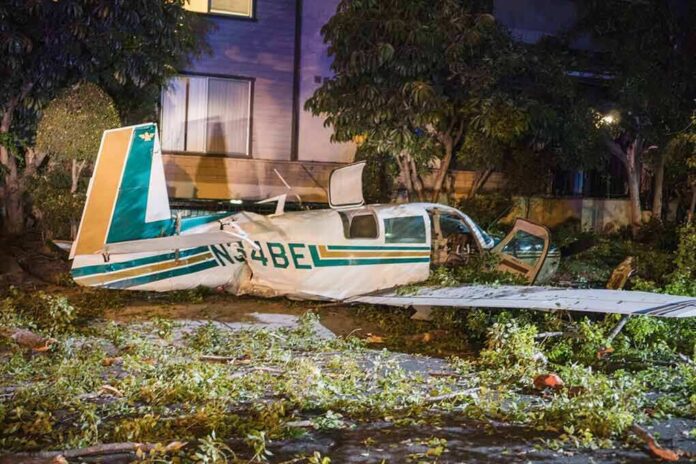
On an October night flight in eastern North Carolina, Dustin and Autumn Davis were cruising in a single-engine Piper PA-32 when the engine “wasn’t producing power,” as Davis later described. At roughly 6,000 feet above the ground, the couple worked through cockpit troubleshooting and contacted air traffic control for assistance, a disciplined response that preserves options and buys time. With thrust gone and darkness limiting off-field choices, Davis maneuvered toward a treed area and, seeing trunks fill the windscreen, pulled to a higher nose attitude at the last moment to reduce forward speed and put the most structurally robust surface—the belly—between occupants and the first contact. The aircraft struck trees that arrested its descent and left the fuselage suspended several feet above ground; the nose, photographs show, came to rest within inches of the soil. The couple and their two dogs exited with minor injuries. Reporters and station crews on scene detailed the improbable tableau: a largely intact fuselage perched over soft earth, wedged amid broken branches, not cratered into the ground.
The Federal Aviation Administration confirmed the airplane suffered mechanical trouble before contacting the trees—establishing the sequence as loss of power, glide, and treetop arrival rather than a navigational or spatial disorientation event. While outlets differed modestly on the precise cruise altitude reported and whether a larger or more pliant sapling performed the final arresting work, the core facts align: a single-engine power loss, a controlled descent to trees, a nose-high attitude at impact, and an outcome defined more by controlled energy management than by luck alone.
How survivable forced landings work: energy management beats heroics
A general-aviation “forced landing” is a landing compelled by loss of thrust or other urgent conditions, executed wherever the airplane can be put down under control. The fatality rate for forced landings is far higher than for precautionary landings—where a pilot decides to land before the situation deteriorates—but survivability hinges on familiar principles: fly the airplane all the way to touchdown, maintain control, keep the wings level as long as possible, and dissipate energy along a longer, controlled collision rather than a short, violent one. Authoritative training materials emphasize that even in rugged terrain, pilots can convert a crash into a survivable arrival by controlling attitude and speed, using the aircraft’s structure and available terrain—fields, brush, trees—to absorb energy progressively.
Trees are not a soft mattress, but in the right geometry they act as frangible energy absorbers, trading sudden deceleration for a sequence of smaller impacts—branches clipping wings, then the belly, then a flexible trunk bending and rebounding—each shaving off kinetic energy. Historical analyses and survival literature have documented relatively low fatality rates in tree-impact landings compared with hard-surface obstacles precisely because of this progressive crush and break sequence that spreads energy out in time and structure. That sequence appears consistent with the Davis aircraft coming to rest above ground, nose-low but intact, after an initial belly-first tree strike.
The role of a last-second flare: why “pulling up” matters
Pilots are trained to “flare” just before touchdown—raising the nose to arrest descent and reduce groundspeed. In off-field landings, especially into rough terrain or trees, a deliberate flare changes everything. A nose-high attitude shifts impact loads toward the main structure and belly and away from the cockpit footwell; it also increases the effective surface area contacting foliage and branches, amplifying the energy-shedding effect. Davis described seeing trees and pulling up at the final moment; separate accounts suggest that this allowed the fuselage belly to take the brunt rather than the nose or cabin. That choice is not theatrical; it aligns with well-established emergency-landing airmanship: aviate first, control attitude, trade speed for impact geometry, and let designed crush zones and sacrificial structures do their work.
Why engines quit: categories, not a single cause
“Engine failure” is a headline, not a diagnosis. In piston aircraft, power loss clusters into categories: mechanical failure (from internal component failure to accessory drive faults), fuel mismanagement (starvation or exhaustion), induction or ignition problems, and maintenance-induced errors. FAA risk guidance and safety briefings underscore that while engines can and do fail, the dominant fatal pathway remains loss of control, not the initial mechanical cause; pilots who keep the aircraft under control through the emergency markedly improve survival odds. Safety case studies and NTSB reporting show the spread: oil starvation from a failed bearing, improper maintenance leading to leaks or component interference, or accessory malfunctions cascading into partial power loss—all present differently but leave the same airmanship demand when the propeller no longer makes thrust.
In the Davis case, the FAA verified pre-impact mechanical trouble, and local reporting consistently characterizes a loss of power; the precise mechanism awaits the usual investigative work of the FAA and National Transportation Safety Board. That next phase typically includes engine teardown, fuel sampling, magneto and ignition checks, borescope inspections, and review of maintenance records to separate speculation from causation.
Night, workload, and the discipline of procedure
Nighttime compounds an engine-out emergency. Depth cues vanish, terrain options compress, and workload spikes as the pilot must diagnose, navigate, and configure while flying a precise best-glide profile. The disciplined sequence Davis described—run the checklist, attempt restarts, and get on frequency with air traffic control—matters because it creates order amid urgency. ATC can furnish headings to lower terrain, unlit strips, or roads, and can coordinate emergency services. Training syllabi and the FAA’s risk management material consistently emphasize this hierarchy: aviate, navigate, communicate—with checklists integrated but never ahead of aircraft control.
What this incident teaches, broadly
Three durable lessons emerge. First, control is the currency of survival. Pilots who resist the urge to “stretch the glide,” who maintain best-glide speed, and who use a final flare to shape the impact stand a far better chance of an outcome like the Davises’. Second, terrain is not binary good or bad; in many cases, a belt of trees can be a better energy sink than dark water, a road with traffic, or a rocky field. Survival analyses have long treated trees as a legitimate—sometimes preferable—choice for absorbing energy in a controlled arrival. Third, prevention still reigns. Engine monitoring, rigorous maintenance, and conservative fuel and route planning remain the best antidotes; most fatal accidents in general aviation still trace back to loss of control pathways, often following or intertwined with engine anomalies, which means the real work is done before takeoff and in the first seconds after a failure when discipline dictates the glide, not hope.
One proper caveat
Investigators will ultimately determine what precipitated the loss of power in this case; early reporting correctly reflects a power-loss emergency and a treetop landing with minor injuries, while the exact failure mechanism will come from FAA and NTSB findings when released.
Sources:
nypost.com, wsoctv.com, wwaytv3.com, foxsanantonio.com, aopa.org, us.headtopics.com, wral.com, faa.gov, journals.vilniustech.lt
© fixthisnation.com 2026. All rights reserved.