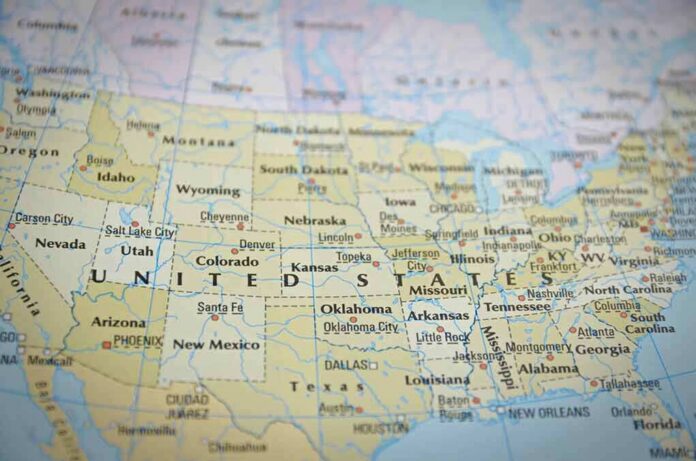
State names are not marketing slogans; they are legal identities, constitutional text, and living heritage—durable precisely because they anchor sovereignty, culture, and governance in one word.
The Short Version
- President Trump has urged New Mexico to “immediately” rename itself “New America,” arguing the change would add value and prestige to the state.
- There is no demonstrated legal pathway for a president to rename a U.S. state; New Mexico’s name is fixed in its own constitution and can only be changed through the state’s amendment process.
- No empirical economic evidence has been presented to substantiate promised gains in home values, incomes, or prestige from a state-name change.
- New Mexico officials across branches and levels of government have publicly rejected the proposal, framing the state’s name as a product of centuries of history and community identity.
What the proposal is—and isn’t
President Trump has repeatedly proposed replacing “New Mexico” with “New America,” framing the shift as a branding correction—New Mexico is not Mexico, and a name emphasizing America would, in his telling, raise the state’s standing and economic fortunes. The core claim is simple and direct; it is also unsupported by a legal mechanism or published analysis. Reporting on the president’s social-media statements records the asserted benefits, but identifies no studies, plans, or administrative follow-through translating an idea into an executable policy. The promise is rhetorical; the process and proof are absent in the material presented to the public so far.
Two questions therefore control any serious evaluation. First, can this be done—by whom and how? Second, would it work, measured against the costs and consequences of rebranding a state built around its existing name for centuries?
The law: who gets to name a state
States are not federal agencies; the federal government does not charter their identities. New Mexico’s name is not only longstanding usage, it is positive law inside the state’s foundational document. The New Mexico Constitution states, with unmistakable clarity, “The name of this state is New Mexico.” That lodges authority with New Mexico’s own constitutional amendment process, not with the White House. The state’s congressional delegation and governor have publicly stressed the same point: an executive order cannot amend a state constitution or alter a state’s legal identity; any change would have to move through New Mexico’s amendment pathway and voter ratification.
Press reporting has captured these constraints consistently: there is no presidential power to rename a state, and there is no federal statute that supplies one. To change the name, New Mexico would have to propose and pass a constitutional amendment through its legislature and place the change before the state’s electorate. That is not an academic nicety; it is how federalism works when foundational attributes—borders, names, charters—are at stake.
Economics and “value”: what evidence would be needed
Treat the renaming argument as a testable proposition: if the name “New America” adds value and prestige, where is the baseline and how would we measure lift? Real evidence would look like a comparative brand-equity study, tourism elasticity estimates, relocation and investment perceptions research, and property-market analyses controlling for confounders such as interest rates, energy prices, and regional growth cycles. None of that has been provided in the public record tied to this proposal. Coverage that quotes the promised upside also notes the absence of a study or plan showing how a change in toponyms would causally produce higher incomes or home values.
History offers caution. Jurisdictions that rebrand—cities consolidating, countries post-independence, regions after conflict—often do so amid structural change that itself drives economic outcomes, making “name effects” hard to isolate. For U.S. states, there is no credible base rate demonstrating that a wholesale rename yields prosperity. The administrative outlays alone—maps and signage, IDs and records, statutory and contract updates, federal-state data synchronization—run directly against any promised net gains without a compelling, documented countervailing benefit.
Identity, endurance, and why state names rarely change
State names persist because they braid together law, memory, and place. New Mexico’s name long predates statehood; the Spanish “Nuevo México” described the region centuries before admission as the 47th state in 1912. That continuity matters to residents who understand “New Mexico” not as a geographic confusion to be corrected, but as a civic identity spanning Native nations, Spanish colonization, territorial politics, and modern statehood. It is why current state leaders responded not just with a legal objection but with a cultural one: the name belongs to New Mexicans and to their constitutionally enshrined history, not to federal rebranding.
Officials have said the state will remain New Mexico, and they have acted in practical ways consistent with that stance—urging major mapping platforms to resist any informal changes that might muddy the state’s legal identity in digital maps and services. Their throughline is consistent: the name is fixed by state law and community inheritance, not federal preference or online rumor.
NEW MEXICO TO NEW AMERICA? PRESIDENT TRUMP WEIGHS IN:
President Donald Trump is making headlines with a bold proposal to rename the state of New Mexico to "New America."
"We are not Mexico, we are the United States of America! The name would add great value and prestige to the… pic.twitter.com/RHAXeiyom5
— JoSweet 🇺🇸🐊 (@Molnar_Politico) October 19, 2026
Process, not posts: what a real attempt would entail
If a renaming ever advanced beyond social media, the necessary dossier would be extensive. At minimum: a formal legal opinion detailing the precise state constitutional amendment steps and timelines; a full transition-cost audit for agencies, courts, licensing, elections, IT systems, and education; a coordinated federal-state implementation plan for treaties, compacts, grants, and data schemas that key on the state name; and, crucially, public-opinion research demonstrating popular consent. Absent these elements, the idea is not a policy—it’s a message. That distinction is not pedantry; it is the threshold between governance and branding.
Politics and reception
The proposal has landed in a polarized media environment where many interpret it as a diversion from substantive policy fights. That reaction is predictable, but it is also orthogonal to the dispositive issues here: authority and evidence. On authority, the counter-case is decisive; a president cannot rename a state, and New Mexico’s constitution says what the state is called. On evidence, the proponent case offers asserted benefits without empirical substantiation. In a system built on federalism and consent of the governed, those two deficits—power and proof—are determinative.
What endures
Names carry weight because they compress law, lineage, and lived experience into a single signifier. Changing one is not impossible—but for a state, it requires the people whose identity is bound up in the word to choose it, through their own constitutional machinery, with eyes open to costs and tradeoffs. Until and unless that occurs, New Mexico is New Mexico—by history, by law, and by the consent of New Mexicans.
Sources:
elpasotimes.com, thehill.com, foxnews.com, abcnews.com, kvia.com, nbcnews.com, upi.com
© fixthisnation.com 2026. All rights reserved.