President Trump’s precision strikes on Iran’s Kharg Island exposed the regime’s Achilles’ heel—a single location that handles 96% of the oil exports funding Tehran’s terrorism, regional militias, and nuclear ambitions.
Story Snapshot
- Kharg Island processes 96% of Iran’s crude oil exports—approximately 1.54 million barrels daily—making it the regime’s economic lifeline and primary funding source for the IRGC and regional proxies.
- US forces struck 90 military targets on March 14, 2026, obliterating Iranian missiles, radars, and drone facilities while deliberately sparing oil terminals to maintain stability and enable safe passage through the Strait of Hormuz.
- The island’s deep-water ports are irreplaceable due to Iran’s shallow coastlines, creating a single point of failure that could collapse the regime’s war economy if fully disrupted.
- Trump’s strategic approach demonstrates American resolve to secure global shipping lanes carrying 20% of the world’s oil while maintaining leverage over Tehran’s destabilizing activities.
Trump’s Strategic Strike Neutralizes Iranian Threats
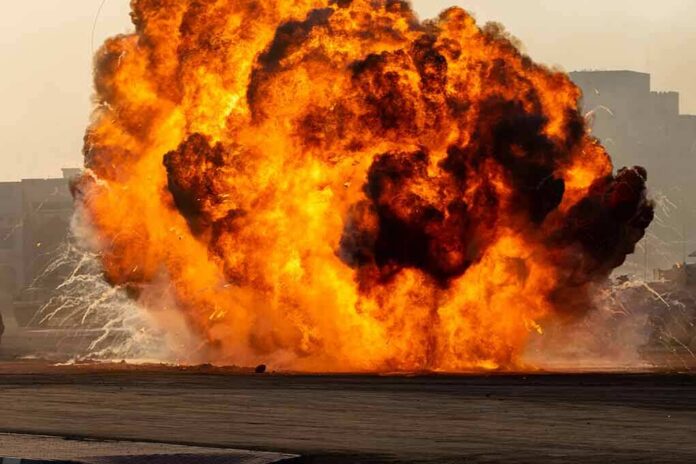
US Central Command executed precision bombing raids on Kharg Island early Saturday morning, March 14, 2026, targeting military infrastructure that threatened commercial shipping in the Strait of Hormuz. President Trump confirmed the operation obliterated every military asset on the island, including the IRGC Navy’s 112th Zolfaghar Brigade headquarters, coastal missile batteries, radar installations, and drone launch facilities. The strikes intentionally avoided oil export terminals, preserving Iran’s economic capability while eliminating threats to international commerce. This measured approach protects American interests and global energy markets while demonstrating overwhelming military superiority that Tehran cannot match.
The Island That Funds Iran’s War Machine
Kharg Island has served as Iran’s primary oil export terminal since 1960, handling between 90-96% of the regime’s crude exports throughout its operational history. Located 15-25 kilometers off the Bushehr coast and 480 kilometers northwest of the Strait of Hormuz, this five-mile-long facility features deep-water ports capable of loading very large crude carriers with up to two million barrels directly—a capability Iran’s shallow mainland coastlines cannot replicate. In 2025, the island processed 1.54 million barrels per day from a total export volume of 1.6 million barrels, with the vast majority flowing to China. This revenue stream directly finances the Islamic Revolutionary Guard Corps, regional terrorist proxies including Hezbollah and Hamas, domestic repression apparatus, and Iran’s nuclear weapons program.
Geographic Vulnerability Creates Strategic Opportunity
Energy analysts at Kpler confirm Kharg Island’s geography makes it simultaneously indispensable and vulnerable—a strategic reality that gives America significant leverage over the Tehran regime. The island sits within easy reach of US naval and air forces while remaining isolated enough for complete military control if required. Pipelines from Iran’s major oil fields converge at Kharg because no alternative deep-water loading facility exists along Iran’s Persian Gulf coastline. Security expert Amir Handjani from the Quincy Institute notes that a full attack disabling the terminals would take 90% of Iran’s exports offline immediately, collapsing revenue for the IRGC and potentially triggering domestic unrest as the regime loses its primary funding mechanism.
Protecting American Interests and Global Commerce
The Strait of Hormuz carries approximately 20% of the world’s oil supply, making its security vital to American economic interests and global stability. Prior to the March 14 strikes, Iran stationed fast-attack boats armed with anti-ship missiles and mines on Kharg Island, alongside Army Navy patrols and coastal defense systems that threatened commercial tanker traffic. The IRGC used these asymmetric warfare capabilities to intimidate international shipping and extort concessions from Western powers. By dismantling this military infrastructure while preserving oil facilities, President Trump ensured safer passage for commercial vessels and enabled US forces to conduct minesweeping operations without Iranian interference. Trump warned that any Iranian retaliation would result in strikes on the oil terminals themselves, demonstrating the conditional nature of America’s restraint.
The operation showcases how decisive American military action protects constitutional principles of free commerce and navigation while maintaining global energy stability. Unlike the previous administration’s appeasement policies that emboldened Tehran through sanctions relief and pallet-loads of cash, Trump’s approach leverages American strength to impose consequences for Iranian aggression. Control over Kharg Island’s operational status gives the United States unprecedented leverage to redirect Iranian oil flows away from hostile Chinese Communist Party purchases toward Western markets, potentially fracturing the axis of authoritarianism that threatens free nations. This strategic advantage undermines the regime’s ability to fund terrorism and nuclear development while protecting American allies in the Gulf region from Iranian retaliation capabilities.
Sources:
Why Iran’s Kharg Island is central to Strait of Hormuz security – Iran International
Kharg Island: Iran’s Financial Oxygen and Strategic Vulnerability – The Jerusalem Post
Kharg Island and Trump’s Strategic Calculus – TIME
Why Kharg Island is the Backbone of Iran’s Oil Economy – Kpler
Why Kharg Island is Vital to Iran and the Global Economy – Euronews
Kharg Island: What to Know About Iran’s Critical Oil Hub – CBS News
The Strategic Value of Kharg Island – Policy Magazine