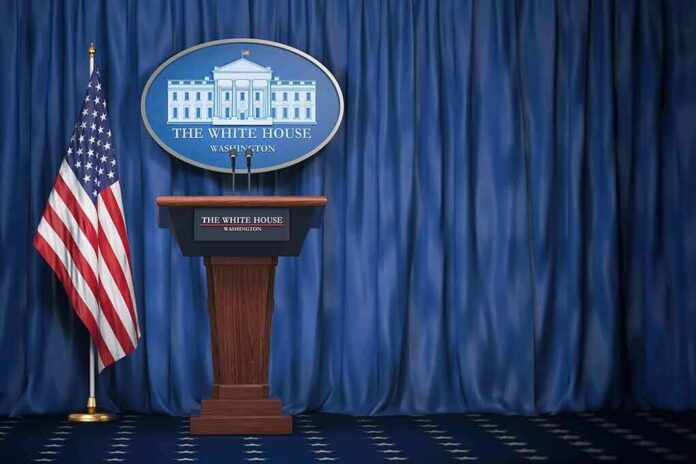
The fight over who gets to stand inside the White House briefing room is not a spat about seating charts; it is a recurring constitutional stress test that asks whether government can condition newsgathering access on favorable coverage, or whether the First Amendment’s protections restrain that impulse even in spaces the Executive tightly controls.
The Short Version
- President Trump publicly tied a ban on CNN, MS NOW, and Politico to what he called “fake news,” framing it as immediate and categorical.
- Press-freedom groups and the outlets called the move unconstitutional retaliation for coverage, signaling litigation to restore access.
- Courts have long held that when the White House opens a press forum, it cannot exclude by viewpoint and must provide due process; recent cases refine how far that rule reaches into highly restricted spaces.
- The evidentiary basis for the “fake news” rationale and for claims about Politico’s alleged government funding was not produced in contemporaneous reporting.
What happened, and why it matters
In a public post, President Trump said he was banning CNN, MS NOW, and Politico from the White House because they “report fake news,” language he has used for years to signal what he regards as systemic bias. Major outlets reported the White House was informing the three organizations that access would end on a set date and that at least some journalists were subsequently denied entry, suggesting the edict was not merely rhetorical. The stakes are larger than a turf dispute: White House access is the logistical gateway to independent observation of the presidency — pool sprays in the Oval Office, departures on the South Lawn, quick-turn questioning that can’t be replicated from a bureau across town. When the government opens that gateway to some, constitutional law sharply limits closing it to others for their viewpoint.
Trump’s announcement also carried a broader accusation — that these outlets “purposely write negative news” to diminish Republicans — and an unsubstantiated claim that the Biden administration kept Politico “afloat” with $8 million. The first goes to motive; the second, to purported financial contamination. Neither, standing alone, supplies legal authority to bar an outlet from a government press forum. And contemporaneous reporting did not include contracts, audits, or a policy record substantiating those assertions.
The legal framework that actually governs press access
Two doctrinal pillars have anchored White House press access for nearly half a century. First, when the Executive creates a system of press credentials or otherwise opens working spaces to journalists, it constructs a limited public forum; access rules there must be grounded in explicit, meaningful standards and applied without viewpoint discrimination. Second, even in that constrained environment, due process attaches: the government must provide notice and an opportunity to respond before revoking a credential. Those principles animated the district court’s order restoring CNN correspondent Jim Acosta’s pass in 2018 and were restated in later rulings addressing access limits during Trump’s second term.
Recent litigation adds nuance. Courts have recognized that the White House may exercise tighter control over highly restricted venues — the Oval Office in particular — than over the broader campus or briefing facilities. One divided appellate ruling credited broader presidential discretion for specific, cramped settings; at the same time, district and appellate opinions have reiterated that once the government “opens its doors to some journalists,” it cannot shut them to others because of viewpoint, and that credential processes require procedural safeguards. This is the terrain on which any ban of entire outlets — especially when justified by their editorial stance — immediately runs into constitutional headwinds.
Mechanics, precedent, and the difference between rhetoric and enforceable policy
White House access is layered. The hard pass or its successor credential governs routine entry to the grounds and workspace. Pool access determines which reporters rotate into cramped events, like an Oval Office spray. Event-specific credentials gate high-demand moments — joint pressers, bill signings. An administration can, within limits, adjust pool composition or manage space-constrained events. What it cannot do is weaponize those levers to punish disfavored coverage. That is not a matter of press “privilege”; it is a constitutional constraint born of prior practice and judicial oversight.
In prior clashes — Acosta’s revocation and the Associated Press access fight — courts scrutinized the stated rationale, the process afforded, and whether the government’s criteria were genuinely neutral. Where those elements were absent or pretextual, the government lost ground and was ordered to restore access, at least pending fuller litigation. Those cases supply the operative checklist here: is there a written policy and record; were individualized reasons provided; was notice and an opportunity to respond given; and does the rationale rest on conduct and capacity, or on viewpoint?
Evaluating the stated justifications
Trump’s explanation rested on the repeated assertion of “fake news,” coupled with a claim of coordinated negativity. In constitutional terms, that is a viewpoint critique; it does not transform coverage into unprotected speech. Government may, of course, respond to or rebut reporting — that is counterspeech — but withdrawing access because coverage is critical is precisely the kind of retaliation courts have proscribed in limited public forums. The claim that Politico received an $8 million government subscription, if supported by verifiable procurement records, would raise a different set of questions; however, contemporaneous accounts did not supply those records, leaving the allegation as an unsupported premise rather than a policy basis.
The White House’s implementation posture also matters legally. Reports at the time indicated a lack of published credential rules or process changes accompanying the announcement, mixed signals about immediate enforcement, and instances of selective denial. Ambiguity is not merely a communications flaw; it undercuts due process and increases the likelihood that any exclusion will be read as arbitrary or retaliatory rather than rule-bound.
Where the real disagreement lies
There is no dispute that presidents retain broad authority over access to the most restricted rooms and that space constraints necessitate curation. The disagreement is about motive and method. The administration framed the ban as discipline for false reporting; the affected outlets and press-freedom advocates called it unconstitutional retaliation that chills coverage and deprives the public of independent observation. Courts have historically treated motive as dispositive: if viewpoint drives exclusion, it fails. If neutral, published criteria tied to security, capacity, or demonstrable misconduct drive it — and are applied with process — the government often prevails in the most constrained spaces. That is why the evidentiary record and the administrative paper trail, not social media rhetoric, determine outcomes in court.
What to watch next — and why it will outlast this episode
Three practical questions will decide how this chapter ends and shape future presidencies. First, is there a formal, published policy with explicit, viewpoint-neutral standards that the White House is actually using to administer credentials and pool assignments? Second, is there a documented administrative record — notices, incident reports, correspondence — that explains individualized decisions, including any revocations, and shows due process? Third, do exclusions target entire organizations for editorial stance, or specific individuals for conduct-based, provable reasons? If the answers mirror prior episodes — ad hoc justification, scant process, viewpoint-driven rhetoric — courts are likely to order restoration of access for general facilities while preserving some presidential discretion over the tightest spaces.
Sources:
abcnews4.com, aljazeera.com, nytimes.com, latimes.com, cnbc.com, reuters.com, apnews.com, usatoday.com, axios.com, yahoo.com, npr.org, natlawreview.com
© fixthisnation.com 2026. All rights reserved.