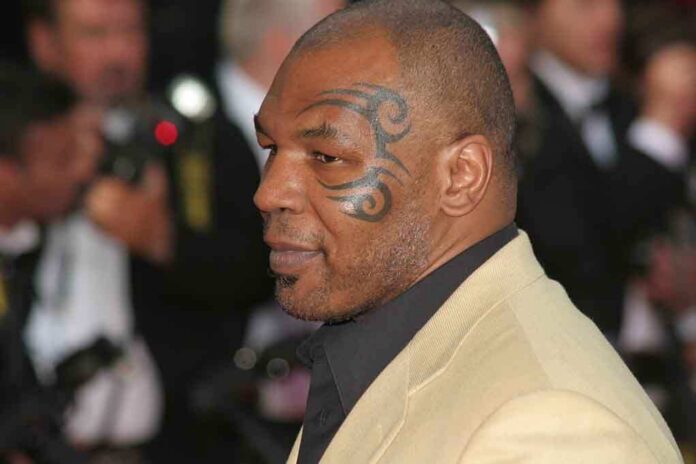
Mike Tyson’s prediction that “Trump is going to win” landed not as an electoral model but as a high-visibility campaign cue delivered from the most symbolically potent media room in American politics—the White House briefing room—and then amplified at a rally in upstate New York.
At a Glance
- Tyson told reporters in the White House briefing room that he thinks “Donald Trump will win,” ahead of traveling with the president to a Syracuse rally.
- The appearance reflected Tyson’s active association with Trump; he joined the president publicly and was introduced onstage at the rally.
- The remark referenced midterm stakes even though Trump himself was not on the ballot, underscoring the ambiguity common to celebrity political predictions.
- Political science suggests celebrity endorsements are reliable attention engines but inconsistent vote-movers; exceptions exist when the celebrity’s influence aligns tightly with voter identity and context.
What Happened: A Celebrity Cue Delivered from the White House to the Rally Stage
On October 9, 2026, Mike Tyson stepped to microphones in the White House briefing room and, asked how Republicans would fare in the midterms, replied that he believed Donald Trump would win. Multiple outlets situated the exchange in the West Wing and described Tyson’s plan to travel with the president to a Syracuse campaign rally focused on Trump-aligned candidates. The Hill quoted Tyson’s formulation as “I think Donald Trump will win,” while other reporting captured the sentiment as “I believe Donald Trump is going to win”—a minor wording variance with no consequence for the core claim that he issued a confident, on-camera prediction in that setting.
The appearance was not a one-off soundbite. Associated Press coverage the same day described Trump presenting Tyson publicly before departure and emphasizing their long friendship—context that matches Tyson’s decision to continue with the president to New York. Video coverage from the following day shows Trump spotlighting Tyson at the Syracuse rally for gubernatorial candidate Bruce Blakeman, further linking the prediction to a mobilization event designed to lift Trump-endorsed Republicans.
Interpreting the Claim: What “Trump Will Win” Meant in a Midterm Cycle
The words were simple; the referent was not. Trump was not on any ballot that November, and the Syracuse event centered on a Republican slate—most prominently Blakeman’s run for governor—so Tyson’s formulation relied on Trump as political metonym more than candidate. In practical terms, the line likely gestured at a hoped-for Republican sweep, control of Congress, or success by Trump-backed contenders in contested races. Contemporary write-ups flagged the ambiguity plainly, noting Tyson offered no polling, race-by-race analysis, or rationale beyond the endorsement sentiment itself.
That imprecision is characteristic of celebrity participation in partisan events: the endorsement is the message. In a rally frame, the function of such a statement is not to litigate crosstabs but to animate identity, signal in-group cohesion, and feed newsworthy imagery back into the campaign’s media ecosystem. That Tyson made the prediction at a White House lectern further heightened the signal—the symbolism of venue doubling the coverage value even before the Syracuse crowd reaction compounded it.
Mechanism: Why Celebrity Endorsements Persist and What They Actually Do
Campaigns invite stars because attention is scarce and expensive; a recognizable figure crowds in spectators, press, and social spillover. The literature on celebrity political endorsements is clear on two points. First, the modal effect is visibility and partisan signaling rather than systematic persuasion of opposing or undecided voters. Reviews and experiments have often found limited or conditional vote-choice impact, particularly when the endorser and audience lack a preexisting affinity or when the endorsement clashes with prior partisan identity. Second, exceptions exist when an endorser’s brand is unusually trusted, culturally salient to targeted voters, or tightly coupled with the campaign’s narrative.
The canonical outlier is Oprah Winfrey’s 2008 primary endorsement of Barack Obama, which rigorous analysis linked to measurable increases in votes, contributions, and turnout—an effect arguably rooted in Oprah’s unparalleled parasocial credibility with Democratic primary audiences at that moment. Most endorsements, however, operate as mobilization and media devices: they enliven events, broaden reach, and harden in-group enthusiasm without reliably converting skeptics. Tyson’s role in the Syracuse swing fits the dominant pattern. The point was to headline the rally, badge the ticket with a beloved sports figure, and deliver cut-through coverage during a crowded news cycle.
Context: Tyson, Trump, and the Uses of Association
Tyson’s relationship with Trump predates the current political era; Trump reminded the press of that fact before their New York departure. That history matters because it reframes the moment from transactional endorsement to longstanding association—audiences tend to discount scripted signalers and register authentic personal ties differently. For the campaign, the value of a figure like Tyson is twofold. He reliably attracts attention across demographics that do not always track political news, and he confers a non-political identity marker—toughness, comeback, icon status—onto a partisan stage. The Syracuse coverage captured precisely that play: the boxer as rally accelerant, the president as master of ceremonies, the statewide ticket absorbing the surplus attention.
Even so, the political content of Tyson’s prediction remained minimal. He offered no claim about Senate seat counts, House margins, or New York’s statewide map. Outlets that highlighted the mismatch between the phrasing and the ballot were not contesting the fact of his statement; they were clarifying its scope. That distinction keeps the episode in proper scale: it was a celebrity cue in a campaign environment, not an evidence-backed forecast with falsifiable specifics.
Why the Venue Matters: The Briefing Room as Message Multiplier
The White House briefing room is a signal amplifier. Remarks made there, even informally, carry an implied official gravity and guarantee press attention. By positioning Tyson’s Q&A in that space before a rally, the operation yoked institutional symbolism to campaign theatrics. The choreography ensured that his one-line prediction would travel: from pool notes and political outlets to rally clips and local coverage of the statewide race. The next-day onstage acknowledgement in Syracuse closed the loop—what began as a soundbite in Washington became a lived moment for thousands and, via video, for far more.
Strategically, this sequencing is textbook: create a pre-event media peg, execute an event with marquee visuals, and harvest the post-event highlights for broader distribution. Whether such sequencing shifts votes is secondary to its core deliverable—agenda-setting oxygen.
What to Watch When Celebrities Campaign
For readers calibrating substance against spectacle, three filters help. First, specificity: does the endorser articulate a testable claim tied to particular races or margins, or offer policy reasoning that can be weighed? Tyson did not, placing his comment firmly in the symbolic tier. Second, alignment: is the celebrity’s audience congruent with the campaign’s target universe? Tyson’s broad sports fame may aid reach, but partisan conversion generally demands more than name recognition. Third, integration: does the campaign build consistent messaging around the appearance, or does it stand alone as a headline burst? The Syracuse rally integration—introduction from the stage, aligned slate, and local press pickup—reflects purposeful use of the moment.
Mike Tyson is great – not sure why Trump convinced him to give an endorsement but probably wrote him a check
— Journal Court 🇺🇸 🇨🇦 (@journal_court) October 10, 2026
Bottom Line
Mike Tyson told reporters at the White House that “Trump is going to win,” then accompanied the president to Syracuse, where he was showcased at a rally for Trump-aligned candidates. The claim was unambiguous as a show of support and deliberately vague as an electoral proposition. It functioned as designed: a celebrity cue that extended the campaign’s reach, energized a rally, and generated coverage. The research record on such cues is consistent—reliable at producing attention, uneven at changing votes—with rare exceptions when celebrity trust, timing, and audience match align unusually well.
Sources:
thegatewaypundit.com, thehill.com, apnews.com, thedailybeast.com, yahoo.com, foxnews.com
© fixthisnation.com 2026. All rights reserved.