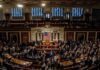
When the nation’s campaign-finance referee cannot vote, the rules still exist—but the whistle is silent. The Federal Election Commission’s prolonged lack of a quorum has converted a law-enforcement agency into a record-keeper at the precise moment transparency and deterrence are most needed.
At a Glance
- The FEC has operated without a quorum since May 1, 2025; core enforcement and policymaking functions are suspended.
- By statute, at least four commissioners must agree to initiate investigations, levy penalties, issue advisory opinions, make rules, or defend certain lawsuits.
- Staff continue to collect, process, and publish disclosure reports; the law remains in force and can be enforced once a quorum returns.
- This is a recurring governance failure: the FEC has lost quorum before (2008; most of 2019–2020), resuming full operations only after Senate confirmations.
What “no quorum” actually disables—and what it doesn’t
Federal law designs the FEC to be bipartisan and deliberative: six commissioners, no more than three from the same party, and a supermajority requirement of four affirmative votes for the most consequential acts. That supermajority is the pivot. With fewer than four sitting commissioners, the agency cannot open or close enforcement matters, approve conciliation agreements or civil penalties, issue binding advisory opinions that campaigns and donors rely on for compliance, promulgate or revise regulations, or authorize and defend certain litigation in court. Those are the functions that give campaign-finance law teeth.
None of this means the law evaporates. The disclosure regime persists; committees still file reports, data still flow to the public, and career staff keep the machinery of intake, audit prep, and compliance assistance running. The Congressional Research Service is explicit: operations do not cease when the quorum is lost; they narrow. Once a quorum is restored, the commission can pick up investigations where staff work has laid groundwork and can enforce against violations that occurred during the gap. The public shorthand—“the FEC can’t enforce the law”—conveys the core problem but oversimplifies a partial, procedural incapacity into a shutdown. The agency is hobbled, not dead.
How the FEC landed here (again)
The Federal Election Campaign Act (FECA) anticipates a six-member commission, but it does not guarantee it. Commissioners are nominated by the President and confirmed by the Senate; vacancies or departures, combined with delayed confirmations, can drive the body below the four-vote threshold. According to the Commission’s own April 30, 2026 statement, it lost quorum on May 1, 2025 and has remained without it for a year—now the longest such lapse in the agency’s half-century history. Court filings from the Commission during this period have had to acknowledge that the body lacked the four votes necessary to authorize investigations or defend certain actions, underscoring that this is not mere optics but a legal constraint baked into FECA’s supermajority rule.
There is precedent. The FEC lost quorum for six months in 2008 and again for much of the 116th Congress: from September 2019 into 2020, with a brief restoration followed by another lapse, until confirmations on December 9, 2020 reconstituted a policymaking quorum. Each episode followed the same script: departures reduce the roster; nominations lag; the Commission signals what it can and cannot do; staff keep the lights on; and normal enforcement resumes only after the Senate seats new commissioners.
Mechanics and consequences: deterrence delayed is sometimes deterrence denied
The core enforcement architecture under FECA is sequential and formal. A complaint is filed or a matter is generated internally; the Commission must find “reason to believe” a violation occurred to open an investigation; subpoenas or voluntary information requests follow; findings can culminate in conciliation (settlement) or civil penalties; the Commission may file suit to enforce the statute. Each stage requires formal votes. Without a quorum, the pipeline clogs at step one: no votes, no investigation—and certainly no penalties.
Why that matters is not theoretical. Disclosure without the credible prospect of timely enforcement can turn into an after-action archive rather than a compliance discipline. Large committees and sophisticated donors track risk. If they read the Commission as structurally unable to authorize investigations for months on end, the incentive to stretch ambiguous rules or to gamble on late-cycle tactics increases. The Commission’s own Inspector General has previously flagged the supermajority requirement as a fragility point; when vacancies or stalemates prevail, the statute’s four-vote gate becomes a choke point for everything from audits to litigation referrals.
What continues during a quorum lapse—and where the limits bite
Three functions keep value flowing even in a quorum drought. First, disclosure: committees continue to report receipts and disbursements; those filings become public on schedule. Second, compliance assistance: staff answer questions, publish guidance keyed to existing rules, and update technical resources to help filers avoid mistakes. Third, administrative preparation: attorneys and analysts review complaints, triage matters, and compile records so that, if and when commissioners return, cases can be presented efficiently for votes.
The limits are equally clear. No new advisory opinions can issue—a problem for campaigns and vendors navigating novel technologies or financing arrangements. No new rules can be adopted to address emerging practices. No formal votes on enforcement mean no subpoenas, no conciliation agreements, no civil penalties, and constrained posture in certain court actions. In short, the Commission’s interpretive and coercive powers are sheathed until four commissioners can agree to unsheathe them.
🚨 THE $20 MILLION RETREAT: TRUMP REVERSES COURSE ON TAXPAYER-FUNDED TV BLITZ, ANNOUNCING HIS SUPER PAC WILL PAY FOR ADS AFTER BIPARTISAN FURY & LEGAL THREATS! 🚨
A sudden, high-stakes retreat over executive media spending has unfolded inside the West Wing just weeks before the… pic.twitter.com/gchEJUfhY4
— Boardroom Patriot (@nwmsound) October 6, 2026
Design tradeoffs: bipartisan guardrails versus operational brittleness
The FEC’s supermajority is a conscious design to require bipartisan consensus before the federal government polices political speech and money. That guardrail protects legitimacy in a domain where partisanship is the water we swim in. The tradeoff is brittleness: the same consensus rule that legitimizes enforcement also makes it easy to disable by attrition or delay. CRS has documented this pattern across episodes; each time, the law remains on the books and can be enforced retroactively, but the real-time deterrent effect erodes and confidence in evenhanded oversight wanes.
There is no mystery about the remedy. The Constitution gives the President the nomination power and the Senate the confirmation power. When both are exercised promptly, quorum is restored and the Commission’s full authorities switch back on—exactly what happened in December 2020, when three confirmations ended a prolonged lapse. Absent that, staff will continue to do what they can: keep the data flowing, preserve the administrative record, and prepare matters so there is something to vote on when four votes exist again.
Practical guidance for campaigns, committees, and donors right now
For regulated actors, the safest assumption is that today’s disclosure obligations and substantive limits apply as if the Commission were fully operational—and that tomorrow’s Commission can enforce yesterday’s violations. Treat advisory questions conservatively; there is no board to bless edge-case innovations mid-cycle. Document internal compliance decisions; the paper trail you keep now is the best defense when votes return. And remember that the Department of Justice’s criminal jurisdiction over willful, knowing violations under FECA is unaffected by the FEC’s administrative quorum; criminal law is not on pause.
Sources:
cbsnews.com, fec.gov, stateandfed.com, congress.gov, sgp.fas.org
© fixthisnation.com 2026. All rights reserved.