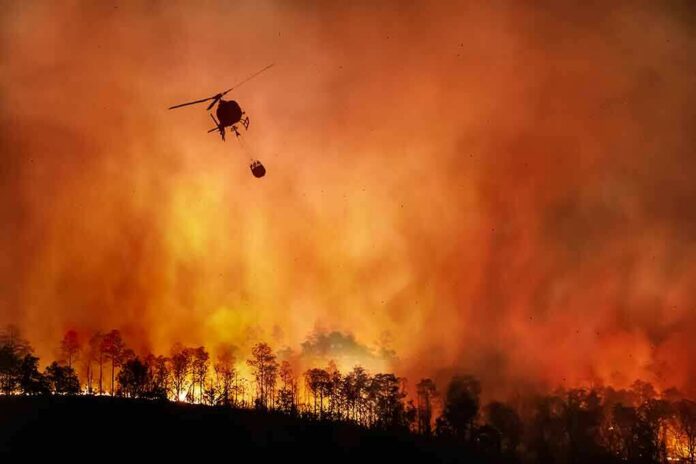
When a wildfire turns the sky into a furnace, the last line between flame and community is often a helicopter crew flying low, heavy, and precise—work so unforgiving that when something goes wrong, it goes wrong fast. That is why the public language after such a loss tilts, correctly, toward duty and valor: it captures both what was at stake and what these pilots chose to do.
The Short Version
- Ryan Cutter and Greg King were identified as the two pilots killed when a firefighting helicopter crashed while attacking the Dome Fire in Yosemite National Park.
- Their employer and firefighting agencies honored their deaths as service and sacrifice, with formal processions and community tributes.
- Cutter’s widow has led public remembrances, emphasizing his compassion, professionalism, and love of the mission.
- As with all aviation accidents, the technical investigation timeline spans months to years; tributes arrive immediately while the causal record develops.
What Happened: A Loss in the Line of Duty
Two contract pilots, Ryan Cutter and Greg King, were killed when their helicopter went down while supporting suppression efforts on the Dome Fire in Yosemite National Park. Their employer publicly confirmed their identities and framed the loss in the language familiar to aerial firefighting—grief, pride, and the gravity of service. The facts here are not contested: the aircraft crashed during an active firefighting mission; both pilots died; agencies and communities organized honors and processions in the days that followed.
Public memorials unfolded quickly. Firefighters, law enforcement, and local residents lined routes for a dignified transfer and later processions. Coverage out of California and the Mountain West chronicled an honor guard’s careful choreography and the solidarity of first responders escorting the fallen along airport tarmacs and regional highways—a ritual that functions as both tribute and testimony to the work’s risks.
The Human Center: A Widow’s Tribute
Cutter’s wife, speaking in multiple interviews, described a man whose professional identity fused flight skill with a firefighter’s ethic—compassionate, steady, committed to the mission, and unmistakably in love with the work. Her language has resonated because it is specific rather than generic: she recounted the care with which the firefighting community received her family, and she asked the public to remember who her husband was, not just how he died.
For families, these public tributes are not pageantry; they are infrastructure. Honors confer recognition, organize support, and knit private grief into a civic vocabulary. Fundraising, peer support, and survivor networks often surge in the days after such ceremonies, catalyzed by the concentrated attention that memorial coverage brings.
How Aerial Firefighting Works—and Why It’s So Demanding
Rotary-wing firefighting is a discipline of margins. Crews fly at low altitude in variable density altitude, where hot, thin air saps rotor efficiency and payload; they navigate terrain that funnels wind, seeds turbulence, and obscures visual cues with smoke; they operate near other aircraft on compressed time, cycling water or retardant drops to match fire behavior. The job blends precision airmanship with incident command discipline, because safety rests on choreography—airspace deconfliction, drop sequencing, and tight radio work—against a fire that is itself changing minute to minute.
When an accident occurs, causes rarely collapse to a single point of failure. Helicopter events tend to implicate a chain: mechanical condition and maintenance history, loading, weather and visibility, crew duty cycles and fatigue management, mission pressure, and real-time decision-making. That is precisely why the investigative process is methodical and long by design.
What Investigators Do—and Why It Takes Time
In any U.S. civil aviation crash, the National Transportation Safety Board (NTSB) leads the technical investigation, with the Federal Aviation Administration playing a supporting role. The sequence is well-defined: notification, on-site evidence collection, component examinations, analysis, and a final report that includes probable cause and any safety recommendations. Preliminary factual summaries typically publish within weeks, but final determinations often require 12–24 months, especially when metallurgy, teardown analysis, or human factors reviews are involved.
The length is not bureaucratic drift; it’s how causal chains are proven rather than guessed. High-profile helicopter cases have routinely followed this arc, with final findings emerging about a year or more after the event, often bundled with concrete recommendations to manufacturers, operators, and regulators to mitigate the specific pathways that led to loss of life.
Why “Heroic Service” Isn’t Just Rhetoric
In the immediate aftermath of a line-of-duty death, public institutions and employers lean into honor language. Some critics, in other contexts, have worried that memorialization can blur accountability. But in aerial firefighting’s culture, “hero” is not a marketing reflex; it is a lived description of a risk calculus that most pilots could explain in crisp operational terms. Flying repeated low-level water drops in hot, smoky, complex terrain is not an abstraction. It is a series of brief exposures to compounded hazards that you accept because the mission—holding a line, protecting crews on the ground, buying time for an evacuation—matters.
In this case, the public record shows alignment more than spin: the employer acknowledged loss and sacrifice; incident teams and local communities staged processions; and the widow’s own words anchored the narrative in character and calling. Those elements cohere because they are describing the same thing from different vantage points—organizational, communal, and familial.
What Comes Next: Process, Learning, Legacy
Over the coming months, the technical investigation will do its work. The goals are pragmatic: identify what failed, map how the chain assembled, and translate insight into practice—whether that means maintenance directives, training adjustments, operational limits under specific density-altitude conditions, or changes in incident airspace procedures. This is how aviation improves: not by rhetoric but by codifying lessons and then verifying they stick, a cycle the NTSB and FAA have iterated across thousands of cases over decades.
For the families and colleagues of Ryan Cutter and Greg King, legacy has a second dimension. It lives in the people who took the time to bear witness—lining a route, standing at attention, or telling a story that captures a human being rather than a headline. It also lives in the crews who will strap in next season, flying the same profiles with one more piece of knowledge in the briefing because an investigation extracted it from tragedy. That dual legacy—remembrance and improvement—is the sober compact at the heart of public-risk professions.
Alaska honors fallen firefighter Greg King
On September 29, 2026, the Honor Guard processed from Anchorage to Palmer, carrying home Alaskan wildland firefighter and pilot Greg King, who died while fighting the Dome Fire in Yosemite, California. A contracted Super Puma helicopter… pic.twitter.com/y7sFZwX45z
— Must Read Alaska (@MustReadAlaska) September 30, 2026
Bottom Line
Two pilots died doing work that demands both nerve and competence, in service of a mission that keeps communities and fellow firefighters safer when the landscape burns. Their names—Ryan Cutter and Greg King—now anchor a story told in honor guards and in hangars, in family eulogies and, eventually, in the footnotes of a safety recommendation that may keep another crew alive. That is not sentimentality. It is how meaning is made, and how risk work advances, one hard-earned lesson at a time.
Sources:
nypost.com, abc7chicago.com, thenewsapi.com, abc4.com, ksl.com, sierranewsonline.com, parkrecord.com, accuweather.com, ntsb.gov, apnews.com, sacbee.com
© fixthisnation.com 2026. All rights reserved.