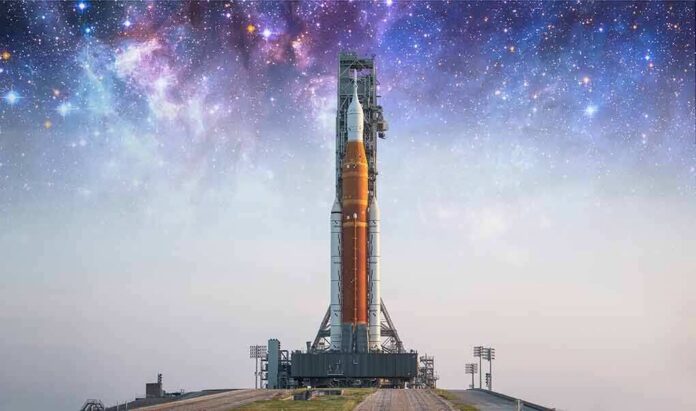
South Korea’s fifth Nuri launch wasn’t just another liftoff; it was a systems demonstration that moved the country from proving a rocket to operating one—fifteen satellites deployed on a homegrown vehicle, on a schedule set and executed domestically, in a sun-synchronous orbit that underpins real services, not just headlines.
At a Glance
- Nuri’s fifth mission lifted off from Naro Space Center carrying 15 satellites toward a 575-kilometer sun-synchronous orbit.
- The payload mixed five NEONSAT microsatellites with 10 CubeSats—South Korea’s first domestically launched microsatellite constellation effort.
- The flight formalized a public-private operating model, with KASA/KARI leadership and industry execution.
- The mission capped a measured program arc from an early shortfall in 2021 to reliable multi-satellite deployment.
What flew: the payload, the orbit, and the mission profile
The fifth Nuri mission launched from the Naro Space Center’s second pad at 12:25 p.m. local time, aiming for a sun-synchronous orbit near 575 kilometers—an altitude band favored for Earth observation because it preserves lighting conditions across passes, essential for change detection and rapid mapping. The payload manifest was unusually dense for a national launcher at this maturity: five NEONSAT microsatellites designed to form the backbone of a domestic constellation for safety and monitoring, plus 10 CubeSats contributed by universities and research groups. The combined mass was reported around 1,071 kilograms, the heaviest yet for Nuri and a meaningful proof of capacity for the KSLV‑II platform.
Reports from Korean outlets and wire services are consistent on the mission’s central facts: liftoff timing, pad, orbit class, and the 15-satellite count, with agency attribution to the Korea AeroSpace Administration (KASA) and the Korea Aerospace Research Institute (KARI). Coverage framed the flight as a complete mission—ascending to the target orbit and deploying the full payload complement in sequence—aligning with the program’s published objective for this outing.
How Nuri works: the KSLV‑II architecture and why sun-synchronous matters
Nuri (KSLV‑II) is a three-stage, kerosene–liquid oxygen launch vehicle built entirely with domestic technology, a deliberate break from the imported engine heritage of South Korea’s earlier Naro-1. The first stage clusters four 75‑ton-class engines, the second stage flies a single engine variant, and the third stage provides the precise orbital insertion burn. This architecture—clustered thrust, staged combustion, and a dedicated orbital stage—places Nuri squarely in the mainstream of modern medium-lift design. The mission’s target, a sun-synchronous orbit (SSO) near 575 kilometers, trades altitude against revisit and illumination; for civil safety and high-cadence imaging, SSO is the workhorse regime, enabling NEONSAT to tile the peninsula multiple times per day with predictable shadows and comparable radiometry.
The deployment sequence for a “rideshare” of this size is nontrivial. Each separation event must be timed to avoid plume impingement, minimize collision risk, and prevent radio interference during early acquisition. Preflight briefings referenced staggered releases in regular intervals, followed by depletion burns and collision-avoidance maneuvers—now standard practice for responsible constellation deployment. The reported completion of these steps marks a shift in program focus from proving propulsion to demonstrating traffic-aware, multi-payload operations.
How the program got here: from early shortfall to operational rhythm
Program arcs matter. Nuri’s first orbital attempt in October 2021 reached its intended altitude but fell short on orbital velocity when the third-stage engine shut down early—an outcome that underscored how demanding the final meters per second can be and how little margin exists for pressure-fed systems and burn timing errors at insertion. Engineers traced the shortfall to premature engine cutoff, a failure mode consistent with pressurization or valve behavior at altitude, and then iterated. Subsequent flights tightened performance and reliability, building toward this mission’s heavier, multi-satellite loadout—a step change from launching a single primary spacecraft to managing a manifest of 15 with precise phasing.
In parallel, South Korea retooled its institutional machinery. KASA and KARI expanded roles from development and test toward cadence and commercial interface, while industry—most prominently Hanwha Aerospace—assumed deeper responsibility in production and launch operations, mirroring the global playbook that moves national programs from bespoke engineering to repeatable service. That governance shift, highlighted in pre- and postlaunch statements, is as consequential as any engine upgrade because it determines throughput, cost, and schedule credibility for future missions.
Why this flight’s payload mix matters: NEONSAT and the rideshare ecosystem
The NEONSAT cluster is the centerpiece. A microsatellite constellation launched domestically signals that South Korea intends to source not just the bus and the ground segment but also the launch slot from within its own industrial base—a strategic hedge against crowded manifests on foreign rockets and shifting geopolitical access. Operating in SSO, NEONSAT targets national safety missions: disaster response, maritime domain awareness, and infrastructure monitoring, where latency and sovereignty over tasking trump marginal gains from ultra-high resolution. The complement of 10 CubeSats reflects a healthy pipeline of university and lab payloads that mature sensors and algorithms quickly; rideshare on a homegrown vehicle lowers barriers to entry and compacts iteration cycles.
From a systems perspective, deploying 15 satellites forces the ground segment to scale. Pass scheduling, first contact, ephemeris dissemination, and collision screening all expand. Completing this ballet on a single launch slots South Korea into the mainstream of spacefaring nations that run constellation logistics as a routine, not a stunt.
Risk, reliability, and the calibration provided by 2021
There is a reason launch professionals obsess over second-order details like mixture ratios and stage separation transients: they haunt the line between “reached altitude” and “achieved orbit.” The 2021 third-stage shortfall provided the calibration point for the program—proof that liftoff headlines mean little without orbital energy and deployment confirmation. That episode now functions as institutional memory baked into Nuri’s flight readiness process, from pressurization management to engine chill-down and ignition margins on the upper stage. It also explains why this fifth mission’s reported full deployment in SSO carries weight; it signals that the program has metabolized its early lessons and graduated to repeatable outcomes rather than one-off successes.
The program’s evolving reliability is not just engineering bravado; it influences insurance rates, export prospects for the launch service, and the tempo at which South Korea can field follow-on missions—including technology demonstrators for higher-thrust engines and, eventually, lunar and deep-space payloads referenced in broader national plans.
🔴 LIVE NOW: South Korea Launches 15 Satellites Aboard Homegrown Nuri Rocket — South Korea's KSLV-II Nuri rocket lifted off from Naro Space Center carrying 15 satellites into orbit, live from the Associated Press. Watch: https://t.co/pPA8OnR5DT
— Zark News (@ZarkNewsHQ) October 7, 2026
What it means next: cadence, capacity, and industrial posture
The strategic payoff from this mission is operational cadence. A rocket becomes economically and geopolitically useful only when it flies often enough to de-risk schedule and allocate slots to national priorities without begging space on foreign vehicles. KASA’s and KARI’s visible leadership, paired with a stronger industry hand in day-of-operations, is the architecture that enables at least annual launches—more if production and range availability mature on track. The payload capacity demonstrated—about a metric ton to SSO with multi-satellite sequencing—puts Nuri into a competitive middle tier, suitable for Earth-observation constellations and technology clusters that are increasingly the backbone of commercial and civil space.
Sources:
youtube.com, en.yna.co.kr, news.sbs.co.kr, chosun.com, ajupress.com, biz.chosun.com, en.sedaily.com, ground.news, techtimes.com, koreaherald.com
© fixthisnation.com 2026. All rights reserved.