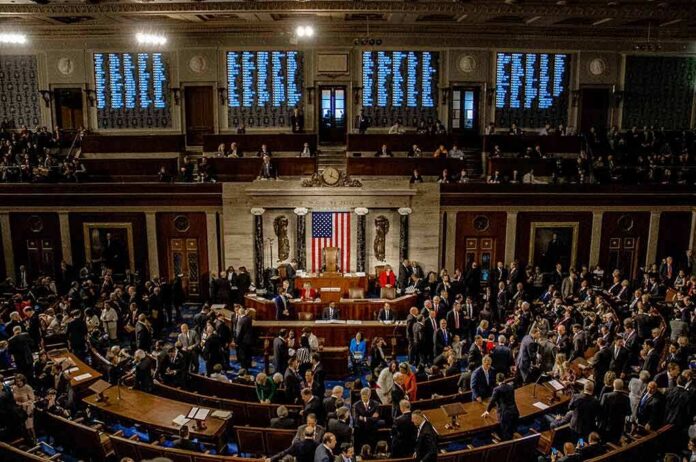
When spending power collides with the calendar, procedure often decides substance; that is the quiet lesson of the Senate clash over “pocket rescissions,” where a single objection on the floor preserved President Trump’s late-year spending cuts while the legal fight rages on outside the chamber.
At a Glance
- A pocket rescission exploits timing: send a rescission request so late in the fiscal year that Congress cannot act before funds expire.
- Senator Ron Johnson’s objection stopped Democrats from fast-tracking a bill to reverse Trump’s $810 million cuts; the attempt failed in that moment.
- Watchdogs at GAO argue pocket rescissions violate the Impoundment Control Act’s limits on withholding funds through expiration.
- Schumer and Senate Democrats call the maneuver illegal and vow continued challenges; the parliamentary setback does not resolve the underlying legal dispute.
What actually happened in the Senate
The immediate fight turned on a narrow but consequential question: could Democrats move quickly to nullify the administration’s pocket rescissions before the fiscal year closed? They tried to do so by unanimous consent, a routine way to expedite noncontroversial business. It only takes one senator to object, and Johnson did; that single objection derailed the effort to put a reversal bill on the floor in time. Bloomberg Government reported the move plainly: Johnson blocked Democrats’ attempt to reverse the White House’s use of a loophole to cut $810 million Congress had already approved. Yahoo’s account matched the mechanics—Johnson objected, and the fast-track path closed.
Procedurally, that was enough to let the rescissions stand in the short run. Substantively, it did not answer the legality of pocket rescissions. Johnson’s objection created a decisive calendar outcome without a final legal judgment. That asymmetry—decisive for the moment, unresolved in principle—is common in end-of-year appropriations fights.
How a pocket rescission works—and why timing is the whole game
The Impoundment Control Act (ICA) of 1974 permits a president to propose rescissions—cancellations of previously enacted budget authority—but only Congress can approve them. The law also allows temporary “deferrals” of spending, but not indefinite withholding through expiration. A pocket rescission tries to thread that needle: transmit a rescission proposal in the final stretch of a fund’s availability so Congress’s 45-day review window cannot practically elapse before the money times out. Once the clock runs, the money is gone without an explicit congressional vote.
That is why the Senate calendar mattered more than a debate on the merits. If Democrats could not bring a vehicle to the floor immediately, the expiration date would do the work of cancellation for the executive branch. The tactic has surfaced episodically because it converts a statutory review period into a de facto veto-by-time-limit, leveraging the reality that Congress cannot move at will near fiscal year-end.
The legal landscape: GAO’s view versus unresolved courts
On the law, the Government Accountability Office has been unambiguous: pocket rescissions contravene the ICA. GAO’s general counsel reiterated that the Act permits only temporary withholding and does not allow the executive to run out the clock; Congress did not cede its power of the purse by authorizing rescission proposals that can be transformed into expirations. Independent coverage summarized the same position: GAO reasserted that Trump’s pocket rescission to cancel $810 million was unlawful because withholding cannot extend through funds’ expiration.
That is a forceful watchdog verdict, but it is not a court ruling. Congressional research notes that pocket rescissions are infrequent and that—with an exception or two—courts have not squarely reached the merits, often because timing or mootness swallows the controversy once funds lapse. The effect is a recurring gray zone: GAO declares the tactic illegal; administrations test timing; litigation struggles to catch up before the money expires; and institutional players fight on procedural ground while the constitutional question—how far the executive can go without violating the purse power—remains under-determined in binding case law.
Schumer’s argument and why the fight did not end on the floor
Majority Leader Chuck Schumer framed the administration’s action as flatly illegal and pledged to challenge it “at every turn,” promising continued parliamentary and political efforts to protect the targeted domestic programs. That rhetoric is not bluster detached from law; it mirrors GAO’s reading of the ICA. But rhetoric cannot erase the Senate’s rules: one objection blocks unanimous consent, and absent time and votes for a full debate and cloture, the calendar advantage stays with the administration.
In other words, Johnson’s floor move produced a concrete outcome—no fast-track reversal—while Schumer’s stance preserved the legal and political contest in other venues. The Bloomberg characterization—Johnson blocked an attempt to reverse the cuts—captures this balance: a tactical defeat for Democrats on a day when days mattered, not a judicial resolution of the executive’s authority.
The stakes: power of the purse versus speed of the pen
Why this matters goes beyond a single $810 million episode. Pocket rescissions exploit an enduring structural mismatch: Congress legislates deliberately; the executive operates continuously. When the law’s timing windows overlap with fiscal-year deadlines, a president can sometimes achieve with a clock what would be impossible with a veto pen—especially when Congress cannot muster floor time or 60 votes to respond swiftly. GAO’s warnings rest on precisely this concern: if end-stage withholding through expiration is tolerated, the president effectively amends appropriations unilaterally, eroding Congress’s constitutional prerogative.
For appropriators and agency heads, the consequences are concrete. Agencies confronted with late-year freezes face operational whiplash—halt grant awards, delay contracts, and scramble to avoid violating the Antideficiency Act. For Congress, the episode is a cautionary tale about drafting availability windows, enforcing reporting cadences, and guarding the endgame of the fiscal calendar so that program integrity does not depend on whether a single objection occurs on the Senate floor at 7 p.m. two days before September 30.
What to watch next
Three arenas will determine whether pocket rescissions remain a usable tactic or recede into the category of failed experiments. First, statutory clarity: Congress can amend the ICA to foreclose rescissions transmitted within a fixed number of days from expiration or to require immediate obligation during congressional review. Second, litigation: if a case survives mootness and secures a merits ruling, courts could align practice with GAO’s view or, alternatively, cabin it with clearer boundaries. Third, internal congressional process: leaders can pre-commit floor time near year-end to consider any impoundment challenge, making the clock less of a weapon.
Sources:
democrats.senate.gov, yahoo.com, news.bgov.com, apnews.com, commondreams.org
© fixthisnation.com 2026. All rights reserved.