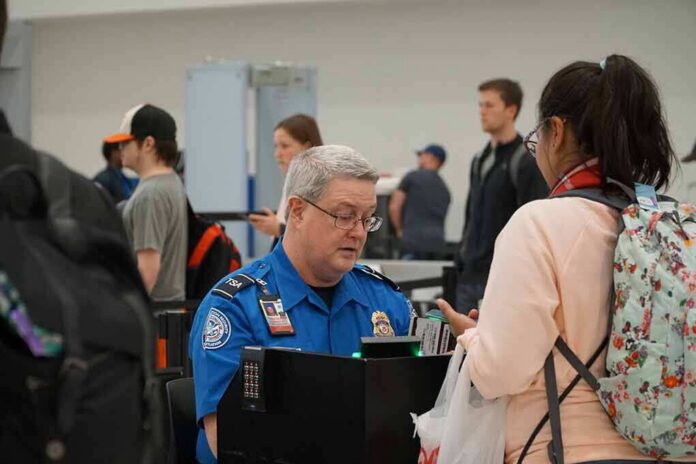
Biometric border checks have moved from pilot projects to quiet gatekeepers of U.S. entry; a recent Orange County case shows why the technology now sits at the center of passport fraud detection and, increasingly, national security practice.
The Short Version
- Federal prosecutors charged two Chinese nationals who allegedly tried to enter the U.S. at John Wayne Airport using U.S. passports issued to other people.
- CBP’s facial-comparison system flagged a mismatch between the travelers and the passport photos, triggering secondary inspection and arrests.
- The case exemplifies how airport biometrics blend flight manifests, passport datasets, and live images to verify identity at scale.
- Misuse of a U.S. passport is a federal crime; related statutes have long allowed prosecution even when an imposter uses a “real” document secured by false statements.
What happened at John Wayne Airport, and why it matters
According to the Justice Department, two Chinese nationals arrived from Mexico at Orange County’s John Wayne Airport and presented U.S. passports that belonged to other people. CBP officers used facial recognition to compare each traveler’s live image to the document photo and reference records, detected a mismatch, and referred both to secondary inspection; prosecutors subsequently filed a federal criminal complaint alleging misuse of U.S. passports. The core allegation is straightforward: the passports were authentic, but the bearers allegedly were not the Americans to whom those passports were issued. This is precisely the lane where modern border biometrics have proven most operationally valuable—exposing imposters whose physical documents pass a quick visual scan.
The reason the incident resonates beyond a single airport counter is that it maps onto the threat model border agencies worry about most: not crude forgeries, but genuine credentials in the wrong hands. That risk increases as criminal networks traffic in stolen or borrowed passports, assemble tailored travel itineraries, and coach imposters on inspection choreography. The best countermeasure is not a sharper watermark; it is an independent check that the face in front of an officer is the face the bureaucracy expects to see. That is what the CBP system delivered here, according to the charging narrative.
How the facial-comparison system actually works
CBP’s Traveler Verification Service (TVS) stitches together three ingredients: biographic flight manifest data (APIS), authoritative gallery images (passport, visa, prior entry/exit records), and a live photo captured at the inspection point. The algorithm conducts a one-to-few comparison—matching the live capture to the small, pre-built gallery for that specific traveler movement—rather than a dragnet one-to-many search across a national database. The output is a match score that either clears the traveler or prompts human review and, when warranted, secondary inspection.
Deployed in partnership with airports and airlines as part of the Biometric Entry-Exit program, this architecture is designed to reduce identity errors and accelerate throughput without surrendering scrutiny. GAO reported that by 2020 CBP had expanded facial recognition across dozens of airports and continued to refine performance and governance; the core objective is consistent: verify who is traveling, with high confidence, and catch imposters who possess legitimate documents but lack the legitimate face.
The legal backbone: what “misuse of a passport” covers
The United States has prosecuted passport fraud under a pair of long-standing statutes—18 U.S.C. § 1542 and § 1544—covering false statements to obtain a passport and misuse of a passport, respectively. The Supreme Court’s Browder decision affirmed decades ago that even the “innocent” use of a passport procured by false statements can sustain a conviction under § 1542, underscoring how seriously federal law treats the integrity of U.S. travel documents. While charging instruments vary by fact pattern, the common thread is the same: the passport system is only as trustworthy as the chain that links an identity to a person. Break that chain, and you invite federal charges.
In practice, prosecutors rely on documentary records, officer observations, and, now, biometric comparisons to show that the bearer was not the rightful holder or that the document’s issuance or use rested on falsehoods. That evidentiary mix is precisely why biometric mismatches in primary inspection have become a fulcrum in modern passport cases; they are not verdicts but triggers that steer cases toward deeper verification and, where appropriate, charges.
Why airports—and why now
Air travel offers border agencies a structured data environment: manifests are transmitted in advance, passport photos are standardized, and inspection lanes can be instrumented with cameras purpose-built for face capture. This lets CBP perform near-real-time verification with higher quality inputs than a random street encounter would afford. DHS privacy and oversight documents describe a workflow that narrows the comparison gallery to the expected travelers on a given movement, which improves both speed and accuracy and limits unnecessary data exposure.
The result is a capability that is simultaneously mundane and consequential. Most travelers move through in seconds, never thinking about the behind-the-scenes algorithm that silently confirmed they are who their documents say they are. But for the small fraction who are not—whether through mistake or malice—the system changes the trajectory of the inspection. In Orange County, that meant a referral and a criminal complaint when the faces did not line up with the U.S. passports presented.
Performance, governance, and the line between promise and practice
Independent reviews and oversight bodies have documented both the gains and the gaps. GAO and congressional hearings have pointed to meaningful progress in deployment and accuracy, while also flagging implementation limits, especially at land borders and in specialized environments where image capture is harder and throughput pressures higher. DHS advisory materials have pressed for clear retention rules, transparency to travelers, and robust auditing to detect demographic performance skews and operational drift as systems scale.
For the traveling public, the salient point is not that the technology is flawless—it isn’t—but that its design in the airport context is constrained, auditable, and targeted at the identity-verification step where it does the most good. That is where cases like John Wayne Airport provide a concrete demonstration: the system is doing identity work humans alone struggle to do quickly when imposters hold authentic documents, and it is handing officers an evidence-based reason to take a closer look.
2 Chinese nationals arrested at John Wayne Airport, allegedly used passports of American citizens https://t.co/Vwjxbz5qv1
— Whittier Daily News (@WhittierNews) September 30, 2026
What this means going forward
Expect more of this, not less. As long as stolen or borrowed passports circulate, the incentives for imposters to exploit authentic documents remain strong; as long as those incentives exist, CBP and partner agencies will lean on biometric gates to harden identity checks in the fastest-moving part of the border. The policy questions ahead are therefore not about whether to use facial biometrics in air entry—they are about how to govern accuracy thresholds, data retention, third-party participation, and traveler redress when the system misfires. Those are solvable problems, but they require sustained oversight and disciplined engineering, not rhetoric.
Sources:
© fixthisnation.com 2026. All rights reserved.