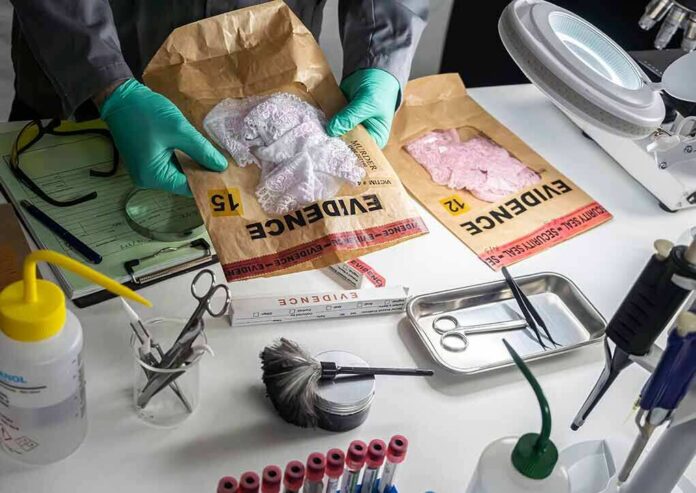
Cold cases are not solved by a single breakthrough so much as by a convergence: preserved evidence, modern laboratory methods, and old-fashioned proximity all aligning until the picture is no longer ambiguous.
At a Glance
- Chicago police say preserved fingerprint and modern DNA testing identify former officer Thomas McInerney as the killer of 8-year-old Gloria Kowalewicz in 1960.
- A latent print from the child’s purse reportedly matched McInerney’s employment fingerprints from 1959.
- DNA from biological material retained from the case was analyzed with current methods and tied to McInerney, with Illinois State Police and the FBI assisting.
- Investigators also cite proximity, timing, and firearm records consistent with the murder weapon’s type.
What investigators say cracked a 1960 child murder
Chicago police have publicly attributed the long-unsolved murder of 8-year-old Gloria Kowalewicz to Thomas McInerney, who in 1960 was a 24-year-old officer living within blocks of the child’s home. The department reports two core identifications. First, a latent fingerprint recovered from the strap of Gloria’s small purse was compared against the rolled impressions McInerney provided when he joined the force in 1959; examiners concluded they matched. Second, biological material preserved from the case—reporting specifies semen recovered on clothing—was tested using modern DNA methods and, according to police accounts, identified McInerney as the contributor.
Chicago’s Forensic Services Division says it worked with Illinois State Police and the FBI to generate and confirm the identification, a common interagency approach when revisiting decades-old evidence whose handling predated contemporary standards. The case narrative also includes corroboration beyond the laboratory: investigators reviewed records indicating McInerney owned three Colt revolvers consistent in type with the firearm used to kill Gloria, aligning tool class with a plausible possessor even if individual gun-to-bullet attribution has not been reported publicly.
How the pieces fit: from preserved trace to named suspect
Cold-case forensics succeed or fail on what the original investigation managed to preserve. Here, detectives reportedly retained a usable friction-ridge impression lifted from the child’s purse and biological evidence that, while unanalyzable in 1960, remained viable for DNA profiling decades later. Latent print comparison—matching a partial or smudged “latent” left in the course of an offense to a known “rolled” record print—relies on a trained examiner’s analysis of ridge flow and minutiae (ridge endings, bifurcations) under the ACE-V framework: Analysis, Comparison, Evaluation, and Verification. Properly done and independently verified, the discipline has demonstrated low false positive error rates under controlled conditions, though performance is sensitive to image quality and examiner methodology. In this case, police say the latent matched McInerney’s 1959 application prints, putting his hand on a key item associated with the abduction.
DNA—especially when recovered as semen on clothing—provides a separate line of identity. Modern extraction, quantitation, amplification, and profiling across multiple short tandem repeat (STR) loci generate a genotype capable of high-discrimination matches against a known reference. Investigators say that work identified McInerney as the source, and they credit a multi-lab effort that included state and federal partners. While public summaries do not specify whether investigative genetic genealogy played a role upstream of confirmation, the endpoint, as described, is a direct association between crime-scene DNA and McInerney.
Proximity, timing, and firearms: the circumstantial frame around the lab work
Forensic calls are strongest when they nest in a credible narrative of opportunity. McInerney had joined the Chicago Police Department in 1959 and, according to reporting, lived within several blocks of Gloria at the time of her November 12, 1960 abduction and shooting. That temporal and geographic adjacency matters: it coheres with how most child abductions and short-window homicides unfold—close to home and by someone with local knowledge or presence. Investigators also report that McInerney possessed three Colt revolvers of the same type indicated by ballistics in Gloria’s killing, adding class-consistent firearm ownership to the matrix of evidence. None of these elements—proximity, employment, gun type—would convict on their own; together with the fingerprint and DNA, they function as reinforcing context rather than primary proof.
The investigative arc detailed in reporting tracks with best practices in complex historical cases: identify preserved probative items; reexamine them with up-to-date techniques; reinterview and review historical records for plausibility and access; and cross-check laboratory conclusions with the subject’s documented life, movements, and possessions. It is the pattern, not any isolated datum, that persuades.
Why multi-lab cooperation mattered here
When a case spans generations, no single evidence stream or agency can comfortably bear the epistemic load. Chain-of-custody gaps must be managed, not wished away; aged biological material may need specialized extraction or probabilistic interpretation; latent prints may demand digital enhancement and independent review. Chicago police say their forensic team worked with the Illinois State Police and the FBI, the latter two bringing additional instrumentation, accreditation layers, and peer review cultures that tend to strengthen confidence in results that will never be tested in court because the named suspect died in 2006. That collaboration is not a public-relations flourish; in cold cases, it is often the only responsible way to convert preserved trace into an identification that meets professional standards.
The evidentiary blend here—fingerprint plus STR DNA, both tied to a specific person and buttressed by proximity and firearm records—lands in the zone practitioners look for when closing a historical homicide: two independent biometric identifiers converging on the same individual, with circumstantial fit rather than conflict. In a field where single-modality hits can sometimes be overinterpreted, that redundancy is the point.
A 1960 Chicago child murder took 65 years to resolve. How DNA and a fingerprint linked the crime to a former detective who died before trial.https://t.co/NJQ0ymXrGq
— ForFoxs (@ForFoxsblog) October 13, 2026
Cold-case forensics in context: why this model keeps working
Across the United States, homicide units and cold-case squads are reopening files where a single good preserve—semen on fabric, a hair with intact root, a latent print photographed before it faded—can now be interrogated with tools unavailable to the original detectives. DNA profiling has matured into a highly discriminating biometric; latent print science, when coupled with rigorous examiner protocols and verification, remains a powerful identifier; and interagency lab collaboration adds resiliency to work that will be scrutinized by families and historians rather than juries. Public-support research consistently finds broad approval for applying these methods to serious unsolved crimes, particularly when privacy-sensitive tools like investigative genetic genealogy, if used, are bounded by policy, oversight, and case gravity.
In Gloria Kowalewicz’s case, police say the convergence was finally achieved: a preserved fingerprint, a modern DNA profile, a suspect with documented proximity and class-consistent firearms, and corroboration from multiple laboratories. That is how very old cases close—by design, not by accident. The announced identification will never face cross-examination because McInerney died years ago, but on the evidentiary posture described by investigators and reported across outlets, the attribution rests on two independent biometric pillars, aligned by circumstance rather than strained by it.
Sources:
foxnews.com, cbsnews.com, nbcnews.com, chicagotribune.com, local12.com, ibtimes.co.uk, lawcommentary.com, wpxi.com
© fixthisnation.com 2026. All rights reserved.