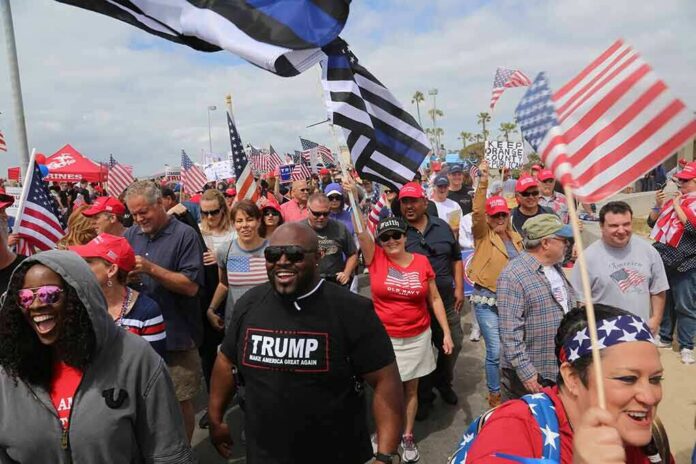
Celebrity cameos at political rallies are not sideshows anymore; they are integrated tools for mobilization, signaling, and attention—on full display when Jake Paul took the microphone at President Trump’s Youngstown event and turned crowd energy into a participatory “USA” moment while urging people to vote.
At a Glance
- Jake Paul appeared on stage at President Trump’s Youngstown, Ohio rally and addressed the crowd directly.
- Paul framed Washington as belonging to ordinary Americans, not celebrities or politicians, and urged attendees to vote in November.
- His appearance coincided with patriotic crowd chants, emblematic of how influencers can catalyze energy at live political events.
- The episode exemplifies a broader trend: campaigns using influencers to fuse entertainment, identity, and civic mobilization.
What Happened On Stage: A Crowd, A Microphone, And A Message
Jake Paul, the Ohio-born influencer and boxer, joined President Trump on stage in Youngstown and delivered a tightly framed populist message: Washington does not belong to celebrities or politicians; it belongs to the American people. He also explicitly encouraged attendees to vote in the upcoming election, coupling identity—Ohio roots, blue-collar pride—with a direct civic ask. Contemporary reporting and live coverage document his stage appearance, the thrust of his remarks, and the patriotic chants that followed, with one outlet encapsulating the moment as Paul “gets the crowd chanting ‘USA.’” The sequence was straightforward: a celebrity walk-on, applause, short remarks that emphasized ownership of government and near-term participation, and a crowd energized by rhythmic, patriotic call-and-response.
Paul’s presence was not incidental to the event; he traveled with President Trump to the rally and spoke from the same stage, linking his persona to the campaign’s broader narrative in both literal and symbolic terms. That proximity matters—the optics of shared travel and shared microphone compress distance between politics and pop culture, an increasingly deliberate tactic in modern campaigning.
How It Works: The Mechanism Of Influencer-Mediated Mobilization
Campaigns invite celebrities and digital-native influencers because they translate attention into participation. At a live rally, the mechanism is visceral: a familiar personality enters, validation flows both ways (the campaign borrows the star’s halo; the star borrows the campaign’s gravitas), and the room’s affect spikes. That spike is not just noise; it is a resource that speakers can channel into a concrete ask—register, volunteer, vote. Paul’s brief was archetypal: recognize the crowd, draw a boundary between “elites” and “the people,” and pair the identity cue with an action cue—vote next month. Research on influencer politics describes this as relational leverage: parasocial familiarity lowers the barrier to attention and can increase engagement and turnout, even as effects on persuasion remain mixed across settings.
The chant itself—USA—functions as a synchronizing device. Chants unify a heterogeneous crowd into a single actor; they set tempo, create belonging, and reward speakers who can pace them. Whether a speaker literally starts a chant or simply catalyzes it often matters less than whether the moment fuses identity and intent. Reporting ties the patriotic chant to Paul’s appearance at Youngstown and records related chants—“Four more years,” among others—elsewhere in the program, all of which are standard fare at high-energy campaign events.
The Immediate Context: Why Youngstown, Why Paul
Youngstown is familiar terrain for Republican mass politics: union lineage, manufacturing identity, and a long-running contest over who speaks credibly for “the working class.” Bringing an Ohio-born influencer to that stage was strategically coherent. Paul emphasized local roots and blue-collar respect, then pivoted to turnout and ownership of government—language that harmonizes with the campaign’s populist frame. Coverage noted Trump and Paul traveled together to the rally, reinforcing intentionality rather than happenstance.
Rallies are coalition theaters—multiple speakers, overlapping messages, and shifting crowd moods. In Youngstown, coverage also documented confrontations with protesters and a menu of chants beyond the patriotic refrain. That texture can complicate clean attribution of every chant to a single figure, but it does not change the essentials: Paul spoke, he urged voting, he framed Washington as the people’s, and the crowd’s response aligned with high-energy, pro-campaign patriotism.
What The Evidence Supports—And What It Doesn’t
The public record supports four core facts with confidence. First, Paul addressed the Youngstown rally from the podium. Second, he told the audience that Washington belongs to ordinary Americans, not celebrities or politicians, a line carried by national and international outlets. Third, he urged attendees to vote in the November election, a clear, actionable mobilization cue. Fourth, his appearance coincided with chants emblematic of patriotic, pro-Trump rally culture, captured in contemporaneous reporting.
What the record does not do is quantify downstream effects: there is no causal estimate tying Paul’s cameo to turnout, registration, or vote share. That is the normal state of campaign events. Scholarship on celebrity and influencer involvement in politics is mixed—some high-salience endorsements have shown measurable effects (Oprah Winfrey’s 2008 mobilization is the canonical example), while other studies find little to no persuasion benefit and, in some subgroups, even backlash. The consistent through-line is that attention is easy to buy, while persuasion is contingent: on credibility, audience fit, message framing, and timing.
The Broader Trend: From Endorsement To Participation
Modern campaigns do not merely seek endorsements; they stage co-participation. The difference is practical. An endorsement is a statement; co-participation is a performance that produces clips for social media, still photos for fundraising emails, and a memory for the people in the room. Influencers bring their own distribution channels; a 30-second reel of a “USA” chant travels differently than a press release, and faster. That is why campaigns court creators whose audiences skew young or apolitical: even if persuasion is uncertain, awareness and early-vote prompts can rise meaningfully with the right messenger and format. Communication research frames these figures as “relational influencers” who trade on perceived authenticity to move engagement behaviors such as registering or showing up on Election Day.
Regulatory context also shapes the field. Individuals may volunteer their time and speech to a campaign without making a contribution, provided they are not paid by a third party for that work. That permissive baseline enables appearances like Paul’s to remain straightforward from a compliance perspective—an important, if underappreciated, reason such moments are common in the closing weeks before an election.
🔥 President Trump just brought Ohio native Jake Paul up on stage at his rally in Youngstown, and he WENT OFF:
"The protesters, do they not have jobs?! That's all they do, just carry signs around while WE'RE doing the work."
pic.twitter.com/WqsTDP7LGN— Mayra Flores (@Mayra_FloresTx) October 13, 2026
What It Means Going Forward
Expect more of this. The Youngstown cameo demonstrates that campaigns will continue to recruit influencers with geographic ties and platform-native instincts to serve as rally accelerants and turnout surrogates. The playbook is simple and durable: establish local credibility, articulate ownership of government by citizens, and convert the room’s emotion into a concrete civic action. Whether such appearances shift votes at the margin is an empirical question that varies by race and messenger. But as a means of fusing identity, attention, and mobilization in real time—and producing media artifacts that outlive the rally—they are here to stay.
Sources:
facebook.com, wfmj.com, pbs.org, x.com, rawstory.com, scholarworks.uark.edu, ijoc.org, kellogg.northwestern.edu, fec.gov, news.ncsu.edu
© fixthisnation.com 2026. All rights reserved.