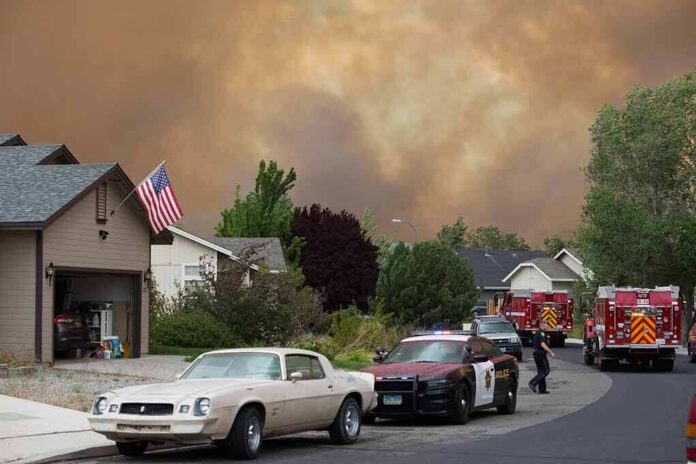
Large civil settlements after industrial near-misses are not just payouts for inconvenience; they are governance by other means, converting a frightening systems failure into money for those disrupted, reimbursement for the public response, penalties to change corporate behavior, and multi‑year oversight that outlives the news cycle.
At a Glance
- A proposed $125 million civil agreement with GKN Aerospace follows the Garden Grove chemical-tank emergency that drove mass evacuations.
- The structure matters: a sizable claims fund for residents and businesses, reimbursement of public emergency costs, civil penalties, and years of external safety monitoring.
- Company statements emphasize there was no confirmed offsite contamination or injuries and highlight cooperation and community aid—while the agreement resolves claims without admitting liability.
- The case fits a national pattern: immediate, visible harm is the upheaval and cost of evacuation; root-cause and prevention work unfold over years within established chemical‑safety frameworks.
What the $125 million agreement actually does
The Orange County District Attorney announced a proposed $125 million civil settlement with GKN Aerospace entities tied to the Garden Grove hazardous-materials emergency. The deal, filed for Superior Court review, is notable for its breadth rather than its headline number: a large claims program for residents and businesses, civil penalties, reimbursement of emergency response and abatement costs, and a long-tail safety and monitoring regime run by an outside expert. Reported terms break down into approximately $100 million for claims, $15 million in penalties, and more than $8.4 million to make public agencies whole for the costly, days-long operation; the agreement also binds the company to multi‑year oversight of its safety practices, on the order of seven years.
Civil resolutions like this are crafted to cover different kinds of loss. Households and shopkeepers do not need toxicology reports to prove they were harmed by evacuation orders; the harm is disruption, displacement, and economic loss. Public agencies likewise need not litigate fault for every cost line when the enforcement authority can negotiate reimbursement. Penalties, by design, change the calculus of future risk-taking. And external monitoring keeps a facility’s risk management from reverting to the mean once the spotlight fades. In aggregate, the structure treats the incident as a systems failure to be compensated, deterred, and fixed, even as root-cause findings may continue in parallel.
What happened in Garden Grove, and why it triggered mass evacuation
On a Memorial Day weekend, a failing tank containing methyl methacrylate (MMA)—a volatile, flammable monomer used in acrylics—set off an extended hazmat crisis at a GKN Aerospace site in Garden Grove. Officials publicly warned the tank could fail or explode; evacuation orders ultimately covered roughly 50,000 residents and businesses across Garden Grove and Stanton while technicians worked to stabilize temperatures and neutralize risk. MMA is hazardous because its vapor can form explosive mixtures in air and it can undergo exothermic polymerization; a runaway reaction can escalate from heat to overpressure in minutes. It is precisely the kind of scenario where authorities move people first and diagnose mechanics second.
Contemporaneous reporting described responders ruling out a “massive blast” at one stage while stressing the crisis was not over; multiple days of round‑the‑clock mitigation ended with residents returning and the immediate danger abated. The bill for that operation—staffing, containment, specialized contractors—ran into the millions, which the settlement’s public-cost reimbursement component is meant to cover.
GKN Aerospace’s position and the meaning of “no admission”
GKN Aerospace has consistently emphasized that officials reported no chemical leak, no contamination, and no injuries, and that the company cooperated closely with fire officials, technical experts, and regulators throughout the response. It has apologized for the disruption and announced community-support contributions, while noting that environmental-response contractors removed MMA from other tanks as part of mitigation. The reported settlement resolves civil claims without an admission of liability—standard language that protects litigation posture while still delivering compensation, penalties, and operational oversight.
These points can appear in tension with the public narrative of a “toxic chemical scare.” They are not. Civil enforcement does not require proof of offsite contamination or body counts to act; the enforceable public harm here was the creation of an acute hazard significant enough to force mass evacuation and consume substantial emergency resources. A no‑admission clause spares both sides the collateral consequences of a formal liability finding, but it does not erase the material commitments: seven years of external safety oversight and eight figures in penalties and reimbursements are concrete accountability mechanisms, not optics.
How serious facilities plan for, and are judged after, near-misses
In the United States, “cause” in chemical-accident practice is broader than a single failed tank. The U.S. Chemical Safety and Hazard Investigation Board (CSB) examines equipment condition, instrumentation, procedures, shift handoffs, maintenance and inspection regimes, hazard analyses, and the management system that ties them together. A runaway polymerization risk in an MMA tank, for example, implicates temperature control, inhibitor concentration management, relief systems, and emergency response planning. The CSB’s mandate is to extract these systemic lessons and feed them back into industry practice; it is independent and nonregulatory, precisely so it can diagnose without prosecuting.
Events like Garden Grove also live inside a larger national risk baseline. Under EPA’s Risk Management Program (RMP), tens of thousands of facilities report their five-year accident histories, covering incidents that trigger evacuations, shelter-in-place orders, injuries, fatalities, or offsite impacts. Across a recent ten-year window, RMP data counted more than 1,500 reportable accidents, hundreds with offsite consequences; while most facilities operate safely, the tail events are numerous enough to make community-scale disruption a recurrent, not rare, phenomenon.
$125 million settlement reached after dangerous Garden Grove chemical leak
https://t.co/ybRWQOjKXW— Tim Conway Jr Show (@ConwayShow) October 13, 2026
Why the settlement’s monitoring and penalties matter more than a headline number
For communities, money addresses immediate loss but does not restore confidence by itself. A meaningful remedy pairs compensation with enforced change. Multi‑year third‑party oversight keeps a facility’s hazard analyses live, verifies that alarms and interlocks actually work under field conditions, and checks that maintenance and operating procedures are neither paper promises nor quietly eroded by production pressure. Civil penalties, while not as emotionally satisfying as a liability verdict, set a price on systemic slippage; paid once, they rarely look attractive to repeat.
The practical lessons for operators and neighbors
For operators that handle reactive, flammable monomers and other high‑energy chemistries, the lesson is blunt: treat storage as a process, not a parking lot. That means continuous temperature surveillance with credible redundancy, chemical inhibitor management with documented calculations and verifications, properly sized relief and vent systems, and drills that assume utilities will fail at the worst moment. For local governments and residents, pre‑incident literacy matters: know who handles what within a few miles, how evacuation and reentry decisions are made, and how claims programs are structured when the sirens finally stop. RMP filings and local emergency planning committees are the starting point; relying on luck and headlines is not a plan.
Sources:
nypost.com, article.wn.com, cbsnews.com, abc7.com, en.wikipedia.org, voiceofoc.org, latimes.com, calmatters.org, nbclosangeles.com, abcnews.com, epa.gov, jurnal.unismuhpalu.ac.id, response.epa.gov, apha.confex.com
© fixthisnation.com 2026. All rights reserved.