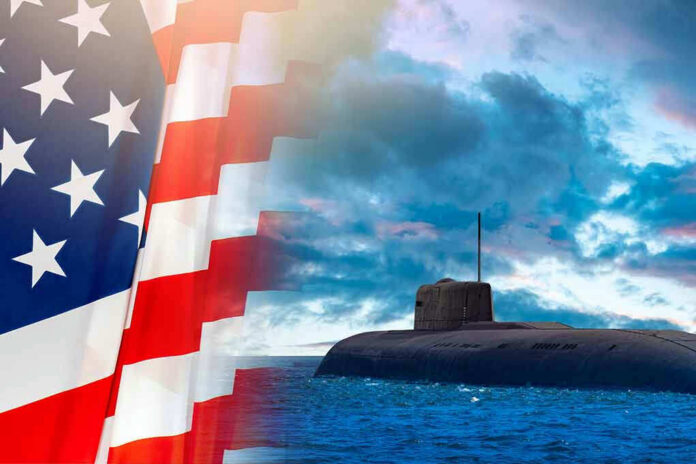
USS Florida’s submariners endured over two years underwater, exposing how years of underfunding have stretched America’s Navy to the breaking point against China and Russia.
Story Highlights
- USS Florida (SSGN-728) completed a record 727-day patrol, sailing 70,000 miles across global theaters undetected.
- Crew rotations enabled strikes on Houthi targets in Yemen and Special Forces operations without surface fleet support.
- Proves U.S. submarine superiority but reveals dangerous Navy shortages amid rising threats from adversaries.
- President Trump’s Navy rebuild now prioritizes fixing these overstretch issues from prior administrations.
- Historic achievement underscores need for fiscal discipline and fleet expansion to deter global foes.
Record-Breaking Deployment Details
USS Florida, an Ohio-class guided-missile submarine, returned to Naval Submarine Base Kings Bay, Georgia, in July 2024 after a 727-day patrol. The mission spanned Fifth, Sixth, and Seventh Fleet areas, covering the Middle East, Europe, and Western Pacific. Crews rotated five times in Blue/Gold shifts, allowing sustained operations over 60,000-70,000 nautical miles. Ports visited included Greece, Guam, Diego Garcia, and the UK for brief liberty. This marked the longest U.S. submarine deployment on record, with no incidents reported.
Combat Operations and Stealth Success
The submarine launched Tomahawk missiles against Houthi targets in Yemen, demonstrating precision strike capabilities. It also hosted Special Forces for likely insertions, operating undetected across multiple oceans. Capt. Peter French, Blue Crew commanding officer, led these efforts, noting the SSGN platform’s ability to function anywhere at any time. This rare East-to-West global circumnavigation highlighted engineering triumphs and submariner resilience under extreme conditions.
Historical Background and Conversions
Commissioned in 1983 as a ballistic missile submarine (SSBN-728), USS Florida underwent conversion to SSGN configuration from 2003-2006. This upgrade, post-Strategic Arms Reduction Treaty, equipped it with 154 Tomahawk missiles and Special Operations Forces lockout chambers. In 2011, it fired 93 Tomahawks at Libya in Operation Odyssey Dawn—the first combat use for any Ohio-class boat. Prior patrols through Suez, Hormuz, and Persian Gulf built endurance precedents for this extended mission.
Ohio-class origins trace to 1970s nuclear deterrence needs. Post-Cold War drawdowns prompted SSGN conversions for four boats, enabling force multiplication without new builds. Florida’s prior milestones included 61 strategic patrols and the Navy’s 3,500th fleet ballistic patrol in 2001.
Navy Overstretch and Strategic Warnings
The extended patrol responded to threats from China’s navy expansion, Russian aggression, Iranian proxies, and Houthi attacks. Undetected operations created uncertainty for adversaries while enabling Yemen strikes and SOF missions. However, it exposed U.S. submarine shortages—fewer boats for growing global demands. Crews of 155 endured prolonged family separations, drawing criticism for strains on personnel.
727 Days Out On Patrol: Navy Ohio-Class Missile Submarine Broke All the Ruleshttps://t.co/XnuUPUhUHe
— Harry J. Kazianis (@GrecianFormula) March 11, 2026
Analysts call this a monumental achievement but a quiet admission of Navy thinness. Extended patrols prove cheaper than new construction yet risky long-term. It validates SSGN endurance via nuclear power and crew swaps, pushing toward Columbia-class replacements. Politically, it reinforces U.S. power projection, vital as President Trump strengthens the fleet against rivals.
Sources:
727 Days and 70,000 Miles: Navy Ohio-Class Guided-Missile Submarine ‘Sails Into History’
727 Days on Patrol: A U.S. Navy Ohio-Class Missile Sub Broke All the Rules
SSGN USS Florida Returns from 800-Day Deployment
USS Florida (SSGN-728) History
USS Florida (SSGN-728) – Wikipedia
USS Florida Returns to Kings Bay Following 727-Day Deployment