Every Labor Day message a president sends is theater, but the substance of that theater tells you something real about how a campaign intends to fight. President Trump’s 2026 Labor Day post did not summon images of union halls or wage gains; it summoned “Radical Left Lunatics, Communists, and Dumocrats” and framed the coming midterms as a final battle against a decade-long conspiracy to ruin the country. That choice of words is not incidental — it is a strategy, one with a documented history and a specific electoral logic behind it.
Key Points
- On September 7, President Trump used his Labor Day message to brand Democrats and the left as “Radical Left Lunatics, Communists, and Dumocrats” bent on destroying the country.
- The post claimed his opponents had spent “10 years” fighting him and were making a final push to “ruin America” before the midterms.
- Academic language studies find Trump’s hostile rhetoric toward opponents has intensified over nearly a decade and now exceeds that of any other major-party candidate studied.
- The message lands amid soft approval ratings in the mid-30s and a Republican midterm strategy built almost entirely around Trump’s personal brand rather than a policy agenda.
- Democrats are countering with an affirmative economic message rather than matching the rhetorical temperature, betting that cost-of-living frustration outweighs culture-war combat.
What the President Actually Said
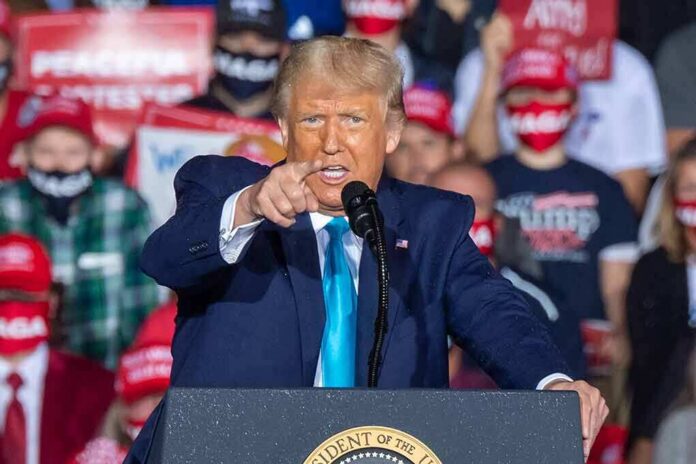
The message was unambiguous. Posted to Truth Social on the Labor Day holiday, Trump wished the country well “including the Radical Left Lunatics, Communists, and Dumocrats who will do anything possible to destroy our Country”. He went further in accompanying remarks, telling supporters his opponents had spent roughly ten years trying to defeat him and were now attempting “one last shot at ruining America” before Republicans, in his telling, would prevail at the ballot box in the midterms. There is no ambiguity to parse here and no missing context that would soften the language — the post says what it says, and it was widely circulated and quoted verbatim within hours by outlets across the political spectrum.
What makes the post noteworthy is not novelty but escalation. Trump has deployed variations of “communist” and “radical left” against Democratic officials for years, including a June 2026 appearance at the Faith and Freedom conference where he labeled newly elected Democratic primary winners “godless communists.” The Labor Day message folds that same vocabulary into a holiday traditionally reserved for bipartisan tributes to the American worker, replacing it with a call to electoral arms.
A Documented Pattern, Not a One-Off Outburst
Independent linguistic research gives this moment its proper context. A National Bureau of Economic Research working paper and a related UCLA study both find that Trump’s use of violent and hostile vocabulary in political speech has climbed steadily since 2015, now exceeding every other major-party candidate measured against the same corpus. One analysis found the share of words associated with violence in his speeches rose from roughly 0.6 percent in 2016 to 1.6 percent by 2024 — a near-tripling that tracks almost exactly with the arc from his first campaign to his second term. A separate computational study out of the University of Chicago concluded that his rhetorical style is measurably distinct from every presidential nominee dating back to 1960, particularly when the subject turns to political opponents.
This is not merely an academic curiosity. Research published through the National Institutes of Health’s public archive found that norm-violating rhetoric of this kind does not necessarily shake supporters’ commitment to democracy as an abstract system, but it does measurably reduce their support for inclusiveness and political equality. In plainer terms: the language doesn’t have to change minds about elections to change how people treat each other across the political divide. Nicknames like “Do Nothing Democrats,” tracked in a separate content analysis of his social media output, follow the same pattern — a small, repeatable arsenal of dismissive labels applied consistently enough to function as branding rather than commentary.
Why the Timing Matters
Labor Day has functioned as the traditional starting gun for general-election campaigning for the better part of a century, and Trump’s team is treating the 2026 midterms accordingly. But the political terrain he is campaigning into is markedly less favorable than the one he inherited. His approval rating sits in the mid-30s, well below the 50 percent he held heading into the 2018 midterms and the 52 percent he carried into 2020, according to reporting from campaign correspondents tracking the cycle. A recent Gallup survey of roughly 3,000 adults found 49 percent identifying as Democratic or Democratic-leaning against 39 percent Republican or Republican-leaning — a gap that reporters covering the campaign describe as unusually wide for this point in a midterm cycle.
That backdrop helps explain the rhetorical intensity. Republican strategists have built their midterm plan almost entirely around Trump’s personal capacity to turn out infrequent voters, rather than around a legislative agenda comparable to the detailed platform Democrats have assembled. Former Ohio Governor John Kasich, reviewing the same period, pointed to Trump’s own social media output — including an AI-generated post claiming he had “made hundreds of billions of dollars on stocks” for the country’s benefit — as evidence of a messaging drift that is costing him support even among sympathetic audiences. Meanwhile former Labor Secretary Robert Reich has hammered the administration’s trade posture, tying tariff disputes with Canada and rising diesel and gas prices to real-wage stagnation that Gallup and other pollsters find is now the dominant concern among likely midterm voters.
President Trump has a Labor Day message for all. pic.twitter.com/uUyAjkxSxq
— Chuck Tompkins (@ChuckTompkins96) September 7, 2026
What This Means for the Fight Ahead
Democrats have so far chosen not to match the rhetorical register. Congressional leaders interviewed in the days following the post emphasized pocketbook issues — health care costs, corporate accountability, an end to congressional stock trading — over direct rebuttal of the “communist” framing, betting that affordability concerns will outweigh culture-war combat with an electorate already souring on the administration’s economic record. Whether that restraint holds through a campaign season in which the president has signaled he intends to keep swinging hardest at his opponents’ character rather than their policies will be one of the more consequential story lines of the midterm cycle — not because the language is unprecedented, but because the data suggests it keeps getting louder.
Sources:
democrats.senate.gov, whitehouse.gov, govinfo.gov, news.meaww.com, cnn.com
© fixthisnation.com 2026. All rights reserved.