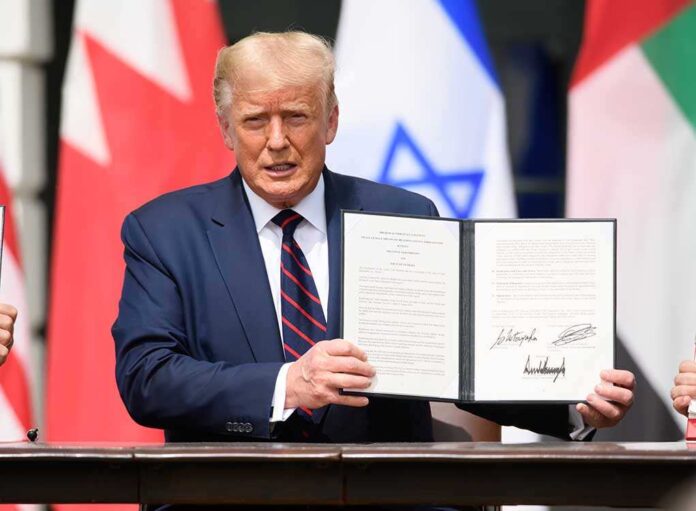
President Trump’s groundbreaking designation of fentanyl as a weapon of mass destruction marks the most aggressive federal escalation in America’s fight against the deadly drug crisis that has claimed hundreds of thousands of lives.
Story Highlights
- Trump signs executive order declaring illicit fentanyl and precursor chemicals as weapons of mass destruction
- DOJ directed to pursue enhanced criminal charges and sentencing for fentanyl trafficking cases
- New designation enables military, intelligence, and counterterrorism tools against drug cartels
- Congressional legislation H.R. 128 supports codifying fentanyl as WMD threat material
- Critics question scientific basis while supporters praise tough enforcement approach
Trump Takes Historic Action Against Deadly Crisis
President Trump signed an executive order on December 15, 2025, designating illicit fentanyl and its core precursor chemicals as weapons of mass destruction. The White House fact sheet emphasizes that illicit fentanyl is “closer to a chemical weapon than a narcotic” and poses serious threats for potential weaponization in large-scale terror attacks by organized adversaries. This unprecedented move represents the first time a widely trafficked illicit narcotic has been explicitly treated as a WMD-class threat at the presidential level.
Enhanced Federal Response Mobilized
The executive order directs multiple federal agencies to deploy enhanced authorities typically reserved for national security threats. The Attorney General must immediately pursue criminal charges, sentencing enhancements, and sentencing variances in fentanyl trafficking cases, treating them more like WMD-linked or terrorism-related conduct. The Departments of State and Treasury are ordered to target relevant assets and financial institutions connected to fentanyl operations using sanctions and financial-sector pressure similar to counterterrorism measures.
The Department of Defense and Department of Homeland Security receive specific mandates to update chemical incident response directives and use WMD nonproliferation intelligence to identify fentanyl smuggling networks. This integration places fentanyl squarely within existing counter-WMD intelligence workflows, fundamentally reshaping how federal agencies approach the drug crisis. DHS’s Countering Weapons of Mass Destruction Office becomes a central bureaucratic actor in operationalizing this new framework.
Congressional Support Reinforces Executive Action
House Resolution 128, titled the “Fentanyl is a WMD Act,” demonstrates strong congressional alignment with Trump’s WMD designation approach. The legislation requires DHS’s Countering Weapons of Mass Destruction Office to treat illicit fentanyl as a chemical weapon threat and coordinate with other federal agencies accordingly. This bipartisan congressional support provides a legislative foundation for Trump’s executive actions and signals potential long-term institutionalization of the security-focused framework.
West Virginia Governor Patrick Morrisey issued a statement thanking President Trump for the WMD declaration, reflecting strong state-level support from areas devastated by the opioid crisis. States experiencing severe overdose burdens view federally amplified enforcement tools as necessary responses to what Trump’s fact sheet describes as fentanyl being the leading cause of death for Americans aged 18-45.
Strategic Context and Implementation Impact
The fentanyl WMD designation operates within Trump’s broader national security strategy that includes declaring a National Emergency at the southern border, designating multiple cartels as Foreign Terrorist Organizations, and imposing tariffs on Mexico, Canada, and China for failing to address drug flows. The administration has also authorized military strikes to stop lethal drugs and signed the HALT Fentanyl Act permanently classifying fentanyl-related substances as Schedule I controlled substances.
This comprehensive approach leverages post-9/11 security frameworks to justify aggressive supply-side measures against what the White House characterizes as narcoterrorists using chemical warfare against American communities. The designation enables DOJ to seek tougher sentences and expanded federal jurisdiction while providing the administration with high-salience symbols of decisive action that resonate with communities and voters favoring punitive approaches to the drug crisis.
Sources:
Fentanyl a weapon of mass destruction? Experts question Trump order
Governor Morrisey Thanks President Trump for Declaring Fentanyl a Weapon of Mass Destruction
H.R.128 – Fentanyl is a WMD Act