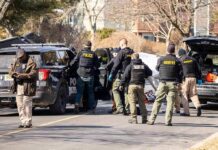
America’s northern border is becoming the new front door for fentanyl traffickers and terror suspects—right as Washington argues over funding and families bury loved ones.
Quick Take
- FBI Director Kash Patel told families in Allentown, Pennsylvania that terror “sleeper cell” threats inside the U.S. are “real,” tying the risk to border vulnerabilities discussed at a fentanyl roundtable.
- CBP data cited in reporting shows 1,903 Known or Suspected Terrorists (KSTs) were apprehended at U.S. borders in FY 2021–2024, with 64% at the northern border.
- Patel and Sen. David McCormick spotlighted recent incidents tied in reporting to ISIS and Hezbollah radicalization as examples of the threat environment.
- Reporting says southern-border enforcement gains have pushed trafficking routes northward, increasing pressure on the long, hard-to-control U.S.-Canada border.
Allentown roundtable shifts from fentanyl grief to homeland-security warning
Kash Patel and Sen. David McCormick met April 1, 2026, at the federal courthouse in Allentown for a roundtable centered on fentanyl victims and their families. Reporting on the event says Patel explicitly warned that terror “sleeper cell” threats in the United States are “real,” linking the concern to border security and to what he described as vulnerabilities created during the prior administration’s border posture. The discussion tied narcotics enforcement to national security priorities.
McCormick’s comments, as described in coverage, focused on the national-security implications of border failures—especially the possibility that individuals on terror watchlists were able to enter during the previous administration. The roundtable messaging also landed in the middle of a broader Washington fight over Department of Homeland Security resources, where policymakers disagree about what should be funded, what should be cut, and how to prioritize enforcement when threats span drugs, illegal crossings, and potential terrorism.
What the KST numbers show—and what they don’t
Border statistics cited in reporting are a major reason Patel’s warning is resonating: 1,903 Known or Suspected Terrorists were apprehended at U.S. borders in fiscal years 2021 through 2024, with 1,216 of those—64%—at the northern border. For FY 2025 through April 30, reporting cites 215 KST apprehensions at the southwest border and 195 at the northern border, with most encounters at ports of entry rather than remote crossings.
Those figures matter for citizens who want plain answers. Apprehension data can indicate attempted entry and law-enforcement interdiction, but it does not automatically prove a “sleeper cell” network is operating at scale in local communities. The reporting’s strongest factual foundation is that watchlisted individuals were encountered at unusually high levels and that officials are treating border vulnerabilities as a national-security issue. The leap from apprehensions to cell structure remains less documented in the cited coverage.
Why the northern border is becoming the pressure point
Reporting describes the U.S.-Canada border as 5,525 miles long with limited operational control, creating a persistent challenge even when the southern border is tightened. Sources cited say fentanyl precursor chemicals originate in China and move through international pathways that can include South America, Canada, and Europe, adapting when enforcement routes change. The theme across the coverage is that traffic flows—whether drugs or people—shift toward the path of least resistance.
That shift matters politically because many conservative voters backed Trump on a simple promise: enforce the border and reduce chaos. When enforcement succeeds in one sector but criminal networks reroute to another, the country still pays the price in overdoses, local crime, and community anxiety. The Allentown event underscored that a “secured border” can’t be a talking point limited to one line on the map; it has to include ports of entry and northern corridors too.
Recent incidents cited in coverage raise the stakes for policymakers
Patel’s warning, as relayed in coverage, referenced recent incidents that reporters described as connected to Islamist extremist influence, including a shooting at Old Dominion University in Norfolk, Virginia by a convicted ISIS supporter and a vehicle crash into a Michigan synagogue linked in reporting to Hezbollah radicalization. Those examples are being used to argue that the threat is not theoretical, and that enforcement decisions have real consequences for ordinary Americans.
The policy fight now centers on resources and priorities: how much capacity goes to drug interdiction, counterterrorism, and border operations; how much pressure is placed on Canadian cooperation; and whether federal leaders can prove measurable outcomes without expanding domestic powers in ways that collide with constitutional limits. Conservatives who are wary of endless foreign entanglements still expect the federal government to execute its core duty at home—protecting citizens while respecting rights.
Sources:
FBI Director: Majority of fentanyl and terrorists coming through northern border
Patel and McCormick meet fentanyl victims’ families in Allentown
Patel, McCormick warn foreign terror threats inside US grew during Biden years