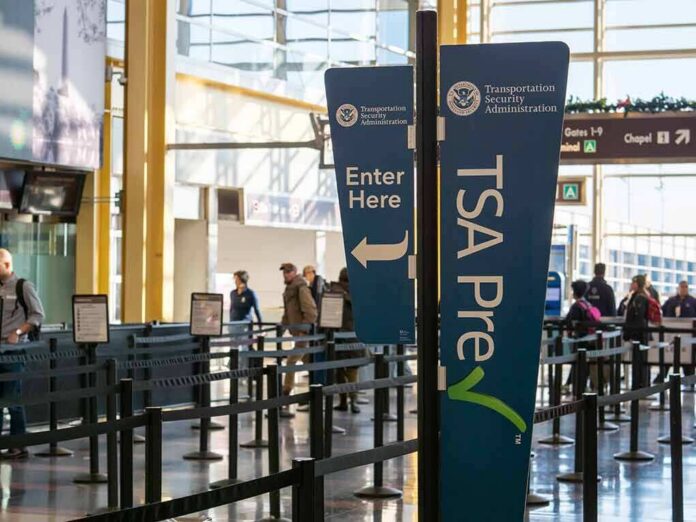
The story of John Gannon and Yasmin Suarez Reyes is less an anomaly than a preview: as immigration enforcement expands into the country’s airports, the line between a routine security checkpoint and a deportation proceeding has grown thinner than most travelers realize, even for citizens who voted to make enforcement stricter.
Key Points
- John Gannon, a 75-year-old lifelong Republican and Houston-area businessman who voted for President Trump, says his fiancée Yasmin Suarez Reyes was detained by eight ICE agents at George Bush Intercontinental Airport in late July as the couple prepared to fly to Las Vegas.
- Suarez Reyes, a citizen of Venezuela and Spain, had a pending asylum case and no criminal record, according to her attorney; she is being held at the Montgomery Processing Center pending a federal habeas corpus challenge.
- The case reflects a documented nationwide surge in airport-based ICE arrests, driven partly by expanded cooperation between ICE and the Transportation Security Administration.
- Similar detentions — including a Canadian green-card holder and a Houston-area high school student — show the pattern extends well beyond any single traveler or airport.
- Gannon’s public regret over his vote has become a flashpoint in the broader argument over how immigration enforcement should distinguish between civil status violations and public-safety threats.
What Happened at Bush Intercontinental
In late July, Gannon and Suarez Reyes were making their way through George Bush Intercontinental Airport for a flight to Las Vegas when, according to Gannon, eight ICE agents surrounded her before she reached the gate. “They didn’t tell us why, and wrestled her off into a car,” he told CBS News, describing an arrest that came without explanation and left him standing alone in the terminal. Suarez Reyes never boarded her flight. She was instead transported to the Montgomery Processing Center, a detention facility north of Houston, where she has remained since, according to a federal habeas corpus petition filed on her behalf.
Gannon is not a bystander with a grievance against immigration policy in the abstract. He describes himself as a lifelong Republican who voted for President Trump, and his public statements since the arrest — that ICE is “picking up law-abiding citizens” and “destroying families, jobs” — have circulated widely precisely because they come from someone who supported the administration’s enforcement agenda before it touched his own household. That reversal is the emotional center of the story, but it should not obscure the more durable, structural facts underneath it: who Suarez Reyes is, how she entered the country, and why her case sits at the center of an enforcement debate that predates this particular couple.
The Legal Mechanics: Visa Waiver, Asylum, and the Gap Between Them
According to her attorney, Suarez Reyes entered the United States legally and had a pending immigration case with no criminal record. Neutral reporting on the case places her within a specific and recurring status category: she entered under the Visa Waiver Program, which permits short authorized stays without a visa for eligible travelers, and later filed for asylum before that authorized window expired. That sequence — lawful entry, an asylum filing, and a subsequently lapsed authorized-stay period — is not an unusual pattern in U.S. immigration law, but it is exactly the kind of technical, in-between status that produces the sharpest public disputes, because it allows both sides of an argument to be simultaneously accurate. Immigration authorities can point to an expired authorization; family members and attorneys can point to a still-pending asylum claim and an unblemished record. The moral and legal frames diverge even when the underlying facts do not.
This is worth understanding because it recurs constantly in coverage of ICE enforcement: an arrest gets reported as “detaining a law-abiding immigrant,” while the enforcement agency’s position typically rests on a narrower, procedural definition — an unresolved status violation, regardless of the person’s conduct or pending applications. Both descriptions can be true of the same case. The public confusion is not usually about facts in dispute; it is about which fact is treated as decisive.
A Widening Front: Why Airports Have Become Enforcement Hotspots
The Suarez Reyes case did not happen in isolation. Immigration attorneys and local reporters have documented a broader shift in which domestic airports — not just points of entry from abroad — have become active sites of ICE enforcement, a change attributed in part to expanded coordination between ICE and the TSA. Arrests by ICE agents carrying out the administration’s immigration crackdown reached record levels in the months surrounding this case, and airports offer a uniquely efficient venue: travelers are already funneled through checkpoints, identity is already being verified, and agents can act on a known itinerary rather than searching a workplace or a residence.
Other cases from the same period and region underline the pattern’s reach. Curtis Wright, a 39-year-old legal U.S. permanent resident originally from Canada, was detained after returning from travel abroad and has remained in ICE custody for months while his family pursues his release. Separately, an 18-year-old Bellaire High School student, Alem Geripov, was detained at Houston’s Hobby Airport, prompting his school community to organize on his behalf. None of these individuals shares a criminal allegation in the reporting; what they share is a civil immigration-status question intersecting with a routine travel plan, at exactly the moment and place where enforcement has become easiest to execute.
Where the Real Disagreement Lies
There is no meaningful dispute in the public record over the basic sequence of events at Bush Intercontinental: Suarez Reyes was detained by ICE agents, she did not board her flight, and she has been held at the Montgomery Processing Center since. The genuine disagreement is not evidentiary but normative — a question of how enforcement priorities should weigh a pending asylum claim and a clean record against an underlying status lapse. Supporters of aggressive enforcement argue that any unresolved status is, by definition, a legitimate basis for detention and removal proceedings, and that airports are simply where compliance can be efficiently checked. Critics, including immigration attorneys representing families like this one, argue that detaining someone mid-process — while her asylum case remains open — treats a pending legal question as if it were already settled against her.
Gannon’s political disillusionment sharpens that argument without resolving it. His experience does not change the legal facts of his fiancée’s case; it changes who is telling the story and to what audience. A lifelong Republican voicing frustration with ICE reaches viewers and voters that immigration attorneys and advocacy groups typically cannot, which is precisely why this case traveled from local Houston coverage to national outlets and international press within weeks.
What It Means Going Forward
The durable lesson here has little to do with any single couple’s wedding plans and everything to do with how enforcement infrastructure has evolved. Airport checkpoints, once associated primarily with entry screening for arriving international travelers, are increasingly functioning as domestic enforcement chokepoints for anyone whose immigration paperwork is incomplete, contested, or simply pending review — regardless of how they arrived or how long they have lived in the country. For families navigating a mixed-status household, the practical takeaway is sobering: a pending asylum application or an expired authorized-stay window is not a shield against detention, even absent any criminal allegation, and travel itself has become a point of legal exposure rather than a routine act. That reality will keep generating stories like this one — some involving political allies of the enforcement agenda, most involving people with no political voice at all.
Sources:
twitchy.com, facebook.com, cbsnews.com, law-mana.com, youtube.com, yahoo.com
© fixthisnation.com 2026. All rights reserved.