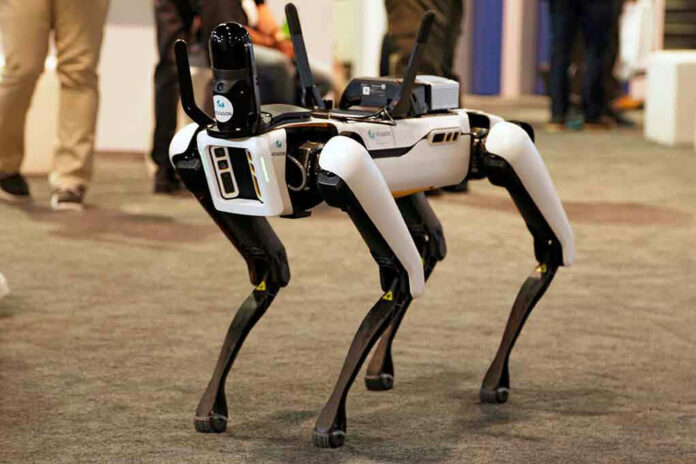
The real significance of the FCC’s robot action is not that Americans are losing access to the robots already in their homes; it is that Washington has turned advanced robotics into a national-security gatekeeping category, with future foreign-made models facing a far harder path into the U.S. market.
Key Points
- The FCC added foreign-produced advanced robotic devices to its Covered List, which blocks new models from obtaining the equipment authorization needed for U.S. import and sale.
- The agency framed the move as a response to supply-chain exposure, cybersecurity risk, and national-security concerns, not as a consumer product recall.
- The restriction is narrower than the loudest headlines suggest: existing authorized robots remain legal, federal purchases are exempt, and manufacturers can seek conditional approval.
- The strongest criticism is not that the FCC lacks a stated rationale; it is that the public record shows a broad, category-based rule aimed chiefly at Chinese suppliers, while leaving ordinary consumers to infer the actual risk profile of devices like robot vacuums and lawn mowers.
What the FCC Actually Did
The FCC did not announce a blanket confiscation of household robots. It updated its Covered List to add “advanced robotic devices,” defined in the public fact sheet as mobile robots such as humanoids and quadrupeds, alongside connected power inverters produced in foreign countries. That matters because the Covered List is an authorization mechanism: if a new model is on it, the device cannot receive the FCC approval ordinarily required before it can be imported, marketed, or sold in the United States.
This is why the shorthand “FCC bans robots” is directionally true but operationally imprecise. The rule is forward-looking. Reporting from Yahoo and NPR says it applies only to new device models and does not affect previously authorized products already on the market. That distinction is the difference between a market freeze on future entries and a recall of everything Americans already own. It is also why the Roomba headline is more sensational than exact: the action reaches consumer categories in principle, but it does not suddenly outlaw existing robot vacuums in American homes.
The Security Theory Behind the Rule
The FCC’s case rests on a familiar national-security logic: connected hardware can be a data-collection platform, a remote-access surface, and a supply-chain dependency all at once. ABC News reported that the Commission said foreign-made advanced robots pose supply-chain vulnerabilities, cybersecurity risks, and national-security risks, while Chair Brendan Carr said the goal was to “secure America’s critical supply chains.” Yahoo’s coverage says the decision followed a White House-convened interagency determination that foreign-produced advanced robotic devices pose “unacceptable risks” to U.S. national security or the safety and security of U.S. persons.
That language is not accidental, and it is not unique to robotics. It fits the broader U.S. pattern of preemptive technology-security regulation: the government often moves before a catastrophic incident is publicly documented, especially when the hardware is networked, sensors are involved, and the supply chain runs through geopolitical rivals. The logic is especially potent for mobile robots because they combine cameras, microphones, mapping software, wireless connectivity, and autonomous navigation. In plain English, they are not just mechanical objects; they are rolling computers with environmental awareness.
Why China Is at the Center of the Story
Officially, Yahoo reports that the new rules say “any foreign country,” which makes the regulation nationality-neutral on paper. In practice, the target is clear. Multiple outlets, including ABC, The Washington Post, Fox News, and DW, describe the action as aimed largely at China, which dominates the relevant market for these devices. That is the political and commercial reality the FCC is working inside: a formal rule framed in universal language, and a market structure that makes Chinese firms the obvious losers.
This is also why the policy will be read through the U.S.-China technology rivalry rather than through a narrow equipment-authorization lens. The Trump administration has already used similar logic against drones, routers, telecom gear, and power-related hardware; robotics now joins the same strategic shelf. Chinese officials have condemned the move as protectionist, and that critique will stick with some observers precisely because the practical effect lands on the firms that dominate the category. But political discomfort is not the same thing as evidentiary refutation. The public record still shows a formal security determination as the basis for the action.
The US just moved to ban new foreign-made advanced robots.
RoboStrategy's investment specialist @JacklouisP breaks down how to navigate this new regime.
0:00 Intro
0:22 What the FCC Ban Covers
1:35 Four Key Nuances
4:37 The Drone Ban: A Case Study
8:23 The Case For and Against… pic.twitter.com/3XkoWXSQhJ— RoboStrategy (@RoboStrategy) August 3, 2026
Where the Critique Is Strongest
The strongest objection is overbreadth, not falsehood. The public material provided here does not identify a specific U.S. incident in which a foreign-made consumer robot or humanoid actually carried out the feared surveillance or remote-control harm. That does not mean the risk is imaginary; it means the FCC is acting on a prophylactic theory rather than on a documented domestic breach. For a regulator, that can be enough. For skeptics, it leaves a gap between abstract threat categories and device-specific proof.
There is also a legitimate proportionality question. The reporting says manufacturers can seek conditional approval through national-security review, which implies the agency recognizes that not every covered device presents the same risk. That undercuts the most sweeping reading of the rule. If exceptions are available, then the FCC is not declaring all foreign-made robots equally dangerous; it is treating foreign origin, connectivity, and autonomy as risk markers that trigger review. That is a more nuanced policy than a total ban, but it is still a broad one.
The consumer-facing angle is the most rhetorically powerful and the least substantiated on the present record. Social posts and commentary quickly translated the action into “Roombas,” robot mowers, and other household devices, but the formal reporting says the legal effect is on new models, not existing units. That distinction matters. The policy may shape which future products reach U.S. shelves, but it does not instantly strip Americans of the devices already sitting in closets and corners. The more serious long-term question is whether household robotics now enters the same security vetting regime that already governs more obviously strategic hardware.
What This Means for Robotics and Industrial Policy
The deeper consequence is that robotics is no longer being treated as a neutral consumer electronics category. Once a class of devices is folded into a national-security Covered List, the market story changes: compliance, not just engineering, becomes part of product design; geography becomes part of risk analysis; and market access can hinge on whether regulators trust the country of manufacture as much as the firmware itself. That is a major shift for a field that is still trying to scale from novelty to infrastructure.
It also reveals the current U.S. governing style in advanced hardware: act early, rely on interagency security judgments, and accept that the public will often see broad category rules before it sees technical appendices. Critics will call that opaque. Supporters will call it prudent. Both reactions are understandable. But the structure of the FCC action is clear enough: new foreign-made advanced robots are now treated less like gadgets and more like strategic systems whose connectivity, data flows, and supply chains must clear a national-security threshold before they enter the American market.
Sources:
reason.com, abcnews.com, yahoo.com, npr.org, washingtonpost.com, techcrunch.com, dw.com, youtube.com, thehill.com, nextgov.com, xenospectrum.com
© fixthisnation.com 2026. All rights reserved.