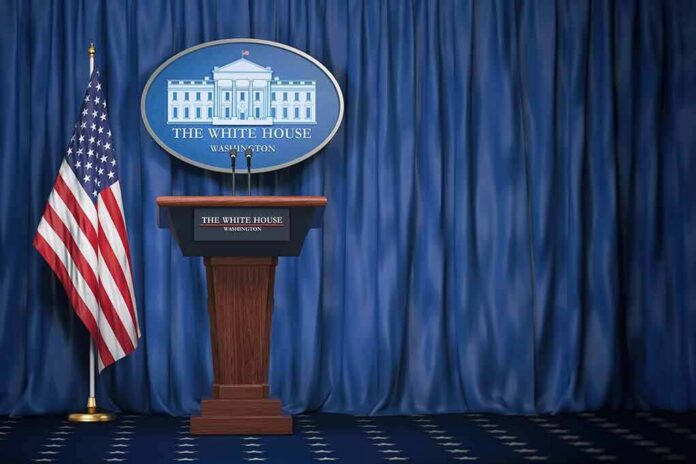
When a White House builds its own always-on broadcast, the story isn’t just about another video stream; it’s about who controls the lens on the presidency and how that power reshapes the daily flow of public information.
At a Glance
- The White House launched “Trump TV,” a 24/7 administration-run stream for speeches, announcements, and curated highlights.
- The rollout followed bans on CNN, MS NOW, and Politico from White House access and a resulting rupture in traditional TV pool coverage.
- The feed lives on the White House website and YouTube, pitched as a centralized place for “top moments” and real-time updates.
- This move escalates a long-running struggle over press access and the balance between direct-to-public messaging and independent coverage.
What Was Launched: A Continuous, Centralized Presidential Feed
The White House introduced “Trump TV,” described by the administration as a 24/7 stream that packages past presidential moments, major remarks, announcements, and ongoing updates into a single, always-available destination. The official launch page, titled “Trump TV is Here,” anchors the initiative as a standing feature, not a one-off broadcast or campaign-style livestream. The stated premise is straightforward: not every significant moment reaches conventional television; this feed ensures it can, on the administration’s terms.
Multiple outlets reported the administration’s public description of the channel: a continuously updated stream offering “top past moments” and the “latest and greatest” from the White House, positioned as a corrective to gaps in network coverage. Reporting also places the launch in the context of a simultaneous breakdown in the TV pool arrangement after the administration barred specific outlets from access and several networks curtailed or boycotted pool coverage in response.
Mechanism and Format: How “Trump TV” Works
Operationally, the channel functions as a centralized video pipe: a persistent schedule of archival highlights interleaved with live or fresh content, surfaced across the White House’s owned platforms. That structure mirrors how modern institutions—governments, corporations, sports leagues—use always-on channels to keep audiences in their ecosystem between marquee events. Here, the editorial control is explicit: the White House selects the clips, sets the sequence, and defines what counts as essential presidential content. The administration’s language—“streaming now,” “updated in real time”—signals a commitment to consistency and recency that traditional press briefings, episodic addresses, or sporadic social posts cannot match.
Placement matters. By situating the feed on both the official website and a major video platform, the White House reduces friction for casual viewers and can syndicate highlights across social channels. The upshot is reach with fewer intermediaries. For an audience accustomed to on-demand video, this format opens a simple path: go straight to the source, watch what the White House wants you to see, when it wants you to see it.
Why Now: A Direct Answer to an Access Breakdown
Context explains timing. The launch followed the administration’s ban on three outlets—CNN, MS NOW, and Politico—from the White House, a decision that catalyzed a wider rupture in the TV pool, the shared system that ensures at least one camera follows the president for all to use. Several major networks curtailed or boycotted pool coverage in solidarity, creating gaps in televised access. In practical terms, fewer independent cameras meant fewer organic cuts of presidential events airing in near-real time; an administration-controlled stream fills that void with its own footage, framing, and continuity.
There is history here. Access fights are not rare, but the sequence—exclusions, a pool breakdown, then an alternative official feed—marks an escalation. The press pool exists because the presidency is a moving, security-sensitive operation; logistics require shared coverage. When the pool frays, the White House can either accommodate independent media or stand up its own channel. This White House chose the latter, making editorial selection an executive function rather than a press function.
Precedent and Pattern: From Press Clashes to State-Controlled Framing
Presidential clashes with the press span generations; each era’s tools differ, but the structural tension is constant. The novelty is not the desire to bypass skeptical intermediaries—it is how easy it has become to do so at scale. Digital distribution collapses the barrier to entry, letting an administration mimic a cable channel without buying carriage or clearing broadcast rules. The moment a White House curates an always-on stream, the informational battleground shifts: arguments over accuracy coexist with arguments over selection and omission—what was shown, what was minimized, and what never aired at all.
Legal and institutional backdrops have evolved as well. Litigation has tested the limits of excluding outlets from access and the standards for credentialing, and professional associations have struggled to protect the integrity of pooled coverage amid executive pushback. Against that canvas, a 24/7 official feed is both an end-run around immediate friction and a structural statement: the executive will not wait for pooled cameras to return; it will publish continuously regardless.
What This Changes for Viewers, Newsrooms, and the Presidency
For viewers, the benefit is clarity of access. If you want presidential footage, you can now find it reliably, in one place, without hoping a network carries it. The downside is equally clear: you are seeing the presidency through a single editorial aperture, one that maximizes favorable context and sequence. In an era when raw video confers an aura of authenticity, curation is leverage; controlling the run-of-show can be as consequential as controlling the script.
For newsrooms, the calculus becomes tougher. Relying on White House video preserves visibility but risks normalizing a feed that sidelines independent newsgathering. Boycotting may cede audience attention to the official channel. The most durable strategy—parallel coverage with independent cameras and context—depends on restoring practical access and credible pooling. Until then, verification and counter-programming will lean more on off-site reporting, documents, and sourced accounts, while the administration’s stream competes as the default audiovisual record.
How to Watch the Signal, Not the Sizzle
The question to ask of any official stream is not just, “Is this accurate?” but, “What editorial choices made this feel inevitable?” Sequence, selection, and repetition shape perception. A day of events can be told as steady governance or perpetual victory depending on clip choice and pacing. The counterweight—independent footage, spontaneous press queries, comparative context—does not fit neatly inside a government-run channel. That is why stable pool arrangements matter; they are the plumbing behind plural viewpoints on a fast-moving presidency.
None of this renders “Trump TV” illegitimate; governments have long published transcripts, photos, and live feeds. What’s new is volume and centrality. An always-on stream invites audiences to treat curated highlights as the main event and invites newsrooms to treat official video as the path of least resistance. Understanding the mechanism is the first step toward using it without being used by it.
Trump declares war on media, launches his own version of Pravda
Trump TV debutes just hours after Trump gave CNN et. al. a tongue lashing and kicked them out of White House press corps. Is this a harbinger of future crackdowns on other First Amendment freedoms?
— LEO HOHMANN…— Steve Williams (@HISteveWilliams) September 23, 2026
What To Watch Next
Two tracks will determine how this settles. First, access: whether litigation and negotiation restore a robust pool that coexists with the official feed, or whether the executive channel effectively becomes the primary lens for televised presidential coverage. Second, audience behavior: whether viewers prefer the immediacy of a single source or continue to demand the friction and messiness of independent reporting layered on top. Either way, the architecture of presidential communication has shifted. The institution now owns a channel. The rest of the system will have to decide how to program around it.
Sources:
military.com, en.apa.az, geo.tv, thegatewaypundit.com, americanbazaaronline.com, brusselssignal.eu, tvcnews.tv, nationalheraldindia.com, cnn.com, bbc.co.uk, knightcolumbia.org
© fixthisnation.com 2026. All rights reserved.