When a rural community locks its doors in daylight, it is almost never because of rumor; it is because law enforcement has concluded a specific, active threat is moving, armed, and unpredictable.
At a Glance
- Deputies in Placer County identified 44-year-old Derek Spencer as the suspect in a manhunt centered on Iowa Hill and described him as armed and dangerous.
- Authorities said Spencer rammed a deputy’s patrol vehicle during the search and then fled into rugged terrain.
- Law enforcement reported that the suspect fired at deputies and at a helicopter, prompting a shelter-in-place advisory for residents.
- The search window stretched from late morning into the evening on a Sunday, with a defined geographic focus east of Colfax.
What Drove the Lockdown: A Specific Suspect, A Clear Threat
Placer County’s response followed a well-worn public-safety playbook: after deputies publicly named 44-year-old Derek Spencer as the individual they were seeking, they warned residents in and around the small mountain community of Iowa Hill to remain inside and lock doors while the search unfolded. The sheriff’s office told multiple outlets that Spencer was wanted for several felonies, including pointing a firearm at victims earlier the same day; that predicate matters because it explains why deputies were already canvassing the area before the incident escalated.
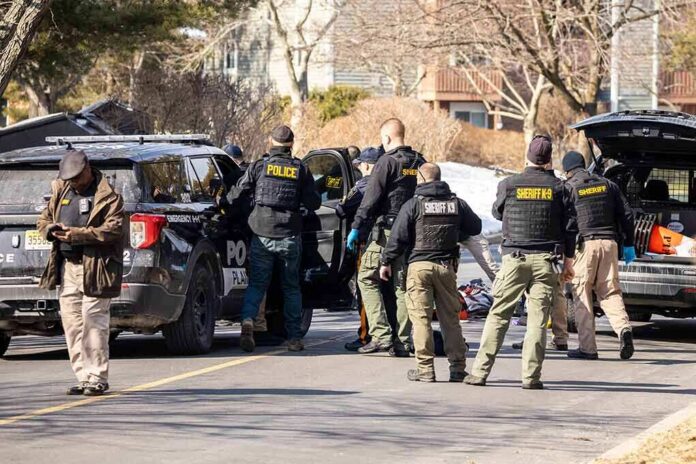
The escalation itself was unusually hazardous. According to contemporaneous reports that cite the sheriff’s office, Spencer rammed a patrol vehicle and, during the pursuit and containment effort, fired at deputies and at an overhead law-enforcement helicopter. The ramming elevated the risk at ground level; gunfire at an aircraft expands the hazard footprint dramatically, since a compromised rotorcraft can endanger anyone below. The combination—vehicular assault on an officer and rounds discharged at officers on the ground and in the air—justifies the “armed and dangerous” designation and the decision to harden the area with a shelter-in-place request.
Where and When: Rugged Country, Tight Timeline
Iowa Hill is an isolated ridge community east of Colfax, stitched together by narrow mountain roads and dense tree cover. Geography matters here: steep canyons and limited egress routes complicate perimeter control and aerial sightlines, making any footborne escape harder to track and any search grid slower to clear. Deputies encountered Spencer in the late morning, around 10:30 a.m., with advisories and active searching continuing into the afternoon and evening as units tried to pin down movement vectors in terrain that favors the person who knows the cuts and draws. Those conditions explain why the sheriff’s office pressed residents to reduce their own movements—removing unpredictable civilian traffic allows patrols and aviation assets to operate with fewer variables.
That the manhunt quickly narrowed to Iowa Hill gave residents clarity: this was not an amorphous countywide alert but a pointed response in a defined area. For households on ridge lines and in canyon bottoms, that precision underscores a basic calculus: law enforcement believed the suspect was within practical range of those homes and roadways, which is why the lock-your-doors instruction was not just boilerplate but a location-specific instruction tied to an evolving search pattern.
How These Responses Work: Tactics, Thresholds, and Communication
Incidents like this typically sequence through four steps. First, predicate offense and identification: deputies collect complaints, witness statements, or probable-cause leads that fix a name and earlier conduct—in this case, reports that Spencer had pointed a firearm at victims. Second, contact and escalation: the suspect is located or sighted; the encounter deteriorates through flight or violence—here, the reported ramming of a patrol vehicle and gunfire at officers. Third, containment: perimeters, checkpoints on choke points, and air support, which increase situational awareness and pressure. Fourth, public protection: advisories to shelter in place and avoid the search zone, allowing deputies to move faster and with fewer safety conflicts.
Agencies issue those directives early and often in manhunts because the most dangerous period is the first few hours after escalation. The objective is to convert a dynamic, moving threat into a bounded, predictable problem—ideally one that ends with a safe surrender. That is why language such as “armed and dangerous” is not rhetorical flourish; it is a risk classification that shapes everything from how many units respond to whether a helicopter remains on station for extended overwatch.
The Evidence Backbone: What Was Reported, And Why It Convinces
In the first reporting wave, several established outlets independently cited statements from the Placer County Sheriff’s Office on the same core facts: Spencer’s identification and wanted status, the ramming of a patrol vehicle, and gunfire at deputies and a helicopter, along with the Iowa Hill shelter-in-place advisory. Convergence across CBS Sacramento, KCRA, the Sacramento Bee, and others on those specifics matters; it reduces the chance of transmission error and indicates a coherent brief from the agency leading the response.
Timelines and geography also aligned: an initial deputy encounter late in the morning, a continuing search into the afternoon and evening, and a defined search box east of Colfax. Those shared anchors—who, what, where, when—are the spine of any credible incident narrative and, here, they were consistent across outlets. Given the stakes for resident behavior, agencies are generally conservative in issuing lock-ins; the fact of the advisory itself is a consequential data point that corroborates the seriousness of what deputies said they faced on the ground.
🚨 BREAKING: Small California town of Iowa Hill on lockdown after gunman rams and fires on deputies before fleeing into the woods.
Placer County Sheriff's deputies searching for 44-year-old Derek Spencer, considered armed and dangerous.
NO SUSPECT IN CUSTODY. MANHUNT ONGOING.… pic.twitter.com/xEvjx4lqO3
— EzeNews (@EzeBets) September 21, 2026
What It Means for Residents: Practical Safety in a High-Threat Window
For people living in ridge communities like Iowa Hill, the guidance during an active search is straightforward: stay inside, lock entry points, do not approach or engage unknown individuals, and minimize outbound calls that are not emergencies so dispatch can keep the radio and phone lines clear for the operation. In terrain that funnels movement along a few roads and trails, an open garage or an unlocked truck can become an opportunistic shelter or vehicle for a fleeing suspect; deputies’ advice is calibrated to remove those options quickly.
How We Got Here: A Pattern Seen Elsewhere
While the particulars in Placer County are local, the response pattern is broadly familiar. In manhunts that law enforcement classifies as “high threat, low visibility,” agencies tighten perimeters, deploy aviation, and ask civilians to shelter while they compress the suspect’s maneuver space. The point is to create a kind of temporary sterile field—reduce the number of moving parts so trained units can work the problem methodically without bystander risk. That method has been studied and debated since major manhunts earlier in the century, but its core logic endures in mountainous rural terrain because the environment already limits line of sight and communication.
Sources:
nypost.com, fox40.com, placer.ca.gov
© fixthisnation.com 2026. All rights reserved.