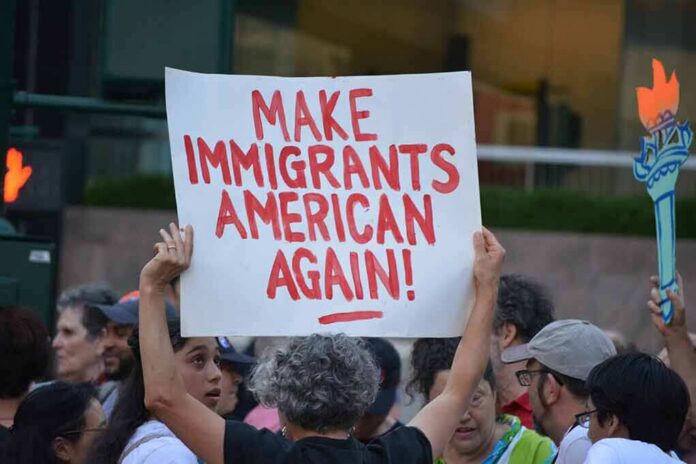
The fault line in today’s immigration protest battles is not whether dissent is protected, but where expressive conduct ends and unlawful interference with federal operations begins; in Minnesota, federal prosecutors have drawn that line around coordinated blockades and physical obstruction, and they have put it in indictments rather than op-eds.
At a Glance
- Federal prosecutors unsealed conspiracy charges against 15 defendants tied to anti-ICE actions around Minneapolis–St. Paul, alleging coordinated blockades and interference with agents during Operation Metro Surge.
- Affidavits and local reporting describe tactics beyond speech—blocking vehicles, shoving agents, and obstructing access roads—moving the dispute from First Amendment ground into Section 111 territory.
- Defense voices frame the actions as lawful dissent and community protection; the counter-case is largely rhetorical so far, not documentary.
- The legal hinge is precise: observation and protest are protected, but physical obstruction and conspiracies to impede officers are chargeable felonies; outcomes will clarify that boundary for future protest movements.
What prosecutors say happened, and why it matters
In mid-2026, the U.S. Attorney’s Office charged 15 individuals with conspiring to impede or injure federal officers during and after an immigration enforcement surge around Minneapolis–St. Paul. According to a 94-page indictment described in court coverage, the government’s theory is not about signs, chants, or filming; it is about an organized plan to disrupt Immigration and Customs Enforcement operations at the Bishop Henry Whipple Federal Building through coordinated “blockades” and related confrontations arranged via messaging apps. The charging documents are explicit: this was not simply expressive association, prosecutors say, but a concerted effort to obstruct.
Affidavits reported by the Star Tribune allege interference that—if proved—squarely implicates 18 U.S.C. § 111’s prohibition on “forcibly assaulting, resisting, opposing, impeding, intimidating, or interfering” with federal officers: blocking or bumping agents’ vehicles, shoving officers, and resisting arrest during operational movements. Local outlets documented access-road blockages and arrests when demonstrations exceeded permitted terms outside the Whipple building and at Minneapolis–Saint Paul International Airport. The through-line is straightforward: speech crossed into action that impeded officers executing their duties; that is the fulcrum of the federal case.
The legal mechanism: when protest becomes a felony case
Federal prosecutors rely on a familiar toolkit for protest-adjacent charges. Section 111 is the workhorse; it criminalizes the full spectrum from assault to obstruction against federal officers. Conspiracy theories of liability then allow the government to aggregate discrete acts—blocking a driveway here, shoving during an arrest there—into a single coordinated enterprise. As a matter of doctrine, expressive conduct retains First Amendment protection unless it is directed to, and likely to produce, imminent lawless action; physical interference and force fall outside that shield. That is why the communications record matters so much in these cases: if chats show planning aimed at disruption rather than expression, prosecutors’ narrative strengthens.
This is not unique to Minnesota. Across jurisdictions, the government has increasingly recast immigration protest friction as obstruction cases, invoking Section 111 or administrative obstruction analogues when conduct impedes officer movement, vehicle egress, or facility access. The practical consequence is to turn tactical choices that feel like civil disobedience to activists—such as linked-arm blockades at gates—into felony exposure when federal agents are on the other side of the barrier.
The record on coordination and conduct
On the evidentiary spine, the public record contains more than rhetoric about dissent. Court reporting from CBS Minnesota and Minnesota Lawyer describes the unsealed indictment’s focus on messaging-app coordination of blockades at the Whipple Federal Building, framed as disruption of ICE operations rather than symbolic protest. The Center Square’s summary likewise highlights alleged surveillance of agents and confrontations designed to impede enforcement; while secondary in tone, its claims track with the charging language as reported across outlets.
On-the-ground episodes described by FOX 9 and the Star Tribune add the operational texture that courts look for: access roads physically blocked, vehicles impeded, orders to disperse ignored, arrests following escalations past the scope of permits, and officer contact during attempts to move vehicles or effect arrests. These are precisely the fact patterns that, if credited by a jury, have historically supported Section 111 charges. None of that is a verdict; indictments and affidavits are allegations. But as a map of what the government thinks it can prove, they are specific and consistent across sources.
The counter-argument: protected dissent, not obstruction
Defense-facing narratives are equally clear in their values, if not yet in documentary rebuttal. Nekima Levy Armstrong, a prominent Minneapolis figure arrested after a protest at a St. Paul church where organizers targeted a pastor they identified as an ICE field office director, has argued that authorities “altered the facts” to criminalize nonviolent dissent and that worship continued despite the demonstration. In later commentary, she and allies characterized the arrests as political retaliation for challenging federal brutality. Profiles sympathetic to activists describe a posture of “protection” rather than obstruction—patrolling neighborhoods, documenting agent activity, and ferrying families to safety.
These claims speak to motive and constitutional frame—why demonstrators acted and how they see themselves—but they do not, standing alone, negate the specific conduct alleged in the federal cases. The most effective defense in this posture typically does one of two things: it either undercuts the factual record of physical interference (no blockades, no shoves, no vehicle impediments), or it undermines the government’s proof of agreement and intent (chat logs and timelines show expressive coordination, not an unlawful plan). To date in the public file, the counter-case is more rhetorical than evidentiary.
Where the line is likely to be drawn
For readers sorting principle from charge sheets, the doctrine draws a line that is both clear in theory and messy in practice. Observation of officers, recording from a reasonable distance, chanting, and even aggressive criticism are protected. So are many forms of planned demonstration, including permitted marches and rallies adjacent to federal facilities. Conduct that crosses into physically barring ingress or egress, surrounding moving vehicles, or using force or threats to impede officers is not protected; when done in concert pursuant to an agreement, it is chargeable as a conspiracy. Courts care about proximity, persistence after lawful orders, and whether officers could reasonably complete their duties absent the protest tactics.
The Minneapolis indictments, if litigated to verdicts, will clarify that boundary in a contemporary setting marked by ubiquitous cameras and encrypted chat. They will also test the government’s ability to authenticate digital coordination records and to tie named defendants to specific obstructive acts rather than to a milieu of generalized protest. For movements nationwide, the signal is already clear: tactics designed to obstruct officer movement carry felony risk under Section 111, regardless of the protest’s moral claim.
Secret ICE Agent Tried to “Entice” Minneapolis Activists Into Confrontational Tactics
Documents from ICE’s investigation into the Sunrise Movement show an agent volunteered to build tools for “direct-action” protests.https://t.co/q1ftwaHnsR
— ˶˃ News Reader Cat 📰🗞️NO DMs˂˶ (@typocatCAv2) August 18, 2026
Consequences and durable lessons for movements and agencies
Two lessons endure beyond any single case. First, for activists: strategy and training must separate expressive visibility from operational interference. The same human chain that looks powerful on social media can supply the actus reus of a felony if it blocks an agent’s car. If your theory of change includes civil disobedience, understand the sentencing exposure and conspiracy doctrine that accompany it. Second, for agencies: legitimacy rests not only on successful prosecutions but on restraint—overreach that charges observers or noise-makers without evidence of interference tends to collapse in court and can poison jury pools for stronger cases.
Finally, for the public trying to make sense of polarized coverage, focus on the particulars that matter in law: Did the conduct impede officers? Was there force or threat? Was there an agreement to do so? And can the government prove each element with authenticated records and credible testimony? Those answers—not labels like “leftist” or “protector”—will decide these cases, and they are the answers that set the rules of engagement the next time protest meets federal power.
Sources:
youtube.com, thecentersquare.com, minnlawyer.com, motherjones.com, npr.org, democracynow.org, fox9.com, nypost.com, bbc.com, edition.cnn.com, nytimes.com, tandfonline.com
© fixthisnation.com 2026. All rights reserved.