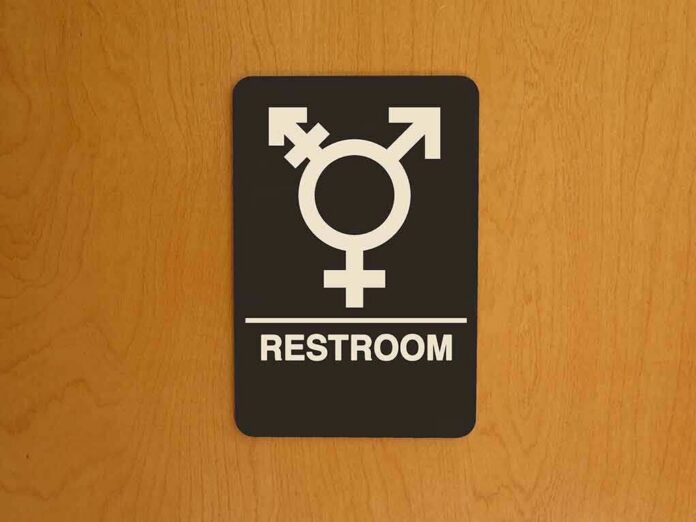
Campaigns don’t just fight over policy; they fight over definitions. The Iowa dispute over “men in women’s locker rooms” is not about whether a vote happened — it did — but about what, precisely, that slogan means and how a single school-policy bill became ammunition for mutually exclusive claims of principle and hypocrisy.
At a Glance
- The candidate’s ad said she opposes letting “men in women’s locker rooms,” while critics point to a 2023 vote against an Iowa bill tying school restroom and locker-room access to biological sex.
- The record, as reported by multiple outlets and the opposing campaign, links her “no” vote to Senate File 482, a measure restricting school facilities by sex assigned at birth.
- Supporters frame her stance as parental choice and context, while adversaries compress the vote into a categorical position on locker rooms.
- This fight illustrates how culture-war messaging turns complex, school-level policy into a potent, simplified line that travels well in ads but poorly reflects legislative nuance.
What the evidence establishes — and what it doesn’t
The concrete pieces are straightforward. In a recent ad, the Iowa candidate says she opposes “letting men in women’s locker rooms” and pairs that line with a parental-choice message. Multiple reports and the opposing campaign tie her 2023 Iowa Senate vote to Senate File 482, a bill that limited student access to school restrooms and changing areas based on biological sex; they cite journal roll-call pages and describe her vote as “no.” The critic whose post helped nationalize the flap repeats that linkage: the ad’s claim versus the 2023 vote against the sex-based facilities bill. These are specific, attributable assertions; none have been rebutted with a conflicting roll call or a different bill history. On the available record, the vote-and-ad tension is real as a matter of public positioning, though the sources in circulation remain largely partisan and secondhand regarding the precise journal text and the full ad script.
What the material does not supply is the verbatim Senate Journal pages or the complete ad transcript. That gap does not erase the underlying vote or the ad line, but it limits how finely we can parse the candidate’s intent — whether she meant a categorical opposition across contexts or a narrower claim anchored in parental discretion and local control. In campaign rhetoric, that distinction matters; in lawmaking, it is everything.
How “men in women’s locker rooms” became the proxy
The phrase is rhetorically forceful because it collapses a set of contested policy questions into a vivid image: who may enter which intimate space. School districts, statehouses, and federal agencies have spent the last decade working through the mechanics — privacy accommodations, Title IX interpretations, equal access, and enforcement — that sit beneath that shorthand. Model district policies often pair sex-segregated facilities with gender-identity access, privacy options, and supervision rules; they try to reconcile student safety, dignity, and administrative feasibility within local constraints. Legislatures, by contrast, tend to draw bright statutory lines keyed to biological sex or, alternatively, to gender identity, because statutes must be administrable and judicially reviewable at scale.
When a legislature enacts a biological-sex rule for school restrooms and locker rooms, supporters describe it as restoring clarity and protecting privacy; opponents describe it as excluding transgender students from facilities aligned with their identity and increasing harm. Researchers have flagged elevated risks — including violence and harassment — associated with denying students access to identity-congruent facilities, which is why many districts and advocacy groups argue for inclusive policies with privacy accommodations. Neither side is operating in a vacuum; they prioritize different risks and different conceptions of fairness.
What SF 482-style votes actually decide
Votes like the one at issue are not symbolic. By setting access on biological sex across restrooms and changing areas, they preempt local discretion and foreclose gender-identity access except via designated alternatives. That legal posture simplifies enforcement for schools but can conflict with district-level inclusion policies and federal civil rights interpretations in flux. A “no” vote on such a bill is typically cast as support for local control, accommodation, or civil-rights compliance; a “yes” vote is framed as privacy protection and statewide consistency. The messaging shortcut — “for” or “against men in women’s locker rooms” — maps these deeper trade-offs onto a binary that voters can process in eight words, even if it obscures the details that make implementation succeed or fail.
In that light, the present controversy is less a mystery than a case study in selective compression. The ad’s declarative line reads as categorical. The voting record, as summarized by adversarial and mainstream-leaning coverage, indicates opposition to a statute that would have barred gender-identity access in school facilities by default. Both statements can be true, yet sit uncomfortably together: the first signals a general value claim; the second marks a specific, contrary legal choice about how schools must operate.
Why campaigns choose this frame
Attack ad architecture rewards precision about an opponent’s pain point and maximal simplicity in the charge. The most effective messages are “truthy” — anchored in a real vote or quote, stripped of surrounding context — because they resist easy debunking while shaping perceptions. Analysts of political advertising stress that ads aim to persuade, not to inform; context is a casualty of brevity, not merely of bad faith. The incentive on the defending side is symmetrical: reclaim the value frame that polls well (parental choice, safety, common sense) and argue that the record has been cherry-picked or wrenched from the setting in which the vote made sense.
For voters, this means the burden of interpretation shifts back to the source materials. If you care about the policy outcome more than the slogan, the operative question is not whether a candidate “opposes letting men in women’s locker rooms” in the abstract; it is whether she supports or opposes statewide biological-sex rules for school restrooms and changing facilities, and under what conditions she would accept exceptions or alternatives.
Yep, Sarah voted against restricting transgender kids from using the restroom of their choice at school.
She's not a bigot like Riley Gaines or @ZachNunn. She believes in supporting ALL kids and she has my vote.
— Raymond Baker (@RayBake) August 22, 2026
How to read claims like these with discipline
Start with the legal mechanism: Was the vote for a statewide mandate or for leaving decisions to local boards and principals? Identify the operative section — restrooms only, or changing areas and overnight accommodations too — and the enforcement pathway. Then map the message back to that mechanism. If an ad stakes out a general opposition to “men in women’s locker rooms” while the record shows a vote against a biological-sex mandate, you are seeing a value claim colliding with a policy instrument. Neither side’s shorthand resolves the collision; only the bill text and the implementation standards do.
Sources:
townhall.com, x.com, foxnews.com, zachnunn.com, nrcc.org, desmoinesregister.com, sarahforiowa.com
© fixthisnation.com 2026. All rights reserved.