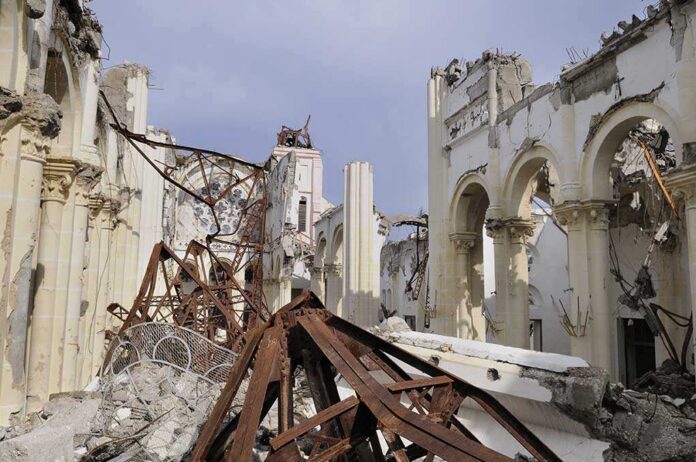
fixthisnation.com — Across Ukraine’s war-scarred landscape, the most revealing front line may not be trenches or tank traps, but the shattered roofs of churches, mosques, synagogues, and cemeteries.
Story Snapshot
- Hundreds of Ukrainian religious sites across all major faiths have been damaged, destroyed, or desecrated since Russia’s full-scale invasion.
- Documented patterns in occupied territories point beyond random “collateral damage” toward a campaign against Ukrainian religious identity.
- Moscow’s record of repression in Crimea and Donbas set the template for today’s broader religious freedom violations in Ukraine.
- The fight over churches and sacred places is really a fight over who Ukrainians are allowed to be as a people.
The scale of destruction points to something more than battlefield chaos
Ukrainian authorities and independent monitors now document a level of damage to religious property that no honest observer can wave away as a handful of unlucky hits. The State Service of Ukraine for Ethnic Policy and Freedom of Conscience reported that in just the first seven months of the full-scale invasion, at least 270 churches, mosques, synagogues, and other religious facilities were fully or partly ruined in at least 14 regions.[2] Later tallies rise far higher: one monitoring effort counts at least 737 affected religious sites, with the true number likely larger due to limited access to occupied areas.[3][5]
Those numbers are not confined to one denomination or one hotly contested city. Data released through the Religion on Fire project show damage to Orthodox, Greek Catholic, Roman Catholic, Protestant, Jewish, and Muslim sites across frontline and occupied regions.[3] Evangelical Protestant communities, a small share of Ukraine’s population, appear to have suffered disproportionately heavy losses.[3] When a campaign leaves virtually every major faith community scarred, the story stops being about chance and starts looking like a systematic wrecking ball hitting the country’s religious life.
Occupied territories reveal the clearest intent against religious freedom
Damage from artillery or drones can always be spun as accidental, but what happens after Russian forces move in strips away much of that ambiguity. The United States Commission on International Religious Freedom (USCIRF) reports that in areas under Russian control, de facto authorities have abducted and tortured religious leaders, imposed restrictive Russian laws, and sharply curtailed religious freedom.[4] These practices follow the same repressive pattern Russia established after its 2014 seizure of Crimea and parts of Donbas, where alternative or non-state-aligned religious voices were squeezed, harassed, or driven underground.[4]
Human rights researchers tracking occupied areas describe a broader effort to dismantle Ukrainian religious identity itself. Willy Fautré of Human Rights Without Frontiers, drawing on detailed field documentation, concludes that the destruction of religious institutions forms part of a wider attempt to erase Ukrainian national, cultural, linguistic, and spiritual identity.[3] According to this research, the policy is not only about shells landing on church domes; it is also about seizures, forced registrations, intimidation, and the replacement of independent communities with structures loyal to Moscow.[3]
Collateral damage, deliberate targeting, and how to tell the difference
Russian officials routinely claim that strikes which hit churches or monasteries are accidents or collateral damage. Some incidents do fit that description on their face. Reports describing Russian missile or drone strikes that hit historic churches during broader attacks on cities leave open the possibility that the religious site was not the primary aim of the mission. Yet the Ukrainian government notes that by the end of 2025, 704 religious buildings had been destroyed or damaged, and that “some of them” were deliberately targeted, with numerous cases of desecration documented during short-lived occupations in the Kyiv and Chernihiv regions.[1]
From a common-sense conservative perspective, patterns matter more than propaganda. When hundreds of religious sites across regions are damaged, when some are clearly desecrated, when clergy are abducted and tortured, and when the same repressive legal model is rolled out again and again, the probability that this is all random battlefield misfortune drops to near zero.[1][3][4] The more consistent explanation is that Russian forces tolerate, and in some cases encourage, attacks and pressure that weaken Ukraine’s religious backbone and civil society.
Why religious sites matter in a war for national identity
Religious buildings in Ukraine are not merely places of worship; they are anchors of cultural memory and community resilience. The Religion on Fire data set illustrates that the greatest devastation falls on regions like Donetsk, Kyiv, Kharkiv, Kherson, and Luhansk—exactly where Russia has tried hardest to uproot Ukrainian identity.[3] Russia’s long-running legal assault on religious minorities in Crimea and Donbas, combined with today’s mass damage to sacred sites, lines up with a strategy that treats independent religious life as a threat to imperial control.[3][4][5] In that light, every shattered steeple and gutted sanctuary is more than a tragic side effect; it is a warning about what kind of “order” Moscow seeks to impose on conquered territory.
Sources:
[1] YouTube – REPORT: Religious sites targeted by Russian aggression against Ukraine …
[2] Web – Russia is Destroying Churches, Monasteries, and Non-Christian …
[3] Web – 7 months of Russia’s full-scale attack: 270 religious sites ruined in …
[4] Web – Hundreds of Churches Destroyed by Russian Forces in Ukraine
[5] Web – Russia continues to torture priests and destroy Ukrainian churches
© fixthisnation.com 2026. All rights reserved.