A five-foot-tall humanoid robot just helped remove a living pig’s gallbladder, and that quiet moment in a UC San Diego operating room may say more about the future of American health care than any campaign speech or tech hype video you will see this year.
Story Snapshot
- Teleoperated humanoid robots completed two live minimally invasive gallbladder surgeries in pigs during a preclinical trial.
- One operation paired a human surgeon with a humanoid robot; the other used two humanoid robots side by side.
- The system fits inside a standard operating room, aiming one day at remote and small-town hospitals with limited staff.
- The tech is real and peer-reviewed, but still far from approved surgery on human patients.
Humanoid robots step into a real operating room
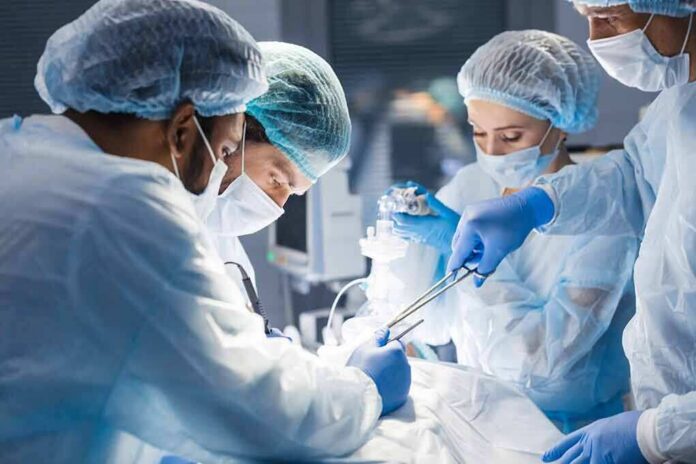
Surgeons at the University of California San Diego ran a world-first preclinical trial: two teleoperated humanoid robots completed minimally invasive gallbladder removals in live pigs. These were not show robots doing backflips for clicks. They stood in a regular operating room, with cameras, screens, and a human surgeon at a control console guiding every move. The robots held the instruments inside the pig’s abdomen and followed the surgeon’s hand motions to peel the gallbladder away and cauterize tissue.
The research team used a general-purpose humanoid body, similar to the Unitree G1 platform, as the base and turned it into a surgical assistant. The robot, nicknamed Surge or Sergei in reports, is about five feet tall with human-like arms sized to slip into standard laparoscopic setups, not giant custom robot bays. That detail matters. Big hospital systems can afford room-sized machines. Small community hospitals and rural clinics often cannot. A robot that works in their existing space is a very different proposition.
Two surgeries, two different teams
The trial ran two live porcine laparoscopic cholecystectomies, the technical term for minimally invasive gallbladder removal in pigs. In the first surgery, a human surgeon operated the humanoid robot while another human surgeon stood at the bedside to adjust the robot’s arms when needed. This human-robot team configuration kept a person close to the patient, just in case. In the second surgery, two humanoid robots worked side by side, with no human physically touching the instruments. The surgeon still teleoperated from a console, but the “hands” on the patient were entirely robotic.
Both procedures were completed successfully. The peer-reviewed Nature paper and the preprint describe them as the first in vivo use of a humanoid robotic surgical system for standard laparoscopic cholecystectomy in an animal model. A surgeon involved said about the system, “As a proof of concept, it absolutely worked,” stressing that the robot handled the tight space of a normal operating room. That is more than a publicity line; surgeons live and die by whether a tool actually fits into their workflow.
What problem are these robots really trying to solve?
This project is not mainly about replacing surgeons. It is about getting expert-level surgery into places and times where a human specialist is not available. Researchers explicitly talk about remote operation, where a skilled surgeon in a city could teleoperate a humanoid robot miles away in a rural clinic or on a military base. The robot’s human-like form factor is not a gimmick. It lets the system stand where a human would stand and use instruments and layouts that small hospitals already own. That design points to a clear goal: extend care, not just impress investors.
From a conservative, common-sense view, that matters. America has counties with no full-time surgeon. Families drive hours for routine operations. If a teleoperated humanoid in a local hospital could safely handle a standard procedure under a remote surgeon’s guidance, that is access and self-reliance, not centralization. The question is not whether robots should exist, but whether they can meet strict safety, cost, and reliability tests before they touch human patients.
Hype, hard limits, and the road to human trials
Media headlines push “historic,” “world first,” and “future of surgery,” and the social feeds echo those lines. The facts underneath are more sober. This was a preclinical study on two pigs. The sample size is tiny, useful for feasibility but useless for statistics on rare complications or long-term outcomes. Regulators like the Food and Drug Administration will demand many more cases, detailed failure analysis, and proof that the robot does not introduce new risks before approving a human trial.
The world’s first humanoid surgical robot can now be used in operating rooms, guided by surgeons during real procedures. Surgeons at UC San Diego have used humanoid robots to remove gallbladders and perform two additional procedures on pigs, marking a key step toward future human… pic.twitter.com/uMAWzGg4ec
— ABC News (@ABC) July 11, 2026
There are other robotic systems in the race too. A learning-based program called Surgical Robot Transformer-Hierarchy has already driven a da Vinci surgical robot to autonomously remove gallbladders from pig cadavers, with no human hand on the controls during key phases. That work, also peer-reviewed, shows how far artificial intelligence can go on its own. The UC San Diego humanoid study instead focuses on teleoperation and human control with a different physical form factor. Both paths will face the same reality: most new robot platforms never make it from animal trials to routine human use.
Where this leaves patients and doctors today
Right now, no one can walk into an American hospital and sign up for a humanoid-robot gallbladder removal. The UC San Diego team is clear that the technology is not ready for human clinical use. The robot still needed human bedside help in one configuration, and the study does not claim superior performance to existing systems, only intermediate performance. That is fine; honest limitations are exactly what you expect from serious science, not science fiction.
The deeper story is that surgery is slowly shifting from hand skills alone to a mix of human judgment, robotic precision, and artificial intelligence. The da Vinci system moved surgeons off the table to a console. New learning robots can watch thousands of hours of video and practice on cadavers until they match human-level accuracy. Humanoid teleoperated robots add another layer: they promise to carry that precision into places that never had top-tier surgeons in the first place. Whether that future feels like hope or threat depends on your trust in the people who set the standards.
Sources:
nypost.com, abcnews.com, instagram.com, facebook.com, reddit.com, kvue.com, ca.finance.yahoo.com
© fixthisnation.com 2026. All rights reserved.